
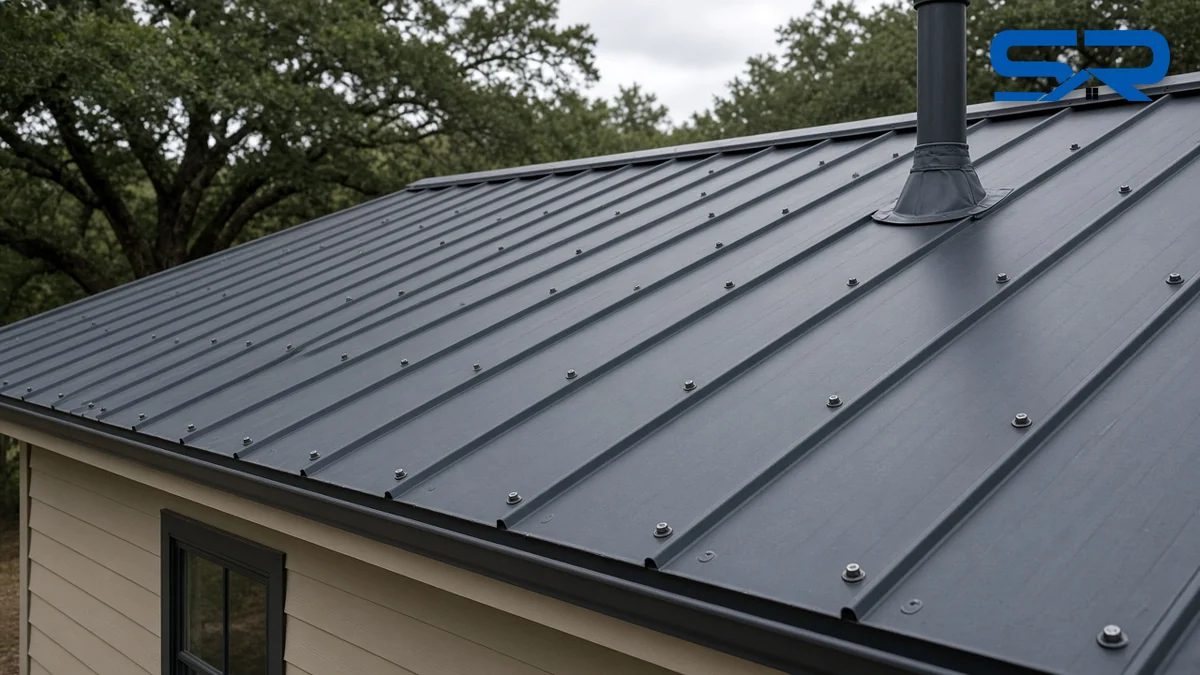
If you have a metal roof on a house, barn or shop around Azle and it’s dripping after a storm, the leak is almost never “the whole roof.” It’s usually a screw, a seam or a piece of flashing. Finding that spot and fixing it the right way is metal roof repair, and it’s the kind of work we do every week.
I’m Blake Snow. I’ve been roofing for 30 years, I’m the third generation in a family roofing business that goes back 75 years, and our crews have completed over $80 million in roofing projects. Here’s how I walk Azle and Eagle Mountain Lake homeowners through a metal leak.
Start with the fasteners on exposed-fastener roofs
A lot of older metal roofs around Azle, Springtown and the county roads west of Fort Worth are R-panel or PBR. Those panels are screwed through the face with sealing washers. The washers do the sealing. Over years of sun, heat and hail, the rubber or neoprene can crack, flatten or pull away from the screw head. Once that happens, every rain finds a path around the shank and into the building.
What I look for on a re-screw inspection:
- Cracked or missing washers. You can often see daylight around the screw head, or a dark ring where water has been sitting.
- Backed-out screws. Vibration and thermal movement can work a screw loose so it no longer compresses the washer.
- Wrong fasteners. Screws that were too short, too long, or driven at an angle never sealed right in the first place.
- Overdriven heads. If the washer is mashed flat or cut by the screw head, it won’t spring back and seal.
A proper re-screw replaces the bad fasteners with the right length and washer for that panel, driven to the right depth. We don’t just smear caulk on top of failed washers and call it done. Caulk over a bad screw is a short-term patch; a new fastener is the repair.
Seams, ridges and eaves
Even on a sound panel field, water can get in where panels meet or stop.
Side laps. On exposed-fastener roofs, panels lap over each other. If the lap was short, or fasteners skipped the lap, wind-driven rain can push under. On standing seam, the seams are raised and usually locked or snapped. A seam that wasn’t closed fully, or that got bent in a storm, can open a path.
Ridge and hip caps. The ridge takes the brunt of weather. Closures under the cap keep wind-blown rain, wasps and birds out. When those closures shrink, shift or get left out, water shows up at the peak of the attic or along the top of a shop bay.
Eave and rake trim. Eave trim kicks water into the gutter. Rake trim locks the gable edge. If either piece was cut short, fastened wrong or left with gaps, rain rides the underside of the panel and shows up at the wall or ceiling line.
Wall flashing, valleys and penetrations
In my experience, most leaks that aren’t at a screw start at a detail:
- Sidewalls and headwalls. Where a roof runs into brick, siding or a taller wall, you need flashing that turns up the wall and counter-flashing that laps over it. Sealant alone along the top of a wall flashing fails. North Texas heat cooks it and the next storm finds the gap.
- Valleys. A valley carries water from two slopes. The pan has to be wide enough, and the panels cut and turned so water can’t run back under them.
- Pipe boots and vents. Plumbing vents, flues and exhaust pipes need boots made for metal roofing, set flat on the panel and clear of a seam. UV and heat crack older boots. A cracked boot is one of the most common “mystery leaks” I find on otherwise solid metal roofs.
- Chimneys and skylights. Same idea as walls: step or curb flashing with counter-flashing, and a cricket or diverter on the uphill side of a chimney so water and leaves don’t pile up against it.
Our metal roofing page covers the systems we install new. On a repair call, the job is to match the fix to whatever system is already up there.
Repair vs. replace: how I decide
Not every leak needs a new roof. Here’s the line I draw:
Repair first when:
- Panels are still solid (no rust-through, no soft spots underfoot)
- Leaks cluster at screws, one boot, one wall or a short ridge run
- The deck and underlayment look dry once we open the detail
- You mainly need the building dry again without a full tear-off
Talk about replacement when:
- Panels are rusted through or corrugated badly from repeated hail
- Soft deck or soaked underlayment shows up in more than a few spots
- The roof was a thin gauge to begin with and is at the end of its life
- You’re already planning to change color, panel type or add insulation
I’ll tell you straight which side you’re on. Large ranch homes, shops and commercial buildings are where our crews and roll formers pay off most on a new roof, but we still welcome small repair jobs. No job is too small. One leaking boot or a short re-screw run is still a call we’ll take.
What a free digital photo inspection looks like
When you call about a leak in Azle, we come out, get on the roof and send you a free digital photo report. You’ll see the failed washers, the cracked boot, the open ridge closure or the wall flashing gap for yourself. That report is also useful if you’re talking with your insurance after a storm. See our storm damage page for how we document hail and wind. We don’t invent damage, and we don’t push a replacement when a repair will do.
Our standard on new standing seam is 26-gauge steel, formed on our own roll formers with our own crew. On repairs we work with what’s there: R-panel, PBR, standing seam or older corrugated. If a section needs new panels, we can form and match as close as the existing profile allows.
Azle, Eagle Mountain Lake and nearby towns
Azle sits on Highway 199 as the gateway to Eagle Mountain Lake, with homes and barns that take more wind and weather than a house tucked into a subdivision. Older metal barns and shops on the acreage around town are exactly where screw washers and pipe boots show their age. We serve Azle from our Rhome office (about 27 road miles) and also cover Springtown, Weatherford and Rhome. We work across the DFW Metroplex and towns within about 65 miles of Bridgeport.
Let’s get your metal roof dry
Whether you need a full re-screw on an R-panel barn, a pipe boot replaced on a lake house, or standing seam flashing fixed at a wall, we’re glad to help. Our residential workmanship warranty runs from 10 years up to lifetime, depending on the job. We’re A+ rated on the BBB, and our Google ratings are 5.0 at all three offices: 86 reviews in Bridgeport, 13 in Decatur and 3 in Rhome. Every inspection comes with a free digital photo report.
Call (817) 733-9228 or request an estimate, and we’ll set a time to walk the roof and show you what’s leaking.