
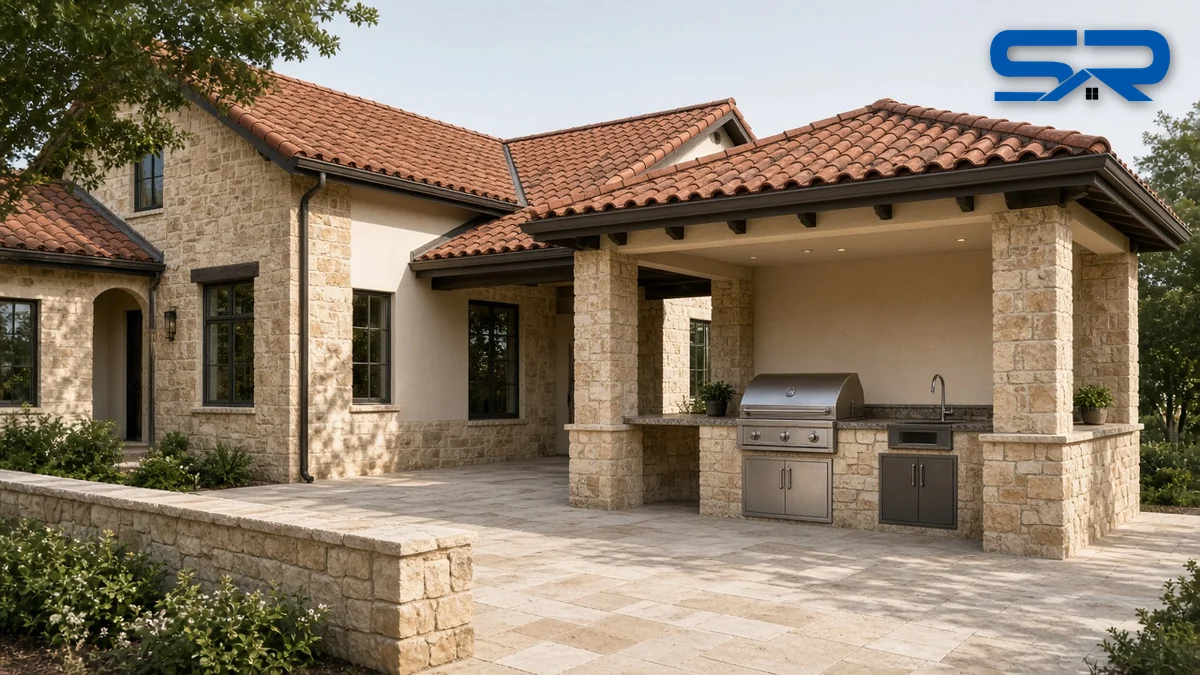
A covered outdoor kitchen is one of the most-used rooms on a Westlake estate. It is also one of the easiest places to put a leak into a beautiful roof. When the main house wears clay tile, concrete tile or natural slate, the new cover has to match that roof, carry its weight, and tie into it without breaking the way water already moves down the slope.
I’m Blake Snow. I’ve been roofing for 30 years, and I’m the third generation of a family roofing business that goes back 75 years. Here is how I think through an outdoor kitchen roof on a tile or slate home before anyone sets a post.
Start with the slope, not the stone
The first question is not which tile. It is how much pitch the cover can have.
Tile and slate are water-shedding roofs. They rely on overlap and gravity, so they need slope. Under the residential building code most Texas cities adopt, clay and concrete tile need at least 2½ in 12, with extra underlayment below 4 in 12. Natural slate generally needs at least 4 in 12. Many outdoor kitchen covers are drawn flatter than that so they slide under a second-story window or an existing eave.
If the cover can be pitched to match the house, tile or slate on the cover usually reads best from the yard. If it can’t, don’t force it. A low-slope cover in standing seam in a color pulled from the tile or slate often looks intentional, and our 26-gauge panels (24-gauge available) are formed on our own roll formers to the length of the run.
Framing has to be designed for the weight
Tile and slate are much heavier than shingles or metal. A cover framed for a light roof can sag, crack tile at the ridge, or pull at the ledger where it meets the house.
Before I recommend tile or slate on a cover, I want to know:
- What the posts, beams and rafters are sized for, and who designed them.
- How the cover attaches to the house. On a tile roof the ledger or brackets have to reach the wall framing or rafters, never just the tile or the decking.
- Whether a stone column or fireplace on the cover adds weight of its own.
If the framing isn’t built for the roof you want, it’s better to know that on paper than after the first spring storm.
The tie-in is where covers leak
Almost every outdoor kitchen leak I’m called to is at the joint between the new roof and the old one.
On tile and slate, the main-roof courses above the tie-in have to be lifted, the flashing slipped under them, and the courses reset so water runs over the metal and onto the cover. Flashing laid on top of tile becomes a dam. Sealant has a place, but it isn’t what keeps the water out. On a slate roof the replaced slates go back with hooks or copper bibs, not face nails and caulk.
Where the cover meets a wall, I want flashing turned up the wall and counterflashed. Where it lands near a valley, the valley metal has to keep its full width and splash rib. And on long-life tile or slate, I like the flashing metal to last as long as the roof. That is often copper, which we covered in our copper flashing and valleys guide.
Matching tile or slate that’s 15 or 25 years old
Matching is the part owners worry about most, and with good reason. Tile profiles and colors get discontinued, and natural slate from one quarry can weather differently from slate cut decades later.
The usual options are:
- Same product from the original maker, if it’s still made.
- Salvage tile or slate in the same profile and color.
- Borrow from a hidden slope. Pull originals from a back slope for the visible cover, and put new material where no one looks.
- A deliberate contrast. A standing seam or copper cover can look better than tile that is close but not quite right.
For more on sourcing matching tile, see tile repair and reset. For slate, see slate roof repair.
Plan the hood before you plan the roof
Smoke and heat under a solid roof collect on the ceiling. Many grill makers call for an outdoor-rated hood or set clearances under certain covers. That means the grill and hood should be chosen first, and the roof framed and flashed around the duct.
A duct through a tile roof needs a deck-level flashing plus a malleable flashing that conforms to the tile. A duct through standing seam needs a boot or curb made for metal. Adding the hole after the roof is finished is how a nice cover ends up with a caulked collar. Gas, electrical and plumbing for the kitchen need licensed trades and the right permits, so I like everyone at the table before the roof goes on.
Gutters and where the water lands
A cover tied into a big tile or slate roof catches the runoff from that roof too. Without a plan, that water dumps onto the cooking area, the counters or the pool deck.
Think through gutter size and color, where the downspouts go, whether a diverter belongs on the main roof above the cover, and how the cover drains if it meets the house in a valley. Half-round copper gutters often suit tile and slate estates.
HOA review and the Town permit
Most Westlake communities review exterior changes. The committee will usually want to know the cover’s roof material and color and how it relates to the main house. The Town handles the building permit and inspection. Get the design approved in writing first, then pull the permit for that approved scope. The same order applies in Southlake, Colleyville and Trophy Club.
Pair it with the rest of the backyard
Owners often build the kitchen cover along with a pergola over the seating or a pool house. When one crew lays out all the roofs, they drain correctly, match each other, and look like one design instead of three projects.
About the photo
The image at the top is an illustration of a covered outdoor kitchen tied into a tile main roof, stamped with our SR mark. It isn’t a completed customer job in Westlake or anywhere else. I use it to show the idea, not to claim a project.
Let’s look at your roof first
If you’re planning an outdoor kitchen on a tile or slate home in Westlake or nearby, I’d start with the main roof. We’ll check its condition, the slope and framing you have to work with, and the best tie-in point, and you’ll get a free digital photo report. Snow Roofing & Exteriors is A+ rated with the BBB and certified with GAF, CertainTeed, Owens Corning, Atlas, Johns Manville, Carlisle, Tropical, Mule-Hide and Enviroshake, and we install the products of many other roof manufacturers. We serve the whole DFW Metroplex and towns within about 65 miles.
Call (817) 733-9228 or request an estimate.