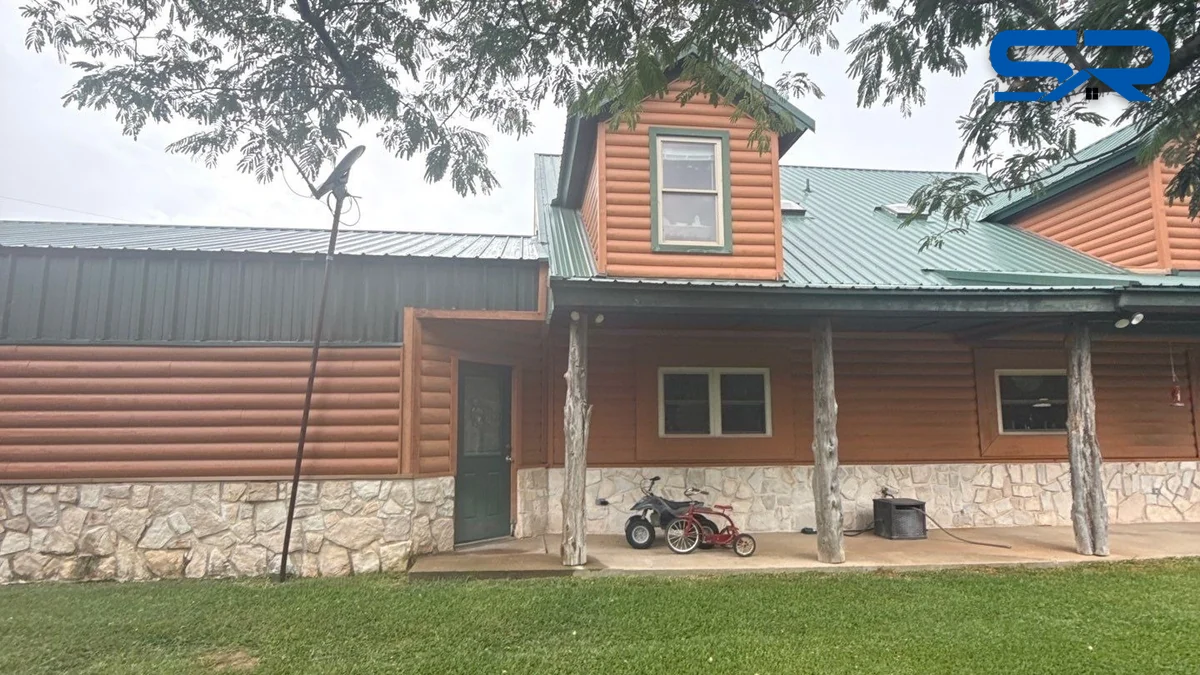
Drive west out of Fort Worth on I-20 and the houses start to change. Around Willow Park, Hudson Oaks and Aledo, you see more stone walls, deep covered porches, cedar posts and wide, simple rooflines. A lot of folks call it the Hill Country look, and there’s one roof that belongs on it more than any other: standing seam metal.
I’m Blake Snow. I’ve been roofing for 30 years, I’m the third generation in a family business that goes back 75 years, and our crews have completed over $80 million in roofing projects. Here’s what I tell homeowners west of Fort Worth who want a metal roof that fits a stone house instead of fighting it.
Why metal and stone go together
Hill-Country-style homes are built on contrast. Rough, warm stone on the walls. Clean, quiet lines on the roof. Standing seam gives you those long, straight vertical seams that run from ridge to eave and make a stone house look settled and finished. Shingles can look fine, but they add texture on top of texture. Metal lets the stone do the talking.
The shape of these houses helps, too. Most have simple hips or gables, low-to-medium pitches and long porch roofs. Those are the roofs where standing seam looks its best, because the panels can run long and straight without a lot of chopping around.
Picking the panel look
Not every metal roof reads as Hill Country. A few things make the difference:
- Standing seam over exposed fasteners on the house. Exposed-screw panel has its place on barns and shops, but on a stone home the clean seam with no screws through the face is what gives you that finished look. We cover both on our metal roofing page.
- Seam spacing and panel width. Narrower panels look more tailored. Wider panels look more ranch. I’ll lay out options on your roof and talk through which one fits your house.
- Straight, flat panels. A stone house shows every wave in a roof. That’s why the decking under the metal has to be solid and flat, and why we replace bad boards before anything goes down.
If you want metal but love the look of shake or tile, stone-coated steel is another way to go, and it sits well on a lot of stone homes too.
Color choices for limestone and stone
The color of your stone should drive the color of your roof. Some starting points I’ve seen work well:
- Dark bronze or charcoal over cream or tan limestone gives strong contrast and looks sharp with dark window frames.
- A natural metallic or light gray gives the old ranch-house look that a lot of people picture when they think Hill Country.
- Deep green or barn red suits homes with cedar, log-look siding or a more rustic feel, like the green roof in the photo at the top of this post.
Bring a photo of your stone, or better yet, let me see it in person in daylight. Colors look different on a sample chip than they do across a whole wall in a Texas afternoon. Your trim, soffit and fascia and gutters should be part of the same decision so everything ties together.
Porches, dormers and accents
Deep porches are a big part of this style, and they’re one of the best places to use metal. Some homeowners do the whole house in standing seam. Others keep shingles on the main roof and put metal on the porch, over a bay window or over the entry for an accent. Both are good choices, and no job is too small, whether it’s the full house or one porch.
Dormers, chimneys and stone walls are where the craftsmanship shows. Where a roof meets a stone wall, the flashing has to be cut and set into the stone properly so water stays out of the joint. A metal roof that leaks almost always leaks at a detail like this, so our crew takes its time there.
How we build it
We run our own roll formers and our own crew. That means we form the standing seam panels right on the job site, cut to the length each run needs, so most runs go in one piece from ridge to eave. Our standard is 26-gauge steel. Panels go on with clips hidden under the seams, which lets the steel move with our hot days and cold nights without wearing out screw holes.
Before any of that, you get a free digital photo report of your current roof, so you can see the decking, flashing and problem spots without climbing a ladder. Then you get a clear written scope covering tear-off, decking, underlayment, panel profile and color, flashing, trim and gutters.
Hail and weather out here
Parker County gets its share of storms. If you’re not sure what the last one did to your current roof, we wrote about the May 28, 2026 hail in Willow Park and Hudson Oaks. If you’re comparing metal to shingles, keep in mind that every shingle roof we install is Class 3 impact-rated or better, so you have good options either way. I’ll give you a straight answer about which one fits your home.
Willow Park and nearby towns
We serve Willow Park, Hudson Oaks, Aledo, Weatherford, Annetta and the rest of Parker County from our offices in Bridgeport, Decatur and Rhome. We work across the DFW Metroplex and towns within about 65 miles of Bridgeport. If you want to see more about how we form panels, I wrote about forming metal panels on site in Weatherford.
Let’s look at your house
Our residential workmanship warranty is 10 years and transferable if you sell. We’re certified with GAF, CertainTeed, Owens Corning and Atlas, and you can see more on our roofing brands page. We’re A+ rated on the BBB and have 5.0 stars on Google at all three offices: Bridgeport, Decatur and Rhome.
Call (817) 733-9228 or request an estimate, and I’ll come out, look at your stone and your rooflines, and show you what standing seam would look like on your home.