When people in Weatherford start shopping for a metal roof, most of the questions are about color, cost and hail. Very few people ask where the panels actually come from. I think it’s one of the most important questions you can ask, so here’s the plain version.
I’m Blake Snow. I’ve been roofing for 30 years, I’m the third generation in a family roofing business that goes back 75 years, and our crews have completed over $80 million in roofing projects. We run our own roll formers and a standing seam machine, and we form our standing seam panels ourselves. Here’s what that means and why it matters on your house.
What a roll former does
A metal roof panel starts as a big coil of flat, painted steel. A roll former feeds that steel through a long row of rollers, and each set of rollers bends it a little more until it comes out the other end as a finished panel with its ribs or seam legs formed in. Then it’s cut to length.
That last part is the key. The machine doesn’t care if you need a short panel over a porch or a long one down the main slope of a ranch house. It makes the length you tell it to make.
A lot of roofing companies don’t own this equipment. They order panels from an outside panel shop, wait for them to be made and shipped, and work with whatever shows up on the truck. Nothing’s wrong with a good supplier, but you give up some control over timing, length and fit.
Why we form panels ourselves
One panel, ridge to eave
When we form a standing seam panel for your roof, we measure each slope and run panels to fit it. On most slopes, that means one continuous panel from the ridge down to the eave, with no splice in the middle. Every lap or splice in a metal roof is a spot that has to be sealed and that water can test, so fewer of them is better. It also just looks cleaner. Long, unbroken seam lines are a big part of why people want standing seam in the first place.
Fit to your roof, not to a delivery truck
Long panels are hard to ship. A big ranch house, a long shop or a barn can have slopes that push past what’s easy to haul and handle. Forming them ourselves means the roof gets panels sized for the roof, not for the trailer.
Less handling damage
Painted metal panels can get bent, kinked or scratched on the way to a job. The fewer times they’re loaded, shipped, unloaded and moved, the fewer chances there are for that. We’d rather the first scratch-free panel on your roof stay that way.
The same people form it and install it
Our own standing seam crew installs the panels we form. That’s not a small thing. When the people running the machine are the same people who measured your roof and will be up there putting the panels on, mistakes get caught early and nobody’s pointing fingers at another company. A lot of outfits sell a metal roof and hand it off to whatever sub crew is open that week. We don’t work that way on standing seam.
Same steel either way: 26 gauge
Every standing seam and R-panel roof we install is 26-gauge steel. Gauge is the thickness of the metal, and a lower number means thicker steel. We don’t offer a thinner panel to win a bid. If you’re comparing quotes, ask every company what gauge they’re using, because it isn’t always the same.
If you’re still deciding between systems, our standing seam vs. R-panel comparison walks through hidden fasteners versus exposed screws, upkeep and looks. You can also read the R-panel and PBR page for shops and barns.
Where this shows up around Weatherford and Parker County
Parker County has a little of everything, and forming our own panels helps on all of it:
- Ranch homes and acreage around Weatherford, Springtown and Millsap, where long, simple roof lines are made for full-length standing seam.
- Higher-end homes in Aledo, Willow Park and Hudson Oaks, where standing seam goes on the whole roof or as an accent over porches, bays and entries.
- Shops, barns and barndominiums, where long slopes and big spans are normal. Our barndominium, shop and ag roofing page covers framing and condensation control on those.
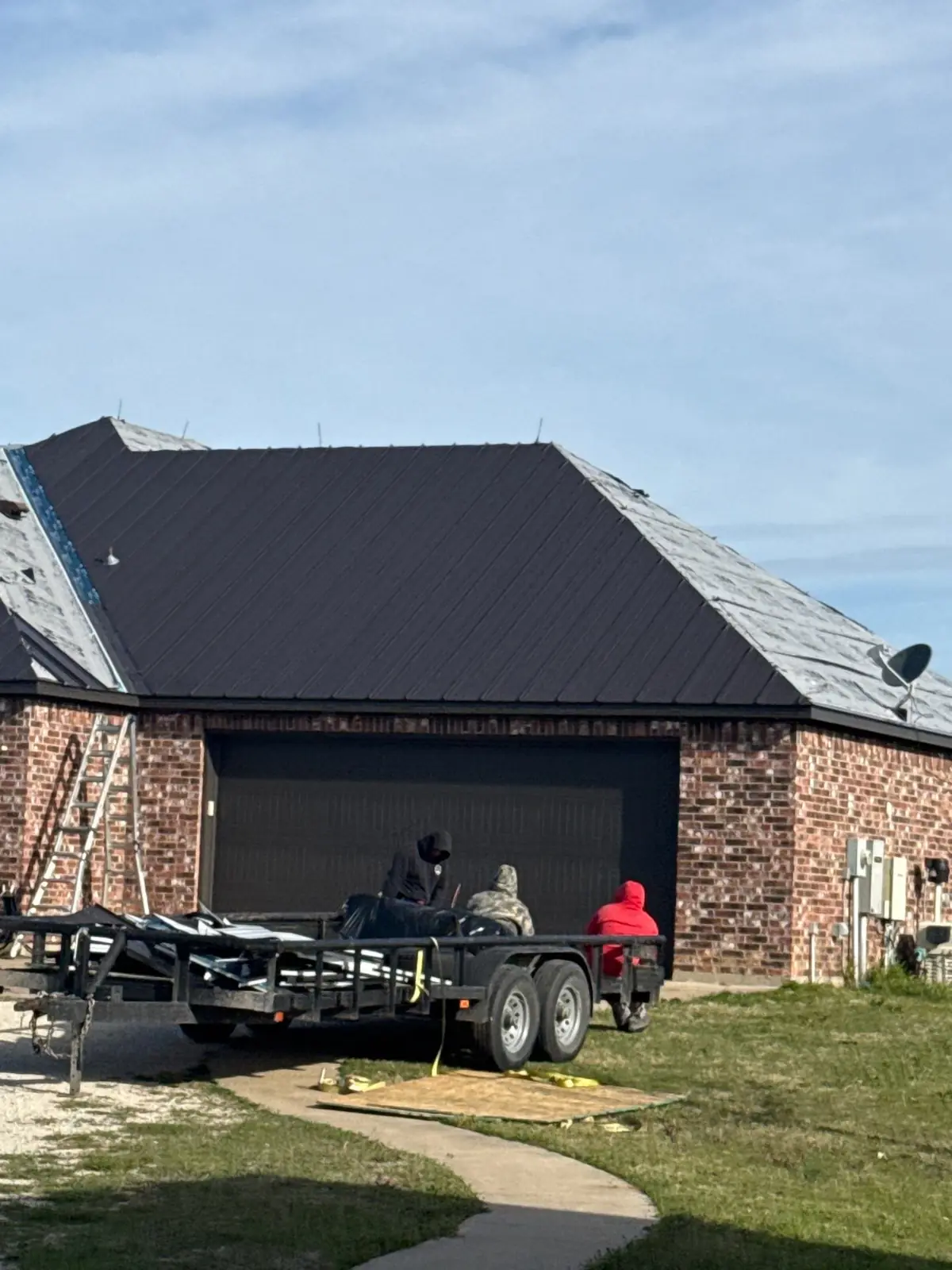
The photo at the top of this post is our crew and panel trailer beside a brick garage on a standing seam conversion in Denton County. You can see more of that job on our standing seam project between Sanger and Valley View, and the brick ranch we did near Rhome is another good example of long, clean panel runs.
Questions worth asking any metal roofer
Whoever you hire, these are fair questions:
- Do you form your own panels, or buy them from a panel shop?
- Will the panels run one piece from ridge to eave on my roof?
- What gauge is the steel?
- Is your own crew installing it, or a sub?
- How do you handle flashing at walls, chimneys and pipes?
A good roofer will answer all five without hesitating.
Let’s look at your roof
Big metal job or a small repair, we’d be glad to come out. We’ll measure each slope, check the decking and ventilation, and every inspection comes with a free digital photo report so you can see what we saw. Then I’ll tell you plainly which metal roofing system fits your house and why.
We’re A+ rated on the BBB, and our Google ratings are 5.0 at all three offices: 86 reviews in Bridgeport, 13 in Decatur and 3 in Rhome. We serve the entire DFW Metroplex and towns within about 65 miles of Bridgeport, including all of Parker County.
Call (817) 733-9228 or request an estimate, and we’ll set up a time to come out.