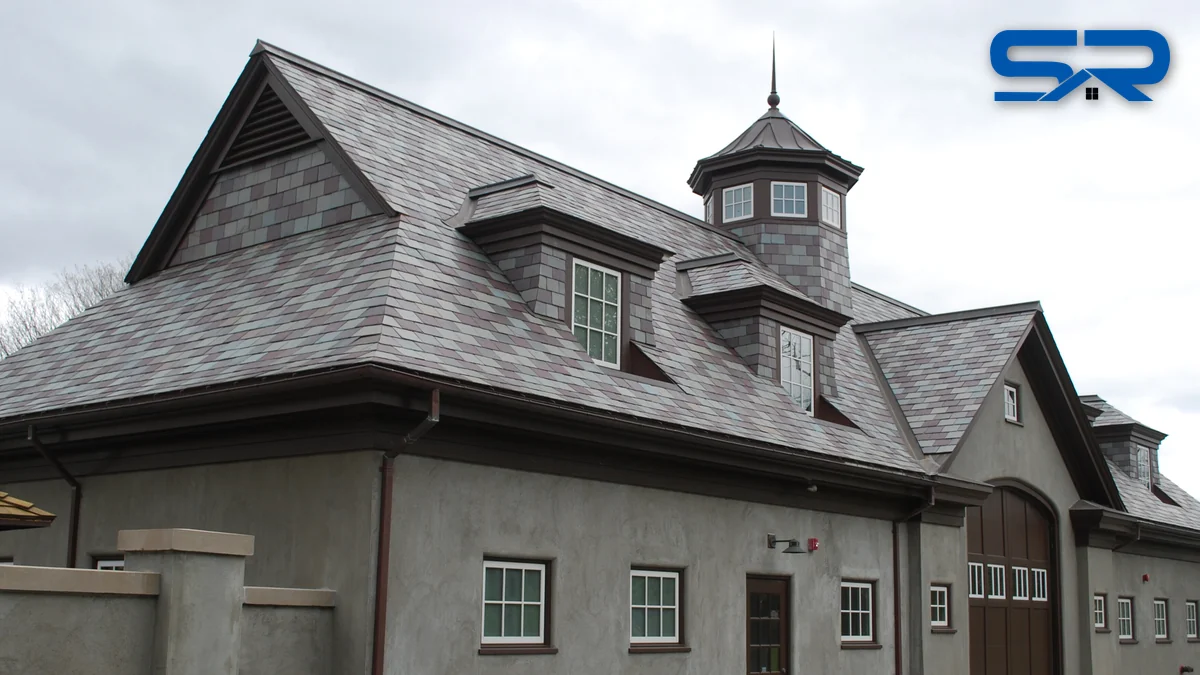
A natural slate roof is one of the best roofs you can put on a house, and one of the easiest to throw away too early. The usual story goes like this: a leak shows up, someone walks the roof in work boots, cracks a few more slates, and calls the roof worn out. Sometimes it is. Often it isn’t. If you own a slate roof on an estate home in Southlake or Westlake, that difference is worth a lot.
I’m Blake Snow. I’ve been in the roofing business for 30 years, I’m the third generation of a family roofing business that goes back 75 years, and I’ve installed and repaired natural slate many times. Here’s how I decide whether a slate roof needs a repair, a partial reslate, or a full replacement.
Start with the right question: is the stone sound?
Slate isn’t like asphalt shingles, where the whole roof wears out together. On most slate roofs, the stone outlasts everything around it: the nails, the flashing, the underlayment, and past repairs. So the first job is to sort the problem into one of three groups:
- The stone is sound, and the problem is local. A few broken or slipped slates, a dented valley, a hail-cracked area, one bad chimney flashing. That’s a repair.
- The stone is sound, but the fasteners or flashing are failing everywhere. Slates slipping all over the roof, rusted nails, valleys worn through on every slope. That can mean stripping and relaying, reusing the good slate.
- The stone itself is worn out. Slates are soft, flaking or delaminating across the roof. That’s a replacement.
Homes in Southlake and Westlake are young compared with the century-old slate roofs in older parts of the country, so worn-out stone is rarely the first thing I’d assume here. That’s why it’s worth getting the diagnosis right before anyone writes a replacement bid.
How to tell sound slate from worn-out slate
The National Park Service’s guide to slate roofs (Preservation Brief 29) gives a simple field test: good slate gives off a clear, solid sound when tapped, and badly weathered slate gives a dull thud. Weathered slate also flakes in thin layers on the surface and turns soft as the inner layers come apart.
On an inspection, I also look at:
- Where the breaks are. Breaks along a walk path or next to a satellite dish or chimney often mean foot traffic, not age or weather.
- The nails. If the slates are sound but slipping, the nails are often the cause, and the stone can be reused.
- Past repairs. Tar, caulk and face-nailed patches hide problems and make the next repair harder. They’re a reason to redo the repair properly, not to replace sound slate.
- The attic. Water stains and soft decking near valleys, hips and the eaves tell me how long a leak has been going on.
We don’t walk a slate roof like a shingle roof. We plan a walk path, step only where the pieces are supported, use roof ladders and pads, and fly a drone over the areas that aren’t safe to walk. Every inspection includes a free digital photo report, so you see what we see.
The 20% rule of thumb
The same National Park Service guide says slate repair makes sense for localized problems on roofs with a long life left, and that if about 20% or more of the slates on a roof or a single slope are broken, cracked, missing or sliding out of place, replacing is usually less expensive than repairing piece by piece.
Note the words “or a single slope.” The answer doesn’t have to be all or nothing. If one slope has taken the beating and the rest of the roof is sound, a partial reslate of that slope can be the smart middle ground. Good slates salvaged from the stripped slope can be stored for future repairs on the rest of the house.
When the leak isn’t the slate at all
On a lot of slate roofs, the leak is in the metal. Valleys, chimney flashing, step flashing where a roof meets a wall, and flashing around dormers wear out first. If those are worn or were done in a light metal, the fix is to rebuild them in a metal that lasts as long as the slate, often copper, while keeping the slate around them. For more on that, see our copper flashing and valleys guide and our gutter services.
What a proper slate repair looks like
A good slate repair should be hard to spot from the street:
- The broken slate is removed with a slate ripper, without disturbing its neighbors.
- The new piece matches the color, size and thickness of the old one. New slate is often cut thicker than older slate, which can make the slates around it sit up and crack. Salvaged slate, or a piece borrowed from a low-visibility slope, is often the better match.
- The replacement is held with a copper or stainless slate hook or a nail-and-bib method, not a face nail and a dab of tar.
- Where several slates are out next to each other, the repair is worked in a small pyramid so fewer pieces need bibs.
If your slate has to be matched and you don’t know the source, our slate quarries and brands page and our pages on Vermont and New York slate and Pennsylvania slate can help you narrow it down.
Repair, partial reslate or replace: a quick comparison
| Repair | Partial reslate | Full replacement | |
|---|---|---|---|
| Best when | Damage is local and the stone is sound | One slope is worn or heavily damaged, the rest is sound | The stone is soft or delaminating across the roof |
| What’s kept | Nearly all of the roof | The sound slopes, plus salvaged slate | Little or none of the old slate |
| Flashing | Rebuilt where it failed | Rebuilt on that slope | All new, so it lasts as long as the new slate |
| Watch for | Thickness and color match | Blending old and new at the seams | Framing, decking and weight checks |
If you do replace: natural or synthetic?
If the slate truly is done, you can go back to natural slate roofing or move to a composite slate. Natural slate is heavy, so the framing has to be checked before it’s specified. Synthetic slate is much lighter and many products carry a Class 4 impact rating (check the exact product). We install both, including Enviroslate from Enviroshake, a brand we’re certified with. See synthetic slate and our synthetic vs. real slate guide for a fuller comparison.
Hail, foot traffic and your claim
Hail is a real threat to slate here. NOAA’s Storm Prediction Center logged 1-inch hail northwest of Grapevine on May 22, 2026 and along Hwy 114 in Grapevine on June 2, 2026, right next to Southlake, and NOAA’s Storm Events Database lists 4-inch hail near Grapevine Reservoir on June 11, 2023. But slate also cracks from foot traffic, rusted nails and old repairs. Telling fresh hail breaks from old breaks matters for the repair and for any storm damage claim. Our photo report separates them. If you file, we meet your adjuster on the roof. Texas law requires you to pay your deductible, and we never waive it.
Permits and HOA review
The City of Southlake requires a building permit to replace a roof. The contractor has to be registered with the city, the permit is filed online, the permit card has to be visible from the road, and a final inspection is required. In Westlake, contractors register with the Town and permits go through its online MyGov system. Many HOAs in both towns review roofing material and color, so if you change from natural slate to synthetic, or change color, get approval in writing first. We provide the manufacturer specs and samples to submit.
Get a straight answer on your slate roof
If you own a slate roof in Southlake, Westlake, Colleyville or Trophy Club, we’ll inspect it carefully, show you in a free digital photo report what’s sound and what isn’t, and tell you plainly whether it needs a repair, a partial reslate or a replacement. Small repairs are welcome. See slate roofing in Southlake and slate roofing in Westlake too.
Snow Roofing & Exteriors is A+ rated on the BBB and certified with GAF, CertainTeed, Owens Corning, Atlas, Johns Manville, Carlisle, Tropical Roofing Products, Mule-Hide and Enviroshake. We serve the whole DFW Metroplex and towns within about 65 miles.
About the photo
The photo at the top is a manufacturer photo from New England Slate showing a natural slate roof, with our SR mark added. It isn’t a Snow Roofing job, and it isn’t a home in Southlake or Westlake. I use it to show what a well-kept natural slate roof with dormers and a cupola looks like.
Call (817) 733-9228 or request an estimate.