
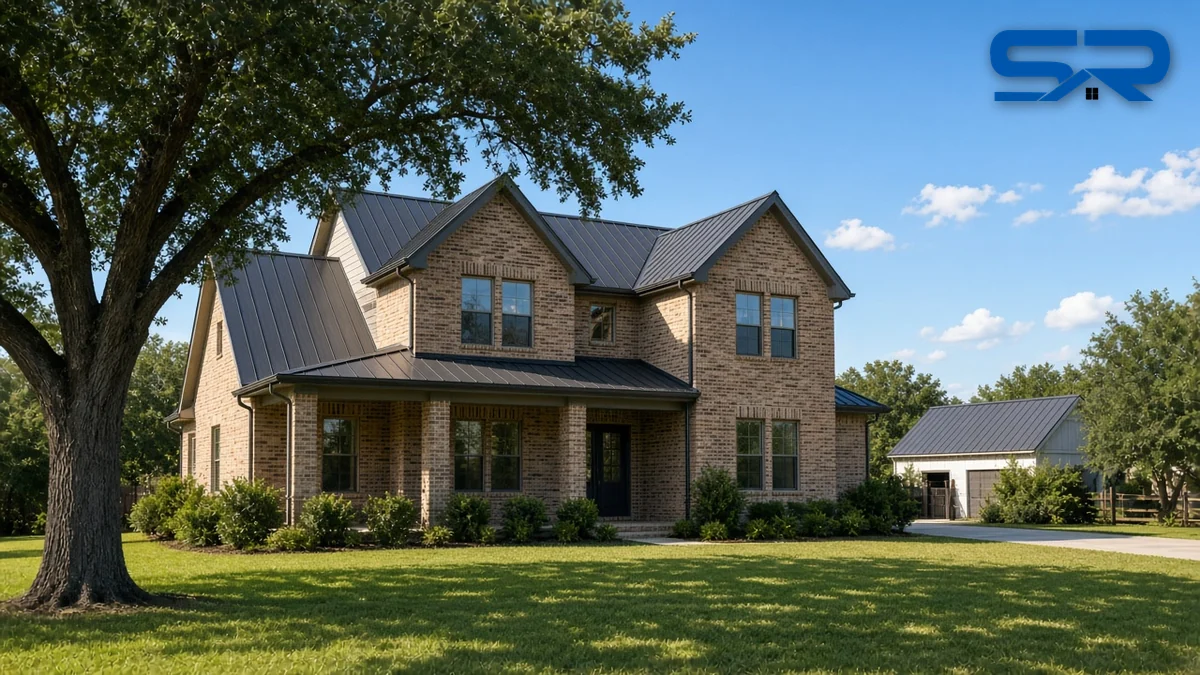
Corinth sits right in the middle of the Lake Cities, along I-35E between Denton and Lewisville, with Lewisville Lake just to the east. That spot puts Corinth roofs in the path of the same spring hail, summer heat and strong wind that hit the rest of Denton County. More homeowners here are asking me about metal, and the first question is almost always the same: standing seam or R-panel?
I’m Blake Snow. I’ve been roofing for 30 years, I’m the third generation in a family business that goes back 75 years, and our crews have completed over $80 million in roofing projects. We run our own roll formers and our own crews. Here’s how I walk Corinth homeowners through the choice.
The short answer
For the house itself, I usually recommend standing seam. For a shop, detached garage, barn, patio cover or carport, R-panel or PBR is often the smarter buy. Plenty of owners do both: standing seam on the house and R-panel on the workshop out back in the same color, so the whole property matches.
Below is why, and what else you should know before you sign.
Standing seam: hidden fasteners and a clean line
On a standing seam roof, each panel locks to the next at a raised seam, and the clips that hold it down sit under that seam, out of the weather. There are no screws through the face of the panel. That matters for three reasons:
- Nothing to back out. Exposed screws work loose over years of heating and cooling, and their rubber washers age in the sun. Hidden clips don’t have that problem. We went deeper on this in our post on hidden fasteners vs. exposed screws.
- The panels can move. Metal grows and shrinks with Texas temperature swings. A proper clip system lets the panel slide instead of tearing at its fasteners.
- It looks right on a suburban home. The straight vertical lines read as a clean, architectural roof, which is why it’s the version most HOAs are comfortable with.
Standing seam takes more skill to install, especially at valleys, dormers, chimneys and wall flashings. That’s the work that separates a good metal roof from a leaky one. Our post on metal roof flashing details shows what we look for.
R-panel: tough, fast and made for outbuildings
R-panel is an exposed-fastener panel with tall ribs. It spans open purlins well, goes on fast, and can be repaired one sheet at a time. That makes it a natural fit for:
- Workshops and detached garages
- Barns, sheds and carports
- Patio covers and lean-tos
- Boat and RV covers
It can go on a house too, and some owners like the ranch look. Just know the screws are part of the deal. They need to be the right screws, set at the right torque, and checked over the years. If you already have an exposed-fastener roof that’s leaking, our repair and restoration page covers re-screwing, resealing and re-paneling.
Gauge and why we form our own panels
We run 24 or 26 gauge. Thicker steel resists denting better and holds fasteners better. Our post on 26 vs. 29 gauge metal explains what that number means in plain terms.
Because we run our own roll formers for standing seam and R-panel, we cut each panel to the length of its run. On most homes that means one piece from ridge to eave, with no end laps for water to find. Metal lead time is typically one to two weeks once you’ve picked a color and profile.
Hail, wind and what to expect
Denton County gets real hail, and Corinth is no exception. You can look up storms near your street in NOAA’s Storm Events Database. I’ll be straight with you: big hail can dent any metal roof. What metal doesn’t do is crack, split or lose granules the way an asphalt shingle does, and a properly clipped and flashed roof holds up to wind far better than a shingle roof that’s starting to lift. Our post on metal roofs and hail goes deeper on dents, coatings and insurance.
If a storm has already come through, start with our storm damage page. We do a free digital photo report so you can see the roof yourself. In Texas you generally have 1 year from the date of loss to file a claim, but check your policy.
HOA approval in Corinth
A lot of Corinth homes sit in neighborhoods with an HOA, and the architectural committee will want to see the roof before it goes on. Here’s what helps a submittal go smoothly:
- Get the current guidelines and look for anything about roof material, color and reflectivity.
- Pick a muted color. Charcoal, dark bronze, weathered gray and black are the usual safe picks.
- Bring the details. I’ll give you the panel profile, seam height, gauge and the exact color name, plus a physical sample if they want to hold it.
Our post on standing seam and HOA review has more on this.
How a metal re-roof works on a Corinth home
- Free digital photo report. I look at the decking, ventilation, penetrations and every wall and chimney flashing.
- Pick profile and color, and get HOA approval if you need it.
- Form the panels on our own roll formers, cut to each run.
- Tear off, check the deck, replace bad decking, and put down underlayment rated for metal.
- Install panels, flashing, ridge and trim, then walk the job with you.
Our post on switching from shingles to standing seam walks through each step in more detail.
Why homeowners around the Lake Cities call us
- Our own roll formers and our own crews for standing seam and R-panel.
- Certified with GAF, CertainTeed, Owens Corning, Atlas, Johns Manville, Carlisle, Tropical Roofing Products, Mule-Hide and Enviroshake, and many other roof manufacturers.
- 5.0 stars on Google at all three offices: Bridgeport, Decatur and Rhome.
- BBB A+ rated.
- Workmanship warranty from 10 years up to lifetime, depending on the job.
We work all over this part of Denton County, including Lake Dallas, Hickory Creek, Shady Shores, Highland Village and Argyle. See our full metal roofing page or our Denton standing seam page for more.
Get a metal roof estimate in Corinth
Whether it’s a full standing seam roof on the house, an R-panel shop roof, or a couple of leaking screws on a patio cover, I’m glad to look at it. Request an estimate or call (817) 733-9228.