A lot of homeowners around Rhome are on their second or third shingle roof and starting to ask whether the next one should be metal. If you’re thinking about making the jump to standing seam, it helps to know exactly what happens from the day we first look at your roof to the day the crew drives off.
I’m Blake Snow. I’ve been roofing for 30 years, I’m the third generation in a family roofing business that goes back 75 years, and our crews have completed over $80 million in roofing projects. We have an office right in Rhome, and shingle-to-metal conversions on brick ranch homes are some of the jobs I enjoy most. Here’s how one goes, step by step.
Step 1: The inspection and photo report
It starts with me or one of our team on your roof. We look at the shingles, the decking we can see and feel, the vents, the chimney and wall flashing, the valleys and the gutters. We take photos of all of it, and you get a free digital photo report so you can see what we saw without climbing a ladder.
This is also when we talk about what you want: color, whether you want the whole house in metal or just certain sections, and any porches, bays or additions that need their own details.
Step 2: A clear written scope
Before anything gets ordered, you should know exactly what’s included. A good conversion scope spells out:
- Tear-off of the old shingles and underlayment
- How bad decking will be handled if we find it
- The underlayment going under the metal
- Panel gauge, profile and color
- Flashing at walls, chimneys, valleys and pipes
- Ridge and eave trim
- What happens with your gutters
- Cleanup and the final walkthrough
If a bid doesn’t say these things, ask. Surprises in the middle of a metal job are what you want to avoid.
Step 3: Tear-off and decking
On the day the crew starts, the old shingles come off down to the wood. This is the part most people never see, and it matters. Shingles hide soft spots, old leaks and boards that have been wet for years.
When we find bad decking, we photograph it, show you, and replace those sections before anything else goes down. Metal is stiff and flat, and it needs a solid, even surface under it to look straight and stay tight.
Step 4: Underlayment
Next comes the underlayment, the layer between the wood and the metal. It’s the roof’s backup if water ever gets past the panels, and under metal it also helps with the heat that builds up on a North Texas afternoon. We lay it carefully at valleys, walls and eaves, because those are the spots that take the most water.
Step 5: Forming the panels on site
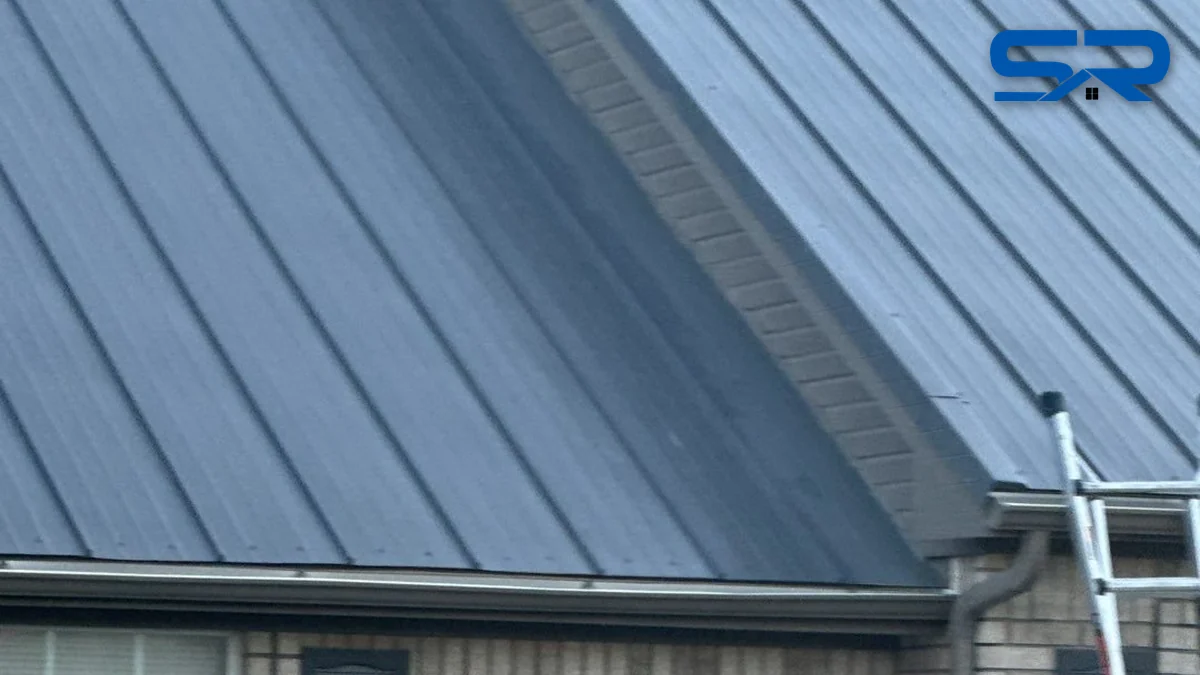
This is where our setup is different. We run our own roll formers and our own crew, so we form the standing seam panels right in your driveway, cut to the length each run needs. Most runs go in one piece from ridge to eave, with no overlaps in the middle of the slope where water could sneak in.
Our standard is 26-gauge steel, with 24-gauge available. If you want the details on why that number matters, our metal roofing page covers gauges and profiles.
Step 6: Flashing, panels and trim
Panels go on with clips hidden under the seams, so there are no screws through the face of the roof. That lets the steel move with the heat and cold without wearing out fastener holes.
The flashing is where the skill shows. Walls, chimneys, valleys, pipe vents and the eave all get metal trim and flashing built for standing seam, not leftover shingle parts. A metal roof that leaks almost always leaks at a detail, so this is where our crew slows down.
Step 7: Gutters, cleanup and the final walkthrough
Once the roof is closed up, we deal with the gutters based on what we agreed in the scope. Some can be reset, and some are better replaced while everything is already open. Our gutter services page covers what we install.
Then the crew cleans up the yard, beds and driveway. I walk the finished roof, take final photos and go over everything with you.
What changes after you switch
The biggest difference is what you stop worrying about. No more lost granules in the gutters or shingles peeling up after a windy night. You’ll also notice the look: clean, straight seams that change how the whole house reads from the street, especially on brick.
If you’re not sure metal is right for your house, that’s fine too. We do plenty of residential shingle roofs, and I’ll give you a straight answer either way.
Rhome and nearby towns
We serve Rhome from our office in town and from Bridgeport, along with Newark, Aurora, Haslet and Boyd. We work across the DFW Metroplex and towns within about 65 miles of Bridgeport. No job is too small, from a full conversion to a porch roof or a repair.
Let’s look at your roof
Our residential workmanship warranty runs from 10 years up to lifetime, depending on the job. We’re certified with GAF, CertainTeed, Owens Corning, Atlas, Johns Manville, Carlisle, Tropical, Mule-Hide and Enviroshake, and we’re A+ rated with the BBB. Our Google ratings are 5.0 at all three offices: Bridgeport, Decatur and Rhome.
Call (817) 733-9228 or request an estimate, and I’ll come walk your roof and lay out exactly what your switch to standing seam would look like.