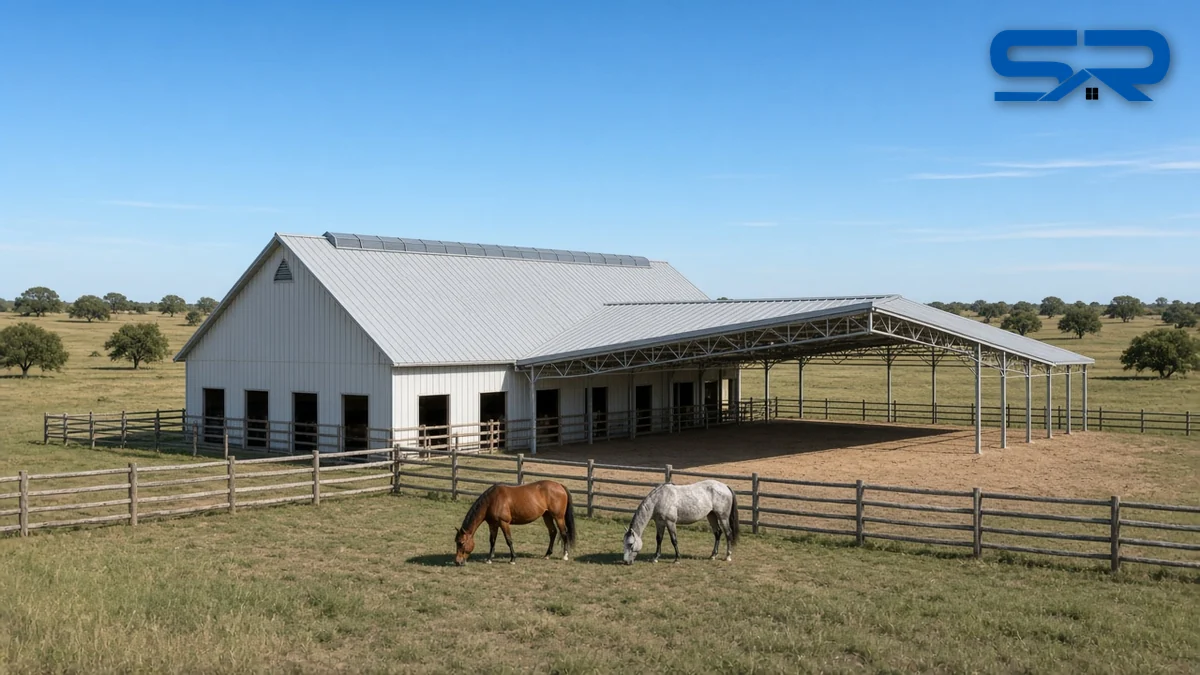
Paradise has always been horse and cattle country, and with all the new homes going up on acreage around town, a lot of those places are adding a barn, a stall row or a covered arena. Those buildings get metal roofs almost every time, and for good reason. But a horse barn isn’t just a big shed. Animals, wet bedding, wash racks and long open spans all change how the roof should be built.
I’m Blake Snow. I’ve been roofing for 30 years, I’m the third generation in a family roofing business that goes back 75 years, and our crews have completed over $80 million in roofing projects. Our Bridgeport office is about 4.5 road miles from Paradise, so this is home turf for us. Here’s what I walk owners through before we roof a barn or arena.
Picking the panel: R-panel, PBR or standing seam
For most barns, stables and arenas, R-panel or PBR is the workhorse. It’s an exposed-fastener panel with tall ribs, it spans well over purlins, and it goes on quickly over a big footprint. Our standard is 26-gauge steel, with 24-gauge available when you want a heavier panel.
Standing seam makes sense when the barn has living quarters, an office or a finished tack room, or when it sits close to the house and you want the two roofs to match. The fasteners are hidden under the seams, so there are no rows of screw washers to maintain down the road.
Either way, I’ll tell you straight which one fits the building and the budget. Our barndominium, shop and ag building page covers how we handle the bigger metal buildings on acreage.
Long spans and one-piece panels
Covered arenas are long. If panels are pieced together from short sheets, every end lap is another spot where wind-driven rain can push under. We run our own roll formers on the jobsite, so we can form panels to the length each slope actually needs, ridge to eave. That means fewer laps, cleaner lines and fewer places to leak.
Long runs also move. Steel grows and shrinks with North Texas heat and cold, so fastener placement and trim details have to let the panels move without wallowing out screw holes over time.
Condensation: the problem nobody plans for
This is the one I see go wrong most on horse barns. Horses breathe out a lot of moisture. Add wet stalls, a wash rack and a cold morning, and that damp air hits the underside of cold steel and turns to water. It drips on the animals, the hay and the tack, and over years it can rust panels and purlins from the inside.
The fix is planned in from the start:
- Ventilation. A ridge vent and open eaves, or other venting that fits the building, let moist air out before it settles under the roof.
- A vapor barrier or insulation under the panels. This keeps warm air off the cold steel. On enclosed barns and stall rows, I usually recommend it.
- Keeping the arena and the stalls in mind separately. An open-sided arena breathes on its own. An enclosed stall barn doesn’t, so it needs more help.
Bolting insulation on after the first winter of drips is a lot harder than doing it while the roof is open.
Noise, light and the animals underneath
Rain and hail on bare metal over open framing are loud, and some horses don’t love it. Insulation under the panels takes the edge off the noise and helps the condensation problem at the same time.
Some owners want more daylight in the arena. Skylight panels and light-colored roofs can help, but any opening in a metal roof is another detail that has to be flashed right. We’ll talk through where they make sense.
Gutters, runoff and footing
A big barn roof sheds a lot of water in a North Texas downpour. If it all dumps along one wall, it can wash out the arena footing, flood stalls or soften the ground at the doors. Plan where the water goes: gutters and downspouts on the stall side, or eaves and drip edges that throw water clear of the walkways and fencing.
Older barns: repair before you replace
Plenty of barns around Paradise, Chico and Boyd already have metal that’s been up for decades. If the panels are still sound, a re-screw with new washers, a new ridge cap and a few replaced sheets can often dry the building out. See our metal roof repair page for how we trace leaks at screws, seams and flashing.
If panels are rusted through, the purlins are soft, or hail has beaten the roof up badly, that’s when we talk replacement. We’ll show you what we find in the free digital photo report so you can decide. No job is too small. One leaking corner on an old horse barn is still worth a call.
Paradise and nearby towns
We serve Paradise from our Bridgeport office and also cover Bridgeport, Decatur, Chico, Boyd and the rest of Wise County. We work across the DFW Metroplex and towns within about 65 miles of Bridgeport, from small acreage barns to big covered arenas and the custom homes that go with them.
Let’s talk about your barn or arena
Whether you’re building a new stall barn, covering an arena or fixing an old roof that drips on your horses, we’re glad to help. Our residential workmanship warranty runs from 10 years up to lifetime, depending on the job. We’re A+ rated on the BBB, and our Google ratings are 5.0 at all three offices: 86 reviews in Bridgeport, 13 in Decatur and 3 in Rhome. Every inspection comes with a free digital photo report.
Call (817) 733-9228 or request an estimate, and we’ll come out, look at the building and give you a straight answer.