
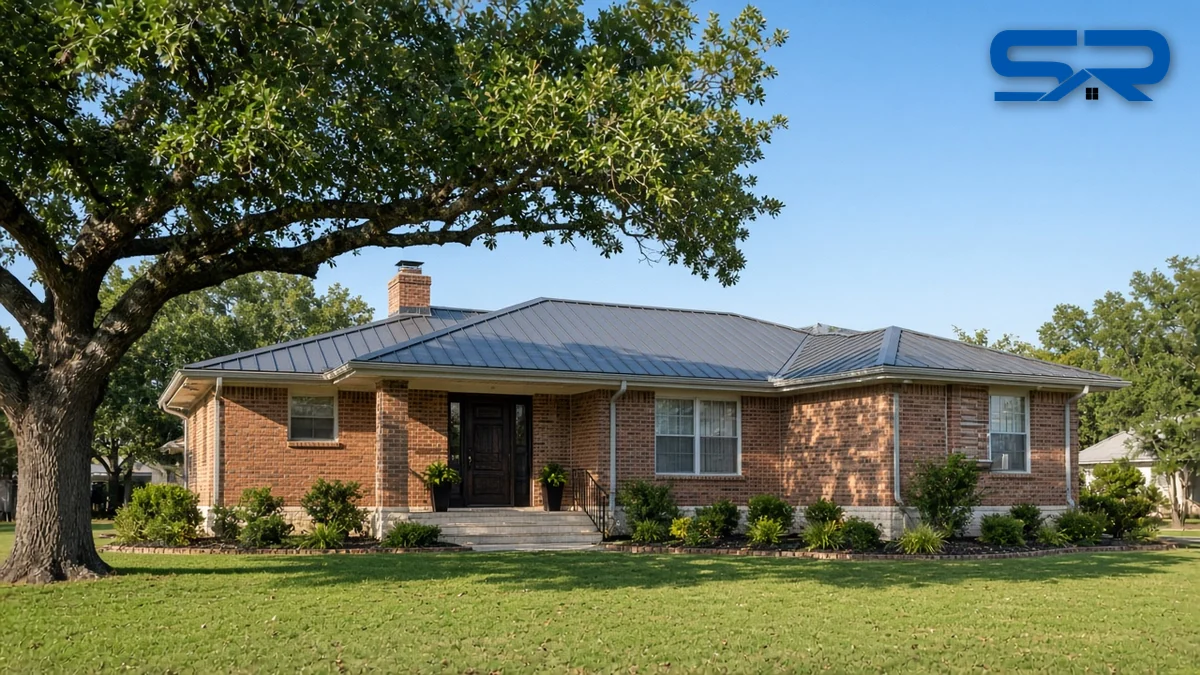
Fort Worth metal roofs for homes have gone from a rare sight to a common question on almost every estimate I give in Tarrant County. Brick ranch houses from the fifties and sixties, Craftsman bungalows near the Near Southside, new builds north toward Alliance and acreage homes out past Benbrook: I get asked about metal on all of them.
I’m Blake Snow. I’ve been roofing for 30 years, I’m the third generation in a family business that goes back 75 years, and our crews have completed over $80 million in roofing projects. Our Rhome office sits just north of Fort Worth on US 287, and we form our own standing seam and R-panel on our own roll formers. Here’s how I’d think through a metal roof on a Fort Worth home.
The short version
- Standing seam fits most Fort Worth homes. Hidden fasteners, long panels, clean lines on brick and stone.
- Stone-coated steel is the traditional-look option. Shake, shingle or tile looks in steel.
- Hail is part of life here. NOAA records show 3-inch hail in far south Fort Worth in 2025 and 2.75-inch hail in northwest Fort Worth in 2026.
- Know the city rules. Decking work needs a permit, and historic districts need a Certificate of Appropriateness first.
- Gauge and details matter more than brand names. 24 or 26 gauge, one-piece panels, and edges fastened for wind.
Which metal roof fits which Fort Worth home
| Your home | What I usually recommend | Why |
|---|---|---|
| 1950s-70s brick ranch | Standing seam in charcoal, bronze or black | Simple hip and gable roofs suit long, clean panels |
| Modern farmhouse or new build | Standing seam, often with black or dark bronze | It’s the look the house was designed for |
| Tudor, traditional or HOA-reviewed home | Stone-coated steel | Reads as shake, shingle or tile from the street |
| Historic-district home | Depends on the district’s standards | Some allow metal shingles only, or standing seam only on porches and low slopes |
| Shop, carport or detached garage | R-panel or standing seam to match the house | One color across the property |
Standing seam vs. stone-coated steel vs. shingles
| Standing seam | Stone-coated steel | Impact-rated shingles | |
|---|---|---|---|
| Fasteners | Hidden under the seams | Hidden in most profiles | Nailed, covered by the course above |
| Look | Clean vertical lines | Shake, shingle or tile | Traditional |
| Hail | Can dent; doesn’t crack or shed granules | Stone chips hide small dings | Class 3 or better on every roof we install |
| Upkeep | Very low | Low | Inspect after big storms |
Every shingle roof we install is Class 3 or better, so shingles are still a fair choice. But if you plan to stay in the house, the homeowners who choose metal usually tell me they want to stop thinking about the roof after every spring storm.
Hail and wind in Fort Worth
Tarrant County storms are well documented. NOAA’s Storm Events Database lists baseball-size (2.75-inch) hail in Everman on June 1, 2025, and the National Weather Service logged a 3-inch stone in far south Fort Worth the same evening. On April 25, 2026, NOAA recorded a 2.75-inch hailstone in northwest Fort Worth during a stretch of storms that also brought tornadoes and damaging wind.
I’ll be honest: hail that size can dent steel. What it doesn’t do is crack the panel or knock off granules, and a dent isn’t a leak. Wind is the other test. Roofs fail at the edges first, so we form panels to run ridge to eave in one piece, tighten clip spacing near the edges and corners, and fasten eave, rake and ridge trim so wind can’t get under it. If you’re switching after a storm, Texas generally gives you 1 year from the date of loss to file a claim; check your policy. Our storm damage inspections start with a free digital photo report.
What Fort Worth’s rules say
The City of Fort Worth posts its residential re-roofing rules, and a few of them matter for a metal roof:
| The city’s rule | What it means for your roof |
|---|---|
| Shingle-only work on a single- or two-family home doesn’t need a permit | A straight shingle swap is simpler |
| Replacing decking, sheathing, rafters or ridge boards needs a building permit | We check the job and pull the permit when it’s required |
| Drip edge and crickets are required on a re-roof if they’re missing | We add them as part of the job |
| Ice barrier underlayment isn’t required in Fort Worth | We use high-temperature synthetic underlayment under metal anyway |
| Historic districts need a Certificate of Appropriateness before permits or work | Approval comes first, then the panels get ordered |
Historic districts are where metal gets tricky. Fairmount’s roofing standards, for example, allow metal shingles only if they replicate the original shingles, allow standing seam only on secondary slopes under 4/12 and on accessory buildings, and prohibit R-panel and rib panel on homes. Other districts have their own standards, so we read yours before we propose a roof. Outside city limits, in places like Westover Hills, Lake Worth or Saginaw, each city and HOA has its own rules, and we check those too.
Picking a color that suits brick
Most Fort Worth homes are brick or stone, so the roof color should come from the masonry:
- Red and orange brick: charcoal, dark bronze or black.
- Tan, cream or limestone: bronze, weathered tones or a warm gray.
- Heat: lighter and mid-tone finishes reflect more sun than black.
- Paint system: a PVDF (Kynar 500) finish holds color longer than SMP. My post on PVDF vs. SMP metal roof paint explains why, and our metal roof colors and finishes page shows the options.
Questions to ask any metal roofer
- Is it standing seam with hidden fasteners, or exposed-fastener panel?
- What gauge, and who forms the panels? (Ours are 24 or 26 gauge; my post on 26 vs. 29 gauge explains why we don’t go thinner.)
- Do the panels run ridge to eave in one piece?
- How are the eaves, rakes and ridge fastened for wind?
- Will you check permits, HOA rules or historic-district standards first?
- What’s the workmanship warranty, in writing?
For more, see our Fort Worth metal roofing page, our Fort Worth standing seam page, and my post on metal roofs for Hill-Country-style homes west of Fort Worth. Seamless gutters finish the job.
Areas we serve around Fort Worth
We install metal roofs on homes across Fort Worth and nearby, including Westover Hills, Benbrook, Lake Worth, Saginaw, Haslet, Keller and Rhome.
Let’s look at your roof
We’re certified with GAF, CertainTeed, Owens Corning, Atlas, Johns Manville, Carlisle, Tropical Roofing Products, Mule-Hide and Enviroshake, and many other roof manufacturers. Snow Roofing & Exteriors is fully insured, has offices in Bridgeport, Decatur and Rhome, is BBB A+ rated, and has 5.0 stars on Google at all three offices: Bridgeport, Decatur and Rhome. References are available on request. Our workmanship warranty runs from 10 years up to lifetime, depending on the job, and our metal lead time is typically 1 to 2 weeks.
Call (817) 733-9228 or request an estimate. I’ll walk the roof with you and give you a free digital photo report and a plan in writing.