
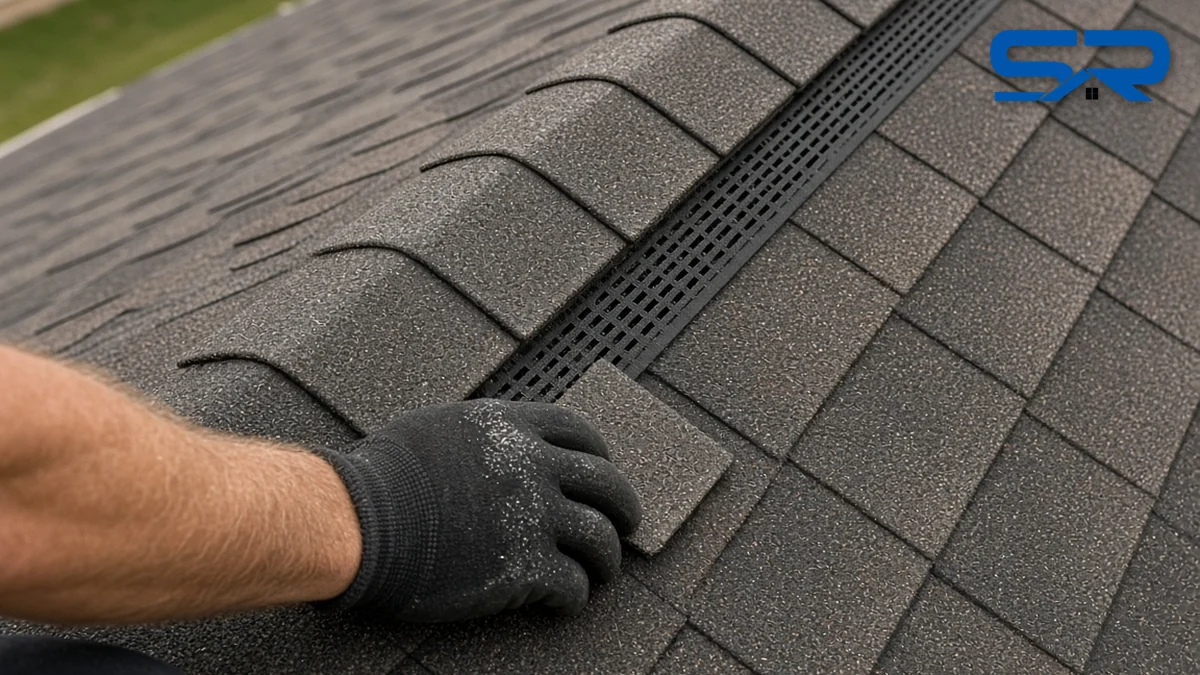

GAF Cobra vs. Air Vent ShingleVent II vs. Lomanco OmniRidge is a choice most Southlake homeowners never hear about, because the ridge vent is usually buried in a bid as one line: “ridge vent.” But on a hot North Texas attic, that strip at the top of the roof and the soffit vents at the bottom decide how much heat and moisture gets out.
I’m Blake Snow. I’ve been roofing for 30 years. Snow Roofing & Exteriors is certified with GAF, and we install Air Vent and Lomanco vents too. All three of these are good shingle-over ridge vents. Here’s how they compare from each maker’s own pages and the ICC-ES evaluation reports, and how much ridge vent your attic actually needs.
The short answer
- Three of them tie at 18 square inches per foot: GAF Cobra Rigid Vent 3, Air Vent ShingleVent II and Lomanco OmniRidge OR-4.
- GAF’s roll vent, Cobra Exhaust Vent, is 16.9 hand-nailed and 14.1 in the nail-gun version, but it handles the widest pitch range (2:12 to 20:12).
- Low-profile versions move less air: ShingleVent II-7/II-9 are 16, Lomanco’s Lo-OmniRidge and Lo-OmniRoll are 11.
- Intake matters more than brand. A ridge vent with no soffit intake is a vent that doesn’t work.
- On a GAF roof, a Cobra vent can count as the attic ventilation accessory for GAF’s system warranties.
Side by side
| GAF Cobra Exhaust Vent (roll) | GAF Cobra Rigid Vent 3 | Air Vent ShingleVent II | Lomanco OmniRidge OR-4 | |
|---|---|---|---|---|
| Net free area per linear foot | 16.9 (hand nail) / 14.1 (nail gun) | 18 | 18 (II-7 and II-9: 16) | 18 (Lo-OmniRidge / Lo-OmniRoll: 11) |
| Format | Mesh roll | Rigid sections; EasyTear sizing in 3” increments | Rigid 4’ sections, injection-molded polypropylene, fiberglass weather filter | Rigid 4’ sections, 15-1/4” wide |
| Roof pitch | 2:12 to 20:12 | 3:12 to 16:12 | 3:12 to 16:12 (II-7/II-9: to 12:12) | 3:12 to 16:12 per ESR-3482 (Lomanco site: 2/12 to 16/12); preformed to 3/12 |
| Cap shingle width | 10”, 12” or 11.75” options | 12” or 10” caps (two vent widths) | 13.8” wide vent (II-7: 10”; II-9: 11.3”) | 15-1/4” wide vent |
| Weather features | Shingle-over design | External baffles | Weather filter, air slots both sides | External venturi baffle, external water shield, underlapping joint, 4 drain holes per foot per side |
| Nails | Smart Nails (hand) or 1-3/4” coil nails (gun) included | Per GAF instructions | No. 11 gauge, 2-1/2” smooth shank through predrilled holes (ESR-2071) | Minimum 2” long (Lomanco instructions); No. 11 gauge with 3/8” heads (ESR-3482) |
| Code listings | GAF lists a Texas Department of Insurance evaluation (RV-19) | GAF lists a TDI evaluation (RV-29) and Miami-Dade approval | ICC-ES ESR-2071: up to 130 mph basic wind speed, mean roof height 40’ or less, Exposure D (2024 IBC) | ICC-ES ESR-3482: up to 130 mph basic design wind speed, mean roof height 40’ or less, Exposure D (2018 IBC) |
| Warranty | Eligible for up to a lifetime limited warranty on GAF Lifetime Shingle roofs | Same | See Air Vent | Limited lifetime warranty (Omni series) |
Sources: GAF Cobra Exhaust Vent and Cobra Rigid Vent 3 product pages; ICC-ES ESR-2071 (Air Vent ShingleVent II, reissued June 2026); ICC-ES ESR-3482 (Lomanco, reissued November 2026), Lomanco’s ridge vent page and OR-4 installation instructions. GAF’s lifetime coverage requires GAF Lifetime Shingles and qualifying accessories and only applies to certain owners; see GAF’s warranty for details.
Net free area: what the number means
Net free area (NFA) is the open area air can actually move through, in square inches per linear foot of vent. More NFA per foot means fewer feet of ridge vent to hit the same number. That matters on Southlake homes with lots of hips and short ridges, where there may not be much ridge to work with.
The roll-style Cobra loses some NFA in the nail-gun version (14.1 vs. 16.9) and low-profile vents trade airflow for a flatter look. That’s a fair trade on a short, visible ridge, as long as the math still works.
How much ridge vent does your attic need?
The International Residential Code, Section R806.2, sets the minimum vent area:
- 1/150 rule: 1 square foot of net free vent area for every 150 square feet of attic floor.
- 1/300 rule: allowed when 40 to 50% of the required vent area is in upper vents no more than 3 feet below the ridge, and the rest is in the bottom third of the attic (the soffits). (The code’s other condition, a vapor retarder, applies only in the coldest climate zones.)
Example: a 2,400-square-foot attic under the 1/300 rule needs 8 square feet, or 1,152 square inches, of vent area. The ridge share (40 to 50%) is about 461 to 576 square inches. That’s roughly:
- 26 to 32 feet of an 18-NFA vent (Cobra Rigid Vent 3, ShingleVent II, OmniRidge)
- 28 to 35 feet of Cobra Exhaust Vent hand-nailed (16.9)
- 33 to 41 feet of Cobra Exhaust Vent nail-gun (14.1)
- 42 to 53 feet of an 11-NFA low-profile vent
The rest, about 576 to 691 square inches, has to come in at the soffits. Your attic is different, so we measure it. Your local code official has the final say on code questions.
Intake: the part most roofs get wrong
GAF’s own product page says it plainly: “In no case should the amount of exhaust ventilation at the ridge exceed the amount of soffit ventilation.” Lomanco’s OR-4 instructions say most codes want a balanced system of about 50% exhaust and 50% intake.
On Southlake re-roofs we often find soffit vents painted over, blocked by insulation, or never cut in the first place. A bigger ridge vent won’t fix that. I also don’t mix ridge vents with power vents, turbines or gable vents on the same attic space; they can short-circuit each other and pull air in through the ridge instead of the soffits.
Cutting the slot and nailing it right
The ICC-ES reports spell out the details, and they’re where leaks start if someone rushes:
- Slot width. ESR-2071 says ShingleVent II goes over a 3/4-inch opening on each side of a ridge board, or a 1-1/2-inch opening centered on the ridge without one. ESR-3482 gives its own ranges for OmniRidge.
- Leave the ends uncut. ESR-2071 says the last 6 inches of sheathing inside the wall line at each end stays uncut. Lomanco’s instructions say the cut should be 1 foot shorter than the distance between end walls.
- Expansion gaps. ESR-2071 recommends a 1/8-inch gap between sections in cold weather; Lomanco calls for a 1/8-inch expansion gap at each underlap.
- Cap nails. ESR-2071 calls for corrosion-resistant, ring-shank nails, six per ridge shingle, long enough to reach 3/4 inch into or through the sheathing.
Ridge leaks often trace back to an over-cut slot, short nails, or a cap shingle that doesn’t cover the vent. These details tie into flashing too. See our roof flashing guide and why most roof leaks start at the flashing.
Matching the ridge cap
The vent has to fit the cap. GAF makes Cobra in widths for 10-inch, 12-inch and 11.75-inch ridge caps, and Cobra Rigid Vent 3 comes in 11.5-inch and 9-inch widths for 12-inch and 10-inch caps. On a Class 4 shingle roof, we also want a Class 4 ridge cap over the vent. My GAF Timberline HDZ vs. UHDZ post covers which GAF caps go with which shingle.
GAF warranties and the ridge vent
GAF’s 15-year WindProven wind warranty on Timberline shingles with LayerLock requires GAF starter strips, roof deck protection, ridge cap shingles, and leak barrier or attic ventilation. A GAF Cobra vent can fill that last slot. If the roof uses a GAF leak barrier instead, a ShingleVent II or OmniRidge doesn’t stop you from qualifying. Either way, we list every accessory by name in the proposal so you know which GAF warranty applies.
Which one would I use on a Southlake home?
- GAF shingle roof, want the most GAF warranty options: Cobra Rigid Vent 3 (18 NFA) or Cobra Exhaust Vent, sized to the cap.
- Short ridges and a big attic: an 18-NFA vent (Cobra Rigid Vent 3, ShingleVent II or OmniRidge), plus more soffit intake if it’s short.
- Very steep roof (over 16:12): GAF Cobra Exhaust Vent, which GAF lists to 20:12.
- Low-slope ridge, near 2:12 or 3:12: check the exact vent’s listing first; most of these start at 3:12.
- Not sure your soffits work: fix intake first. Every inspection we do comes with a free digital photo report, with drone and thermal imaging, and thermal images can help show where an attic is holding heat.
What goes on our re-roof proposals
- Ridge vent brand and model, feet of vent, and its net free area
- Intake: existing soffit vents checked, plus any added intake
- Old exhaust vents (turbines, power vents, box vents) removed or kept, and why
- Ridge cap, starter, underlayment and leak barrier by product name
- Our workmanship warranty, from 10 years up to lifetime, depending on the job
After a storm
High wind can lift ridge caps and crack vents, and hail can bruise the cap shingles over them. Get it documented before anyone patches it. In Texas you generally have 1 year from the date of loss to file a claim, but check your policy. You can look up past storms for Tarrant County in NOAA’s Storm Events Database.
Talk to us about a re-roof in Southlake
We replace roofs across Southlake, Colleyville, Grapevine, Keller, Westlake and Trophy Club. We’re certified with GAF, CertainTeed, Owens Corning, Atlas, Johns Manville, Carlisle, Tropical Roofing Products, Mule-Hide and Enviroshake, and many other roof manufacturers. We’re fully insured, BBB A+ rated, and have 5.0 stars on Google at all three offices: Bridgeport, Decatur and Rhome.
See our shingle roofing, Class 4 shingles in Southlake and Southlake pages, use the estimate form below, or call (817) 733-9228.
Sources
- GAF: Cobra Exhaust Vent for Roof Ridge
- GAF: Cobra Rigid Vent 3 Exhaust Vent for Roof Ridge
- GAF: WindProven Limited Wind Warranty
- ICC-ES ESR-2071: Air Vent ShingleVent II, II-7, II-9 and II-9A (reissued June 2026)
- ICC-ES ESR-3482: Lomanco Lo-OmniRoll, Lo-OmniRidge, OmniRidge and TileRidge (reissued November 2026)
- Lomanco: Ridge Vents
- Lomanco: OmniRidge OR-4 installation instructions
- International Residential Code R806.2: Minimum vent area (via UpCodes)
- NOAA NCEI Storm Events Database