
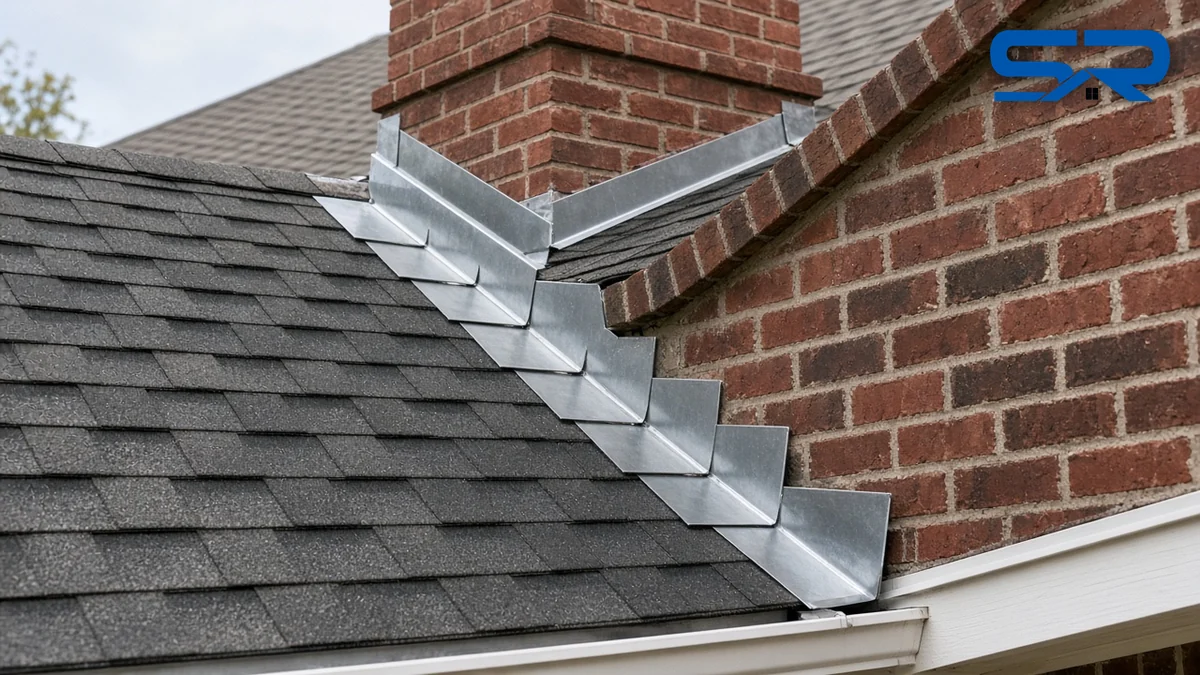
Why most roof leaks start at the flashing is a lesson I learned the long way: on a leak call, I rarely find a hole in the middle of a clean roof field. I find a wall, a chimney, a pipe, a valley or a gable edge where the metal that should have turned the water was missing, reused, unsealed or never installed at all.
I’m Blake Snow. I’ve been roofing for 30 years, I’m the third generation in a family business that goes back 75 years, and we repair and replace flashing on homes and businesses in Decatur, Fort Worth and across DFW. If you already know you need that work, start here: roof flashing repair and replacement. The rest of this post is why the flashing, not the field, is usually the leak.
The field sheds water. The joints have to turn it.
A shingle or a metal panel is good at one job: shedding water down the slope. The moment that slope hits a wall, wraps a chimney, drops into a valley, or ends at a gable, the water has to change direction. Flashing is the formed metal that gives it a path back onto the roof or into a gutter, instead of into the deck or the wall cavity.
GAF, in Technical Advisory Bulletin TAB-R-121, calls poorly manufactured and installed flashings the number one cause of roof leaks, and says they are hard to repair after the fact. The International Residential Code, Section R903.2, requires flashing that keeps moisture out at those intersections, around openings, and at the spot where a sloped roof’s eave meets a vertical sidewall. That last one is the kick-out, or diverter. When I crawl a roof after a stain shows up on a ceiling in Decatur or Fort Worth, those are the places I look first.
The five details that get missed
Step flashing is the series of L-shaped pieces woven with each shingle course along a wall or a chimney side. It has to be new on a reroof, sized to the new shingle, and covered at the top by siding or by counter flashing cut into the masonry. A single long piece of L-metal caulked at the top is the shortcut GAF warns against, and reused bent steps from the old roof are the other one. See step flashing replacement.
Counter flashing is the cap that covers the top of that base metal. On brick or stone it should be cut into a mortar joint, or reglet, and sealed, not just smeared with caulk that the North Texas sun will split. The cap and the steps are not nailed to each other; the wall and the roof need to move on their own.
Chimney flashing is those pieces working together on all four sides of the chimney: an apron on the front, steps on the sides, counter flashing in the brick, and a back pan or cricket on the high side so water doesn’t pond against the masonry. The code requires a cricket on wider chimneys; we install the whole wrap as a system. See chimney flashing repair.
Kick-out flashing, which some people call return flashing, is the diverter at the bottom of a roof-to-wall run. Without it, the last step dumps water behind the siding. That is a very common stain on a two-story wall above a garage or porch roof, and the code requires a flashing that turns the water away from that corner. See kick-out flashing installation.
Gable end and rake flashing is the drip edge and rake trim along the sloped edge of the roof. The code requires drip edge at the eaves and the rakes on a shingle roof. Missing or rusty edge metal is how wind and water get under the first course and behind the fascia. See gable end flashing. On commercial roofs, a termination bar is the compression bar that clamps a TPO or EPDM wall flashing, usually with counter flashing over the top.
What we do instead of hoping the old metal still works
On a reroof, we install new step flashing rather than bending the old pieces back into place. GAF’s TAB-R-170 recommends replacing metal flashings whenever possible, and only contemplates reuse when the metal is in like-new condition and still the right size for the new shingle. If the new shingle has a different exposure, the old steps have to go anyway. On masonry we cut in and seal new counter flashing. At roof-to-wall ends we install a kick-out. On chimneys we do the apron, the steps, the cap and the back pan or cricket as one job. On standing seam we use the matching sidewall, headwall, rake and Z-closure trim, in 24 or 26 gauge, formed on our own roll formers — not leftover shingle flashing under a metal roof.
We’re certified with GAF, CertainTeed, Owens Corning, Atlas, Johns Manville, Carlisle, Tropical Roofing Products, Mule-Hide and Enviroshake, and many other roof manufacturers. We’re BBB A+ rated, fully insured, and we have 5.0 stars on Google at all three offices: Bridgeport, Decatur and Rhome. Every visit comes with a free, itemized written estimate and a digital photo report.
If a flashing repair will keep the roof watertight, that’s what I’ll recommend. If the roof around it is done, I’ll tell you that too. Call (817) 733-9228 or request a free estimate, and we’ll find the joint that’s actually leaking.