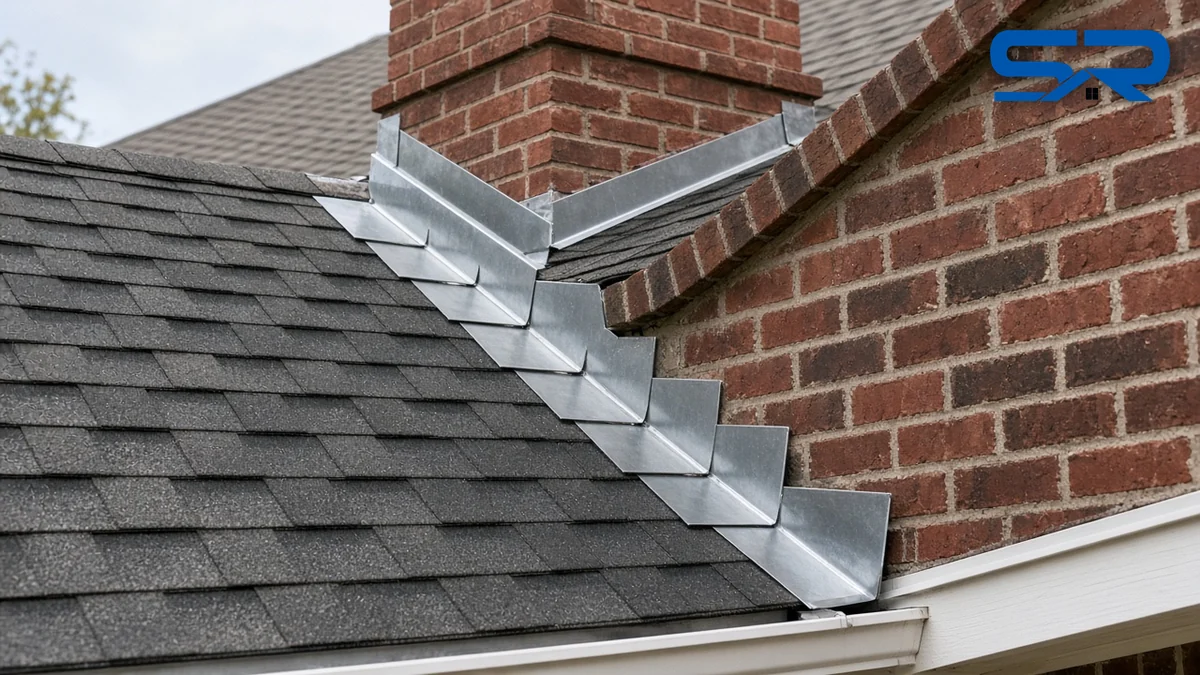
The flashing we repair and replace
Flashing is the formed metal that sheds water at every place the roof stops, turns or meets a wall. The field of shingles or panels sheds most of the rain. The flashing is what keeps the joints watertight. Pick the detail you need, or call us and we'll find it on the roof.
Step flashing replacement
New step flashing woven with each shingle course at walls and chimney sides. We don't reuse bent or undersized pieces on a reroof.
Step flashing → MasonryCounter flashing repair
Cap flashing cut into a masonry reglet or mortar joint and sealed so it covers the base flashing and can move with the wall.
Counter flashing → ChimneysChimney flashing repair
Apron, step and counter flashing, plus a back pan or cricket on the high side, so the chimney doesn't leak into the house.
Chimney flashing → Roof-to-wall endKick-out flashing installation
A diverter — sometimes called return flashing — that turns water into the gutter instead of into the wall at the bottom of a roof-to-wall run.
Kick-out flashing → EdgesGable end & rake flashing
Rake trim and drip edge at the gable, so wind-driven rain can't get under the edge of the roof or behind the fascia.
Gable flashing → CommercialTermination bar installation
A compression bar that clamps a TPO, EPDM or modified-bitumen wall flashing, usually with sealant and a counter flashing over the top.
Termination bar →Why flashing keeps a roof watertight
Water runs downhill until something stops it or turns it. A wall, a chimney, a pipe, a valley or a gable end is that something. Flashing is the metal path that takes water from those spots back onto the roof or into a gutter, instead of into the deck or the wall cavity. When flashing is missing, undersized, unsealed, or reused after it was bent on a tear-off, that path breaks, and the leak shows up as a stain on a ceiling or as soft sheathing years later.
The International Residential Code, Section R903.2, requires flashing that keeps moisture out at copings, parapets and every penetration through the roof. Section R903.2.1 says flashing must be installed at wall and roof intersections, wherever the roof changes slope or direction, and around roof openings. It also requires a flashing that diverts water away from where a sloped roof's eave meets a vertical sidewall — that is the kick-out, or diverter. Where the flashing is metal, the code calls for corrosion-resistant metal at least 0.019 inch thick (No. 26 galvanized sheet). Most North Texas cities adopt the IRC, sometimes with local amendments, so we follow the adopted code and the roof manufacturer's instructions on every job.
GAF, in Technical Advisory Bulletin TAB-R-121, calls poorly manufactured and installed flashings the number one cause of roof leaks, and says they are hard to repair after the fact. That matches what we find on inspections in Decatur, Fort Worth and around DFW: the field of the roof is often still doing its job, and the leak is at a flashing.
What we do on every flashing job
- We trace the leak and photograph the flashing, the deck around it and the inside stain, then put the findings in a free digital photo report.
- On a reroof we install new step flashing rather than reusing old or bent pieces, and we size it to the new shingle's exposure.
- On masonry we cut in and seal counter flashing so it covers the base flashing and is not nailed to the roof.
- Where a sloped roof dies into a wall at the eave, we install a kick-out (diverter) flashing that turns water into the gutter.
- On chimneys we install the apron, step and counter flashing as a system, and we add a back pan or cricket when the code or the drainage calls for it.
- On standing seam and other metal roofs we use the matching sidewall, headwall, rake and Z-closure trim, not leftover shingle flashing.
We're certified with GAF, CertainTeed, Owens Corning, Atlas, Johns Manville, Carlisle, Tropical Roofing Products, Mule-Hide and Enviroshake, and many other roof manufacturers. We form standing seam and R-panel in 24 or 26 gauge steel on our own roll formers, with a metal lead time of typically 1 to 2 weeks.
Do roofers replace flashing when replacing a roof?
We do. GAF's Technical Advisory Bulletin TAB-R-170 recommends replacing metal flashings whenever possible on an asphalt-shingle reroof. Reuse is only contemplated when the metal is in like-new condition — no corrosion, tearing or tear-off damage — and when the piece is still the right size for the new shingle. Step flashing length has to match the new shingle's exposure; if the new shingle is a different size, the old flashing has to go, no matter how it looks. Removing the old metal also lets us see the deck at the wall, which is where hidden rot often starts. Plastic pipe flashings get replaced with metal. We would rather put new metal in than bet your new roof on flashing that already had a life.
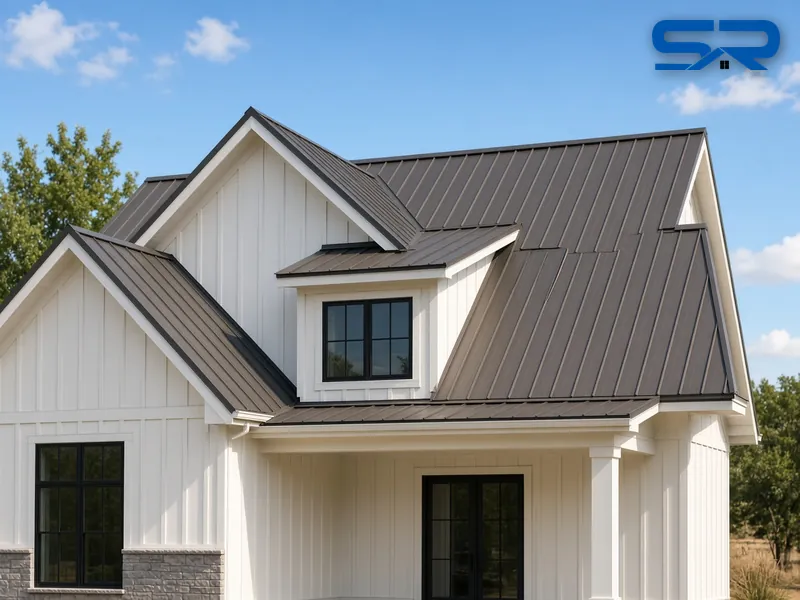
Metal roof flashing: standing seam trim and Z-closures
On a standing seam metal roof, the panels themselves are only part of the watertight system. The edges and walls are closed with formed trim: drip edge at the eave, rake trim at the gable, sidewall and headwall flashing at walls, and valley metal where two slopes meet. A Z-closure (sometimes called a zee closure) is the hat-shaped piece that sits on the panel, usually in butyl tape, and gives the sidewall or headwall trim a solid, sealed ledge to land on. Manufacturer install guides call for that closure to be sealed and fastened, then for the trim to be riveted or hooked to it, with counter flashing over the wall leg where the wall is masonry or siding. We install the trim and closures that belong to the panel, in the same color as the roof. Shingle step flashing is not a substitute. See also our earlier note on metal roof flashing details.
Headers, aprons, valleys and pipe boots
A few other flashings show up on almost every house, so they belong in the same conversation even though they have their own shapes:
- Headwall or apron flashing is the continuous piece at the front of a chimney or at a wall the roof runs down into. It sheds water off the high side of that wall onto the shingles or panels below.
- Valley flashing lines the channel where two roof planes meet. It has to be wide enough, lapped correctly and left open or closed according to the roof system. Debris in a valley is a common leak trigger after a storm.
- Pipe boots and vent flashings seal plumbing stacks, vents and other round penetrations. Rubber collars dry out in the North Texas sun; we replace failed boots rather than caulking over them as a permanent fix.
If you're not sure which detail is leaking, that's fine. Call (817) 733-9228 or request a free estimate. We'll find it, photograph it and tell you whether a flashing repair will do the job or whether the roof around it needs more.
Residential warranty: a workmanship warranty from 10 years up to lifetime, depending on the job, with manufacturer warranties up to lifetime. Manufacturer coverage depends on the product and brand, and on the project qualifying for that manufacturer's program. We put the exact warranty for your roof in writing.
Certified, with 30 years installing every major roofing brand, a family roofing business going back 75 years, and over $80 million in completed roofing projects. 5.0 stars on Google at all three of our offices.
Request a free inspection or call (817) 733-9228. Small repairs are welcome too.