
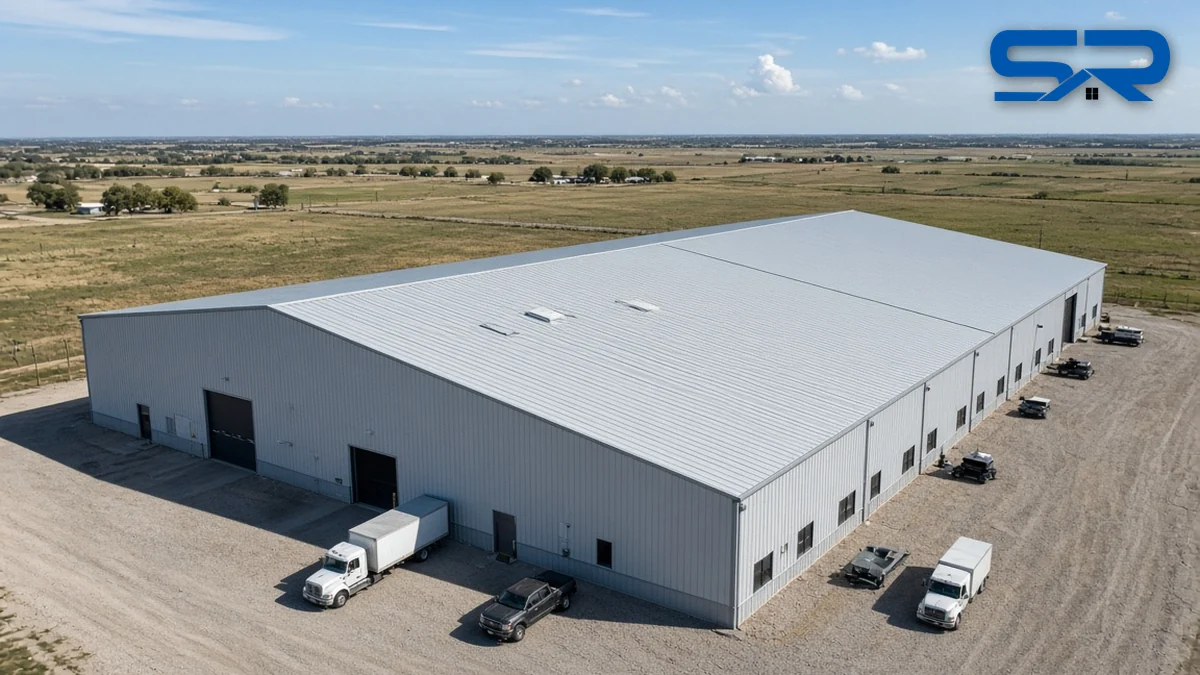
Retrofitting R-panel commercial buildings in Lake Worth comes down to one question: is the roof wearing out, or is only the hardware holding it down wearing out? I’m Blake Snow. I’ve spent 30 years on roofs as the third generation of a family roofing business that goes back 75 years, and I’ve worked on everything from shops and churches to casino roofs. In 2006, right after Hurricane Katrina, I roofed the Imperial Palace Casino in Biloxi, Mississippi. On a metal building, the honest answer is often “don’t tear it off yet.”
Lake Worth sits on the northwest side of Fort Worth along Highway 199. It has a lot of metal shops, warehouses, storage buildings and storefronts that went up decades ago with screw-down R-panel roofs. Here’s how I sort through the options when one of those roofs starts leaking.
The four ways to fix an old R-panel roof
| Option | What we do | When it fits |
|---|---|---|
| Re-screw and reseal | Replace every fastener with oversized screws and new washers; reseal laps, ridge and penetrations | Sound panels, leaks at screws and laps |
| Restoration coating | Clean, treat rust, reinforce seams and fasteners, then coat the whole roof | Sound panels, leaks roof-wide, worn or chalky finish |
| Metal-over-metal recover | New sub-framing fastened through to the purlins, then new R-panel or standing seam on top | Panels at the end of their life, but a sound frame |
| Tear-off and replace | Remove the old panels, check purlins and insulation, install new panels | Rusted-through panels, wet insulation or a damaged structure |
Most of the R-panel roofs I look at around Lake Worth, Sansom Park and Saginaw fall into one of the first three rows. A full tear-off is the right call less often than people expect.
Why R-panel roofs leak
An R-panel roof is held down by screws driven through the face of the panel, and each one has a rubber washer. After years of Texas sun, those washers dry out and crack. Daily heating and cooling also works the screws loose. Every failed washer becomes a small hole. The other usual leak points are the end laps where two panels overlap, the ridge cap, and anywhere someone cut in a vent, an exhaust fan or a rooftop unit after the building was finished.
None of that means the panels are worn out, so the first job is finding out which problem you have.
Option 1: Re-screw and reseal
If the panels are solid steel with only light surface rust, replacing the fasteners is usually the best money you can spend. We pull the old screws, drive oversized screws with new washers so they bite fresh metal, and reseal the end laps, ridge and every penetration. It fixes the actual cause of most metal building leaks. Our metal roof repair and restoration page covers the details.
Option 2: Restoration coating
When the fasteners and laps are failing across the whole roof and the finish is chalking, a metal roof coating system can turn hundreds of small leak points into one continuous surface. The prep is what makes or breaks it: rust treated, fasteners replaced or sealed, and seams reinforced with fabric before the coating goes on. The building stays open, and you get a bright, reflective roof. A coating won’t fix panels that are rusted through.
Option 3: New metal over the old panels
This is the retrofit most owners are really asking about. We fasten new sub-framing through the old roof into the existing purlins, then install new panels on top. The old roof stays in place and keeps the building dried in while we work, so inventory, tenants and equipment stay covered. The space between the old and new roofs is also a chance to add insulation, and on a very low roof, the new framing can add some slope.
Lake Worth has adopted the 2024 International Building Code with North Central Texas amendments. Its roof recover section allows a complete, separate system such as standing seam that carries the roof loads straight to the building’s structure without a tear-off. It does not allow a recover when the existing roof is water-soaked, too deteriorated to act as a base, or already has two coverings. So before I recommend a metal roof retrofit over the existing roof, I check:
- The frame and purlins, and whether they can carry the added load. When a job calls for it, a structural engineer reviews it.
- Moisture. Wet insulation trapped under a new roof causes trouble later, so we look for it first.
- Attachment. The new framing fastens into the structure, not just into the old panels, with tighter spacing at corners and edges for wind.
- Drainage. Gutters and downspouts sized for the new roof.
- Penetrations. Curbs, vents and skylights extended up through the new roof.
For the new roof itself, owners usually pick between commercial R-panel and mechanically seamed standing seam. R-panel is the workhorse for shops and warehouses where budget and speed matter. Standing seam costs more but has no exposed screws in the field and handles lower slopes, so there are no thousands of washers to age out again. Either way, every metal roof we install is Class 4 impact rated under UL 2218.
Option 4: Tear off and replace
If the panels are rusted through in many places, the insulation is soaked, or the purlins are damaged, a recover isn’t allowed and isn’t smart. That’s when we do a full metal building reroof and R-panel replacement. On an occupied building, we open only what we can dry in that day and plan the work around your business hours.
Hail is part of the math in Lake Worth
NOAA’s Storm Events Database lists 45 reports of hail 1.75 inches or larger within about 10 miles of Lake Worth from 2016 through September 2026, including 3-inch hail near Azle on April 25, 2026. Hail can dent panels without making a hole, and it can crack old washers and coatings. If your building was in a storm path, have it documented first. In Texas you generally have 1 year from the date of loss to file a claim, but check your policy.
Why owners call us for this work
- Our own roll formers. We form R-panel and standing seam in 24 or 26 gauge, cut to the length of each run, so long buildings get one-piece panels with no end laps. Lead time is typically 1 to 2 weeks.
- Real warranties. Our workmanship warranty runs from 10 years up to lifetime, depending on the job. Manufacturer NDL warranties typically run 10 to 40 years, depending on the manufacturer and system approval. We don’t promise a term until the manufacturer approves the job.
- We pull the permit. Lake Worth has its own commercial roofing permit application, and we handle it.
We’re certified with GAF, CertainTeed, Owens Corning, Atlas, Johns Manville, Carlisle, Tropical Roofing Products, Mule-Hide and Enviroshake, and many other roof manufacturers, and every roof is installed to manufacturer specs by certified installers. We’re BBB A+ rated and fully insured, and we have 5.0 stars on Google at all three offices: Bridgeport, Decatur and Rhome.
We also work on commercial metal buildings in Lakeside, River Oaks, White Settlement, Azle and across Fort Worth. See our commercial metal roofing and warehouse roofing in Fort Worth pages for more.
Let’s look at your building
The first step is a free inspection with a digital photo report, so you can see what I see before you decide anything. Call (817) 733-9228 or request a free estimate, and I’ll walk the roof with you.