
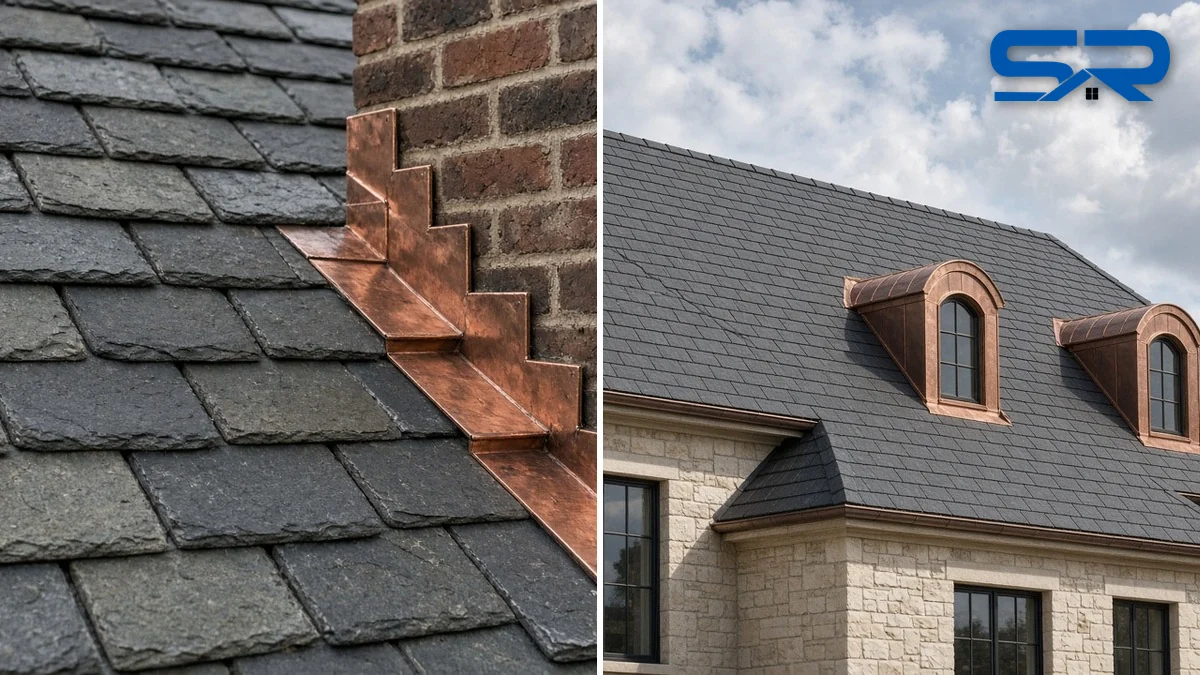
Preston Hollow has some of the best rooflines in Dallas: big masonry chimneys, steep slate and tile roofs, and dormers on every side. Those are also the places that leak. On a fine roof, the chimney and dormer details deserve the same quality as the roof, and copper is still the best material I know for them.
I’m Blake Snow. I’ve been roofing for 30 years, and we fabricate and install copper caps, crickets, flashings and dormer roofs on slate, tile and shake roofs across Dallas and the Park Cities. Here’s how it’s done right, based on the Copper Development Association’s Copper in Architecture Design Handbook and the International Residential Code.
The short version
| Detail | What the references say | What I add on the job |
|---|---|---|
| Cricket | IRC R903.2.2: required on the ridge side of any chimney over 30 inches wide; sheet metal or same material as the roof. CDA: 16 oz copper minimum | Sized to the chimney so the cricket slopes match the roof and water clears both sides |
| Chimney apron and cap flashing | CDA: 16 oz minimum | Cap flashing let into the mortar joints, not caulked to the face |
| Chimney base flashing | CDA: 16 oz on shingles, 20 oz recommended on slate or tile | We use the heavier weight on slate and tile |
| Dormer flashing | CDA: 12 oz minimum; aprons at least 16 oz | Woven with the roofing, extended under the siding |
| Chimney cap (masonry) | IRC R1003.9.1 spark-arrestor screen rules, if one is installed | Copper hood with a code-compliant screen |
| Chimney cap (prefab) | IRC R1005.1: listed, and terminated per the maker’s instructions | Only a shroud the fireplace maker allows |
Crickets: the biggest leak-stopper on a wide chimney
Water coming down a roof hits the uphill side of a chimney and has nowhere to go. A cricket (or saddle) is a small peaked roof behind the chimney that splits the water around both sides.
- The IRC (Section R903.2.2) requires a cricket on the ridge side of any chimney or penetration more than 30 inches wide, measured perpendicular to the slope. The cricket covering must be sheet metal or the same material as the roof.
- The CDA handbook says if a chimney sits entirely on one side of the ridge, a copper cricket must be used on the high side, formed from at least 16 oz copper. It can be one piece, or two pieces joined by a standing seam at its ridge.
Many older chimneys in Dallas are wide enough to need one, and plenty don’t have one or have one that’s too flat. When we re-roof or re-flash, we build the cricket frame first, then sheet it in copper.
Chimney flashing: two ways to do it right
The CDA handbook shows two methods.
1. Step flashing woven with the roof. A separate copper base flashing piece goes in with each course of slate, tile or shingle. Each piece extends 2 inches above its course, stays 1/2 inch above the butts of the next course, and runs at least 4 inches up the wall and onto the roof. A one-piece cap (counter) flashing goes into a reglet in the masonry, is held with lead wedges, and the reglet is sealed. The handbook says no step should be more than three bricks high, and the cap flashing should cover at least 4 inches of the base flashing.
2. A runner flashing under the roofing. One continuous copper piece goes on before the roofing, with a hooked edge to keep water from running under the slate or tile, cleated every 12 inches. It runs at least 8 inches up the wall, with a two-piece receiver and counterflashing above it.
On the downhill side, a copper apron laps over the roofing below. The handbook says the apron joints with the base sheets are soldered.
What I see go wrong most: counterflashing that’s only caulked to the face of the brick, step pieces that are too short, and painted steel or aluminum next to copper. Caulk is a maintenance item. A reglet with proper counterflashing is a permanent detail.
Custom copper chimney caps
A good chimney cap keeps rain, birds and animals out of the flue and protects the crown. Copper caps look right on a Preston Hollow home and age with the rest of the copper.
On a masonry chimney, if the cap includes a spark arrestor, the IRC (Section R1003.9.1) sets the rules:
- The arrestor’s net free area must be at least four times the net free area of the flue outlet it serves
- The screen must have heat and corrosion resistance at least equal to 19-gauge galvanized or 24-gauge stainless steel
- Openings must stop a 1/2-inch sphere but let a 3/8-inch sphere through
- It must be accessible for cleaning, with a removable screen or cap
So a copper cap usually means a copper hood and skirt with a code-compliant screen. We measure every flue, because a cap that chokes the draft is worse than no cap.
On a factory-built (prefab) fireplace, the chimney and its termination cap are a listed system. The IRC (Section R1005.1) requires factory-built chimneys to be installed and terminated per the manufacturer’s instructions. A copper chase cover or decorative shroud is fine only when the fireplace maker allows it. We check the model before we design anything.
Copper dormers
Dormers are flashed much like chimneys, according to the CDA handbook, but the cap flashing is simpler because the walls are framed instead of masonry. The upper edges of the base flashing tuck under the siding.
- Weights: dormer flashing at least 12 oz copper; aprons at least 16 oz
- Step flashing pieces extend at least 4 inches onto the roof and 8 inches up the wall, and the apron joint is soldered
- Apron at the sill laps over the roofing below, cleated at 12 inches on center maximum along the lower edge
- With runner flashing, joints lap 6 inches in the direction of water flow
For a full copper dormer roof, a standing seam or flat-lock copper roof over the dormer is a beautiful upgrade. Our Revere copper and bay roofs post covers sheet weights and warranty fine print.
Three things that ruin copper work
1. Mixing metals. The CDA ranks copper near the top of its nobility table. In contact with aluminum or zinc, copper causes those metals to corrode, and the CDA warns that water washing off copper should not drain onto exposed aluminum. Watch for aluminum gutters and downspouts below a new copper cricket or dormer.
2. Staining light stone. The CDA says slow runoff from copper picks up copper salts, and when that moisture soaks into porous stone like limestone or marble, it leaves green stains. On a limestone chimney, we design drip edges so copper wash stays off the stone.
3. Water concentrated on small copper parts. The CDA describes “erosion corrosion” when acidic rain runs off a large slate, tile or asphalt roof onto a small copper flashing or gutter before it develops its patina, and “line corrosion” where shingles rest directly on copper and hold moisture. The fix is a raised edge (cant strip) or a replaceable strip under the roofing edge.
How it ages
New copper is bright, then turns brown and, over many years, can go green, depending on exposure. The CDA notes that chemical coloring can work on small areas such as flashings and chimney caps, but is impractical on large areas like roofs. If you want new caps to match aged copper on the house, we can talk through options.
Dallas permits
The City of Dallas building inspection FAQ says no permit is needed to re-roof a single-family or duplex home only when the work is $500 or less, and that historic districts, conservation districts and planned development districts can have additional requirements. Most chimney and dormer re-flashing jobs run more than that. We check permits and district rules on every job.
After hail
Hail can dent copper caps, crickets and dormer roofs, and crack the slate or tile around them. Get a free inspection with drone and thermal imaging and a digital photo report. You can look up past storms in NOAA’s Storm Events Database. In Texas you generally have 1 year from the date of loss to file a claim, but check your policy.
What goes on our copper quotes
- Copper weight for each part (cricket, base, cap, apron, dormer)
- Step or runner flashing, and how the counterflashing goes into the masonry
- Cricket size and framing
- Cap design, flue measurements and screen spec (or the prefab maker’s approved shroud)
- Separation from aluminum and zinc, and drip details near stone
- Slate or tile removal and reset around the work
- Permit and district check
- Our workmanship warranty, from 10 years up to lifetime, depending on the job
Related pages
- Copper roofing
- Copper flashing, valleys and gutters on slate and tile
- Slate and copper on turrets, mansards and complex rooflines
- Slate roofing in Preston Hollow and tile roofing in Preston Hollow
Talk to us about copper in Preston Hollow
We fabricate and install copper chimney caps, crickets, flashings and dormer roofs in Preston Hollow, Highland Park and University Park. Every roof is installed to manufacturer specs by certified installers. We’re certified with GAF, CertainTeed, Owens Corning, Atlas, Johns Manville, Carlisle, Tropical Roofing Products, Mule-Hide and Enviroshake, and many other roof manufacturers. We’re BBB A+ rated, with 5.0 stars on Google at all three offices: Bridgeport, Decatur and Rhome. Request a free inspection or call (817) 733-9228.
Sources
- Copper Development Association: Copper in Architecture Design Handbook (A4050), sections 1.3, 9.8 Stepped and Chimney Flashings and 9.10 Dormers
- International Code Council: 2021 IRC Chapter 9, Roof Assemblies (R903.2.2 Crickets and saddles)
- International Code Council: 2021 IRC Chapter 10, Chimneys and Fireplaces (R1003.9.1 Spark arrestors; R1005.1 Factory-built chimneys)
- City of Dallas: Building Inspection FAQs
- NOAA NCEI: Storm Events Database