
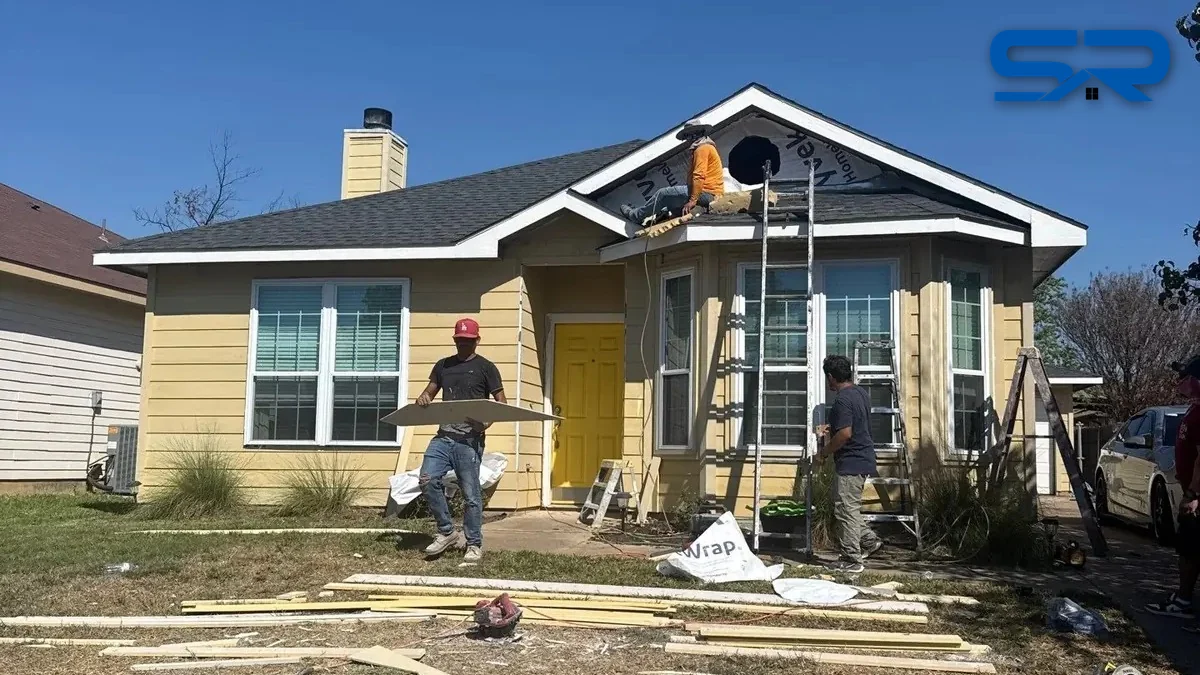
Drive through Flower Mound or Highland Village and most of the houses look alike from a distance: brick or stone on the first floor, a steep roof, tall windows, and a two-story wall or two with siding up high. That mix is exactly why window and siding work on these homes goes wrong so often. The brick lasts. The siding, trim and windows tucked into it don’t, and they all share the same wall.
I’m Blake Snow. I’ve been roofing and building for 30 years, our crews have completed over $80 million in roofing projects, and our own crews replace windows, siding, trim, soffit, gutters and paint. Here’s how I plan window and siding work on Flower Mound and Highland Village homes so it looks right, passes the HOA and keeps water out.
The short version
- Know where your siding is. On most of these homes it’s not the whole house. It’s the upper gables, dormers, chimney chases, bay boxes and second-story walls over a roof.
- Plan windows and siding together. If both are coming, do the windows first, then the siding, then trim and paint. If the roof needs work, it goes first.
- Flash every window into the wall behind it, whether that wall is brick, stone or siding. Caulk is not flashing.
- Build for wind-driven rain. Homes near Lewisville Lake and on open lots take rain sideways, especially on upper walls.
- Permits are required. Flower Mound requires one for window and door replacement. Highland Village requires one for windows, doors and replacing siding.
Where the siding is on a brick and stone two-story
Most siding companies quote “the siding” like it’s a whole house of it. On a typical Flower Mound or Highland Village two-story, it’s a set of hard-to-reach pieces:
| Where | What usually goes wrong | What we do |
|---|---|---|
| Upper gables over brick | Swelling or rot at the bottom edge where it meets the brick ledge; hail splits and chips | Replace with a matching profile, flash the brick ledge, keep the bottom edge off the masonry and seal and paint cut ends |
| Second-story wall over a lower roof | Rot where siding meets the shingles; missing kick-out flashing at the eave | Step flashing and kick-out flashing, siding held off the roof, new trim |
| Chimney chase | Rot at the chase cap and corners; water into the framing | Rebuild trim, new siding, new chase cover so water can’t sit |
| Dormers | Rot at dormer cheeks and window trim; leaks that show up as ceiling stains | Siding, step flashing and window flashing done together |
| Bay boxes and boxed-out windows | Rotted trim and bottom boards, gaps at the brick | New framing where needed, flashing, trim and paint |
| Soffit and fascia | Hail and woodpecker damage, rot at gutter lines | See soffit and fascia |
We install any kind of siding: fiber cement, engineered wood, vinyl, wood, metal and more. On a brick home, the goal is to match the existing profile and exposure on the pieces you’re keeping, or to change it everywhere on purpose. See siding services.
Windows on these homes: what to look for
Two-story brick and stone homes in these towns tend to have tall stacked windows over the entry, arched tops, a big family-room wall of glass facing the backyard and a mix of shapes on the front. When we look at a house, we check:
- Every opening, measured in the field. Arched and stacked units are custom. We don’t order off old plans.
- The wall around each window. A window in brick is flashed differently from one in a siding wall. Many homes have both.
- Signs of past leaks: stained drywall under sills, soft trim, cracked mortar below corners, peeling paint on window trim on the upper floor.
- Glass that has to be safety glass near doors, tubs, stairs and pools, and bedroom windows that have to meet emergency escape rules.
- The look from the street: frame color, grid pattern and sightlines that match across the front.
We install all brands of windows, including our own private label, Snow Vinyl Windows. Vinyl gives strong value and low upkeep. Fiberglass and composite frames stay stable in Texas heat and come in darker colors and slimmer profiles. Wood-clad gives a real wood interior. If you’re going from white or tan frames to black or bronze, check the HOA first. See window replacement, and my post on window replacement on luxury Colleyville homes for more on frame material, sightlines and glass.
Which comes first: windows, siding or both
| Your situation | What I recommend | Why |
|---|---|---|
| Windows and siding both need work | One project: windows, then siding, then trim and paint | Each window gets flashed into new weather barrier; nothing gets cut open twice |
| Only windows, in a siding wall | Remove siding and trim around each window, flash it properly, re-side and paint | Sliding a new window into the old opening with caulk is how upper-floor leaks start |
| Only windows, in brick or stone | Pan and head flashing, proper sealant joints, keep brick weeps open | Brick holds water; the window has to let it drain out, not in |
| Only siding | Check every window and door in that wall before closing it up | If a window is near the end of its life, now is the cheap time to swap it |
| Roof is also due | Roof first, then windows, then siding and paint | Roof work disturbs step and kick-out flashing that tie into the siding |
Doing it in this order is also how you get one clean paint job at the end instead of patching. We use Sherwin-Williams but will use any paint you want. See exterior painting.
Flashing: where most leaks start
On these homes, the leaks I see most are not in the middle of a wall. They’re at the edges:
- Sill pans so water that gets past a window drains back out.
- Side flashing, then head flashing, lapped in order over the house wrap so water always runs over the layer below it.
- A head flashing or drip cap over windows in brick so water running down the wall is kicked out.
- Kick-out flashing where a roof edge dies into a siding or brick wall. Without it, water runs straight into the wall behind the gutter end.
- Step flashing at every dormer and second-story wall over a roof, tied into new siding.
- Sealant joints sized right, with backer rod, and brick weep holes left open so the wall can drain.
Lake wind and wind-driven rain
Highland Village and the east side of Flower Mound sit on Lewisville Lake, and a lot of lots in both towns face open ground. Wind gives rain a sideways push, and the second floor takes it hardest. That’s why upper gables and dormers rot first. On those walls we pay extra attention to house wrap laps, window head flashing, trim joints and paint on cut ends, and we make sure gutters and downspouts carry roof water away instead of sheeting it down a wall. See gutter services.
Hail and storm damage to windows and siding
NOAA’s Storm Events Database lists hail of 1.75 inches (golf-ball size) or larger within about 10 miles of each town from 2016 through September 2026:
| Town | Reports of 1.75 in. or larger hail |
|---|---|
| Flower Mound | 56 |
| Highland Village | 55 |
After a big storm, check more than the roof. Look for cracked or chipped siding on the side the storm came from, dents in metal window wraps and gutters, torn screens, cracked glass, and split trim. Photograph it before anything is patched. If the siding or windows are damaged, they can usually go on the same claim as the roof. Texas generally gives you 1 year from the date of loss to file a claim; check your policy. See storm damage, Flower Mound storm damage and Highland Village storm damage.
Permits and HOA
- Flower Mound: the town’s residential permit guidelines say replacing exterior doors and windows requires a permit, and replacement units have to meet the town’s adopted energy code.
- Highland Village: the city’s permit list includes new windows and doors and replacing siding, along with re-roofing.
We pull the permits. HOA approval is separate. Committees in these neighborhoods usually look at frame color, grid pattern, window style on the front, siding profile and paint colors, so get the approval in writing before anything is ordered. We’ll provide product sheets and color samples for the submittal.
Before you sign: 12 questions for any window and siding bid
- Who does the work, your own crew or a sub?
- Did you measure every opening, including the arched and stacked windows?
- Are windows and siding sequenced as one project, and in what order?
- How is each window flashed in a brick wall? In a siding wall?
- Is new house wrap included behind the new siding?
- Where are you adding step and kick-out flashing?
- What siding profile and material are you proposing, and will it match what’s staying?
- Which windows need safety glass or egress sizing?
- Is trim, soffit and fascia rot included or extra?
- Who handles the permit and the HOA submittal?
- Is paint included, and which product?
- What are the manufacturer and workmanship warranties, in writing?
Nearby towns
We replace windows and siding across southern Denton County, including Lantana, Double Oak, Copper Canyon, Argyle, Bartonville and Lewisville. If the roof is due too, see our metal roofing pages for Flower Mound and Highland Village, and my posts on standing seam accents and tile and Enviroshake for these same homes.
Let’s look at your windows and siding
We’re certified with GAF, CertainTeed, Owens Corning, Atlas, Johns Manville, Carlisle, Tropical Roofing Products, Mule-Hide and Enviroshake, and many other roof manufacturers. Snow Roofing & Exteriors is fully insured, has offices in Bridgeport, Decatur and Rhome, is A+ rated on the BBB, and has 5.0 stars on Google at all three offices: Bridgeport, Decatur and Rhome. References are available on request. Our workmanship warranty runs from 10 years up to lifetime, depending on the job.
Call (817) 733-9228 or request an estimate, and I’ll walk the house with you, check every window and every siding wall, and lay out the order that gets it done once.