What kick-out, or return, flashing is
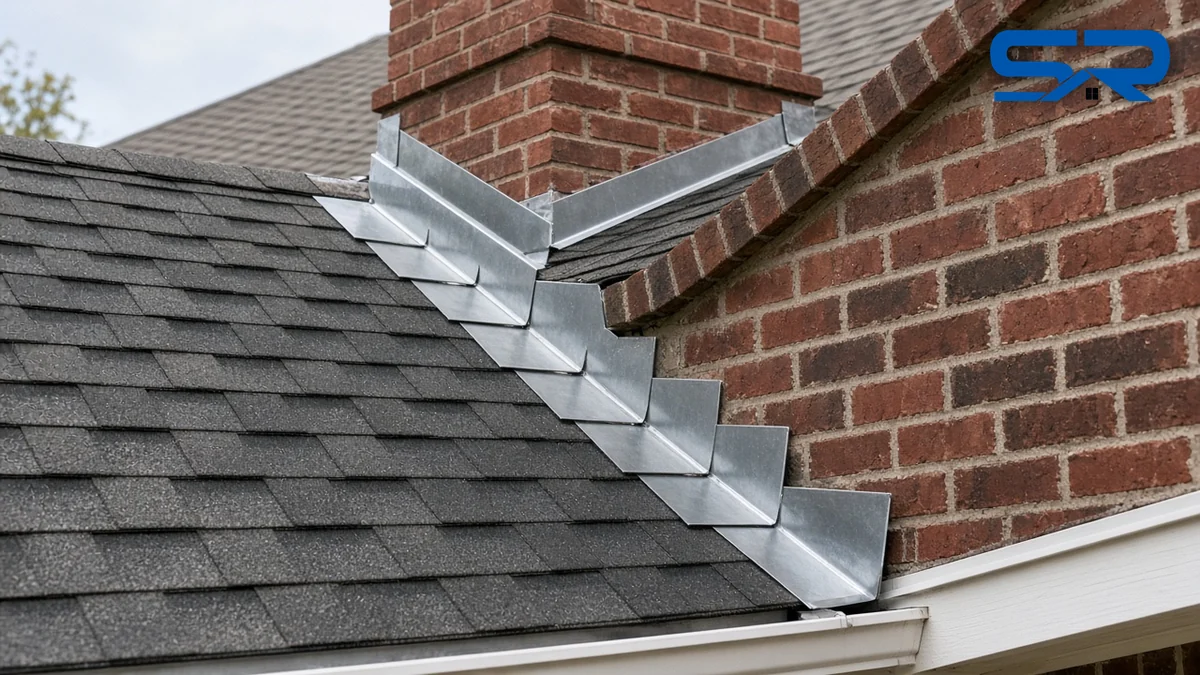
Kick-out flashing is a diverter at the end of a roof-to-wall intersection, where the eave of a sloped roof meets a vertical sidewall. It "kicks" the water running down that wall line out into the gutter or onto an open eave, instead of letting it run behind the siding, into the soffit, or down the inside of the wall. Homeowners and some crews call this return flashing. In the trade, and in the code, it is a kick-out or diverter flashing, and that is the piece we mean when we use either name.
The International Residential Code, Section R903.2.1, requires "a flashing… to divert the water away from where the eave of a sloped roof intersects a vertical sidewall." The U.S. Department of Energy's Building America Solution Center describes installing that kick-out at every such intersection, large enough for the stormwater the roof will actually send it, preferably as a seamless prefabricated piece or a well-soldered metal piece, and integrated with the step flashing, underlayment, house wrap and siding. Siding should end above the roof, not sit down in the water path, so the kick-out can do its job. This is one of the flashings the code added because so many walls rot at that exact corner.
Where it goes, and how it fails
You'll see the need for one at a garage roof that dies into a two-story wall, a porch or patio roof against the house, a dormer sidewall at the eave, or any lower roof that ends at siding. The failure is usually that the piece was never installed. Water follows the last step flashing into the wall, and the stain shows up inside, at the ceiling line, or as soft sheathing and peeling paint on the siding. An undersized, unsealed, or poorly folded shop-made diverter can leak at the folds. A gutter that stops short of the kick-out also leaves the water with nowhere to go.
What we do on every kick-out flashing job
- We install a kick-out, or diverter, flashing at every place a sloped roof's eave meets a vertical sidewall.
- It is integrated with the step flashing above it, the underlayment, and the gutter below it, so the water has a continuous path off the building.
- We use a piece large enough for a North Texas downpour, not a tiny fold that overflows in the first storm.
- On a repair, we open the siding or trim as needed, fix any hidden rot we find, and put the wall and the flashing back as a system.
We're certified with GAF, CertainTeed, Owens Corning, Atlas, Johns Manville, Carlisle, Tropical Roofing Products, Mule-Hide and Enviroshake, and many other roof manufacturers.
Kick-out flashing on a metal roof
On standing seam, the sidewall trim is usually continuous, and the kick-out is formed at the bottom of that trim, or as a matching diverter, so the water still turns into the gutter. We install that detail with the rest of the metal trim, in the same color as the 24 or 26 gauge panels we form on site.
If a wall is staining where a roof dies into it, call (817) 733-9228 or request a free estimate. A missing kick-out is a common cause, and it is one we can fix.
Residential warranty: a workmanship warranty from 10 years up to lifetime, depending on the job, with manufacturer warranties up to lifetime. Manufacturer coverage depends on the product and brand, and on the project qualifying for that manufacturer's program. We put the exact warranty for your roof in writing.
Certified, with 30 years installing every major roofing brand, a family roofing business going back 75 years, and over $80 million in completed roofing projects. 5.0 stars on Google at all three of our offices.
Request a free inspection or call (817) 733-9228. Small repairs are welcome too.