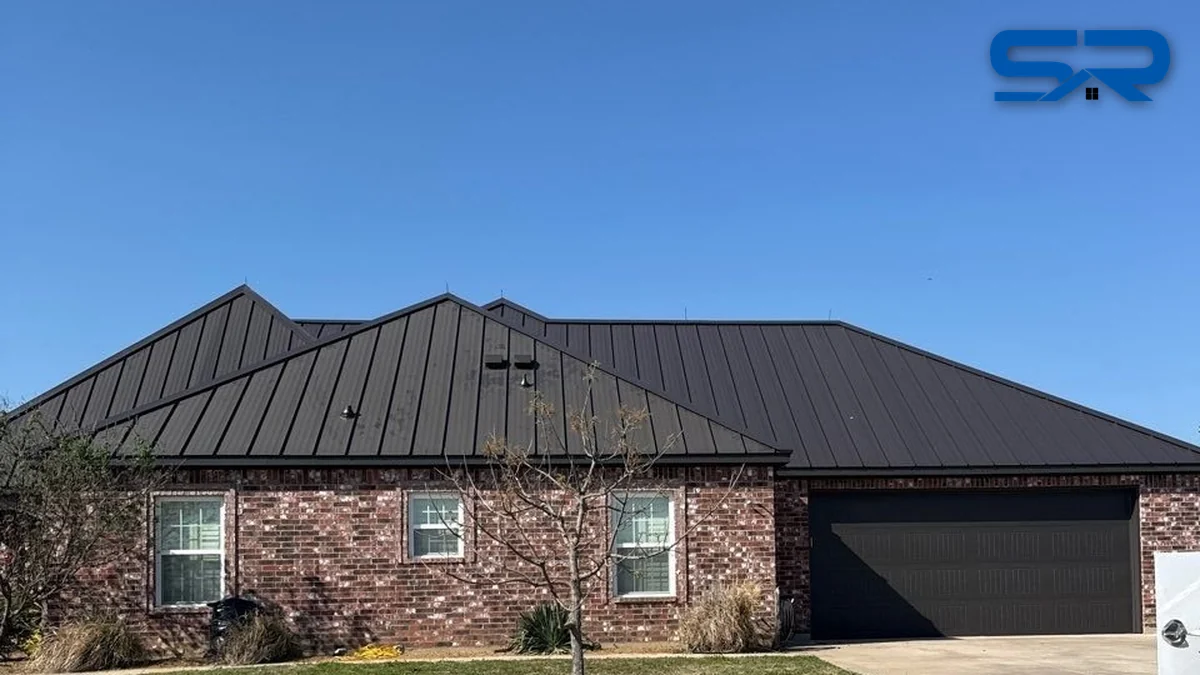
What’s the best roof for Fort Worth climate? My honest answer is metal first. When a homeowner asks me which roof I recommend most for Fort Worth heat, hail and wind, here is exactly what I tell them: “First and foremost, I would recommend metal, but depending on the aesthetics of the house and the style and architecture of the house, a Class 3 or Class 4 shingle will do just fine as well. Metal will just last a lot longer, especially if you go with the standing seam concealed fastener system.”
I’m Blake Snow. I’ve been around and in the roofing business for almost 40 years, and the Snow family roofing legacy has been in this market for 75 years. Below is the reasoning behind that answer, how to tell which side of it your Fort Worth home falls on, and what to get in writing either way.
What Fort Worth weather actually does to a roof
You don’t need a sales pitch to know Fort Worth is hard on roofs. The National Weather Service’s 1991-2020 normals for Dallas/Fort Worth show about 106 days a year at 90°F or hotter, about 20 days at 100°F or hotter, and about 29 nights at or below freezing (NWS Fort Worth climate normals). July and August average highs sit near 96°F. That’s a lot of expansion and contraction every year.
Then there are the storms. NOAA’s Storm Prediction Center logged all of these around Fort Worth in 2026 alone:
- April 17: a 61 mph wind gust at Fort Worth Alliance Airport (SPC reports, April 17, 2026).
- April 28: 1.25-inch hail southwest of Benbrook (SPC reports, April 28, 2026).
- August 26: 1 to 1.5-inch hail near Alliance in the Golden Triangle area (SPC reports, August 26, 2026).
- September 11: golf ball size hail south of Arlington and quarter size hail northeast of Benbrook (SPC reports, September 11, 2026).
You can look up older storms for Tarrant County in NOAA’s Storm Events Database. So the right roof here has to handle three things at once: long, hot summers, hail, and straight-line wind.
Why I recommend standing seam metal first
It lasts. In my experience, standing seam usually lasts 40 to 50 years at minimum. I covered why in how long a metal roof lasts in North Texas.
The fasteners are hidden. That’s the part most people miss. Exposed-fastener panels like R-panel and PBR are screwed through the face, and in Texas heat the rubber washers on those screws usually start breaking down somewhere between 7 and 12 years. Standing seam is a concealed-fastener system. The clips sit under the panel, so there are no washers out in the sun to wear out. R-panel still has its place on shops and barns, and we install it every week.
It’s built for hail and wind here. Every metal roof we install is Class 4 impact rated under UL 2218. We use 24 or 26 gauge panels, and we run our own roll formers, so panels are formed in one piece from ridge to eave. No seams in the middle of a run means fewer places for wind-driven rain to get in. Large hail can still dent metal, and a dent is not always a leak. I’d rather tell you that now than after a storm.
It’s installed to the deck. We tear off to the deck so any bad decking gets replaced and the clips fasten into solid wood, not through an old roof.
See our standing seam in Fort Worth page or the bigger picture on metal roofing in Fort Worth.
When a Class 3 or Class 4 shingle does just fine
Not every house wants a metal roof. A traditional two-story with lots of hips and valleys, a neighborhood with a certain look, or a homeowner who plans to sell in a few years can all point toward shingles. That’s an honest choice, not a lesser one.
Every shingle roof we install is Class 3 impact rated or better, and in Tarrant County I usually steer people toward Class 4 impact-resistant shingles. UL 2218 Class 4 means the shingle passed a 2-inch steel-ball impact test; Class 3 passed a 1.75-inch ball. Neither is hail-proof. My Class 3 vs. Class 4 guide goes deeper. Ask your insurance company whether it offers a credit for impact-rated roofs; that’s their call, not ours.
What a shingle roof won’t do is last as long as standing seam. Heat ages asphalt from above and a hot attic ages it from below, which is why ventilation matters so much on a shingle roof. I walked through that in roof decking and attic ventilation.
A quick way to decide for your house
| If this sounds like you | I’d usually point you toward |
|---|---|
| You plan to stay 15+ years and want the longest life | Standing seam metal |
| Ranch, farmhouse, modern, lake or acreage home | Standing seam metal |
| You want metal durability with a shake or tile look | Stone-coated steel |
| Traditional style, HOA look, or a shorter stay | Class 4 shingles |
| A tight budget for now, but you still want hail protection | Class 3 or Class 4 shingles |
For a side-by-side, see our metal vs. Class 4 shingles guide. If you’re leaning metal, my post on Fort Worth metal roofs for homes covers which metal fits which house and what the city requires.
What about tile, slate and other roofs?
We install tile, slate, synthetic and composite roofs too, and on the right architecture they’re beautiful. In a hail-heavy county, they need the right product and a structure built to carry it. If your house was designed around one of those looks, we’ll walk through the options honestly rather than push you into metal.
What to get in writing, whichever roof you pick
- Tear-off to the deck, and how bad decking is found, photographed and billed.
- The panel gauge and profile, or the shingle line and its impact rating, by name.
- How flashing at walls, chimneys and valleys is done.
- The ventilation plan.
- The warranty. Our workmanship warranty runs from 10 years up to lifetime, depending on the job. Manufacturer NDL warranties typically range from 10 to 40 years, depending on the manufacturer and system approval. We don’t promise a specific term until the manufacturer approves the job.
We’re certified with GAF, CertainTeed, Owens Corning, Atlas, Johns Manville, Carlisle, Tropical Roofing Products, Mule-Hide and Enviroshake, and many other roof manufacturers. We’re fully insured, BBB A+ rated, references are available on request, and we have 5.0 stars on Google at all three offices: Bridgeport, Decatur and Rhome.
Honest advice, and someone to call later
Snow Roofing started as a tier-one commercial company doing only large-scale work, then expanded into residential. We’ve done multimillion-dollar projects down to the average home. No job is too big or too small, Snow Roofing does them all. We honor our warranty, we’re around whenever you need us, and we do much more than roofing, from siding and gutters to full exterior work, so you have one trusted contact for the life of your home.
Start with a free roof inspection and a free digital photo report. I’ll tell you what your roof needs and which option fits your house, even if that’s a repair. We work across Fort Worth and nearby Benbrook, Haslet, Keller, Saginaw, White Settlement, Lake Worth and Aledo. Call (817) 733-9228 or request a free estimate.