
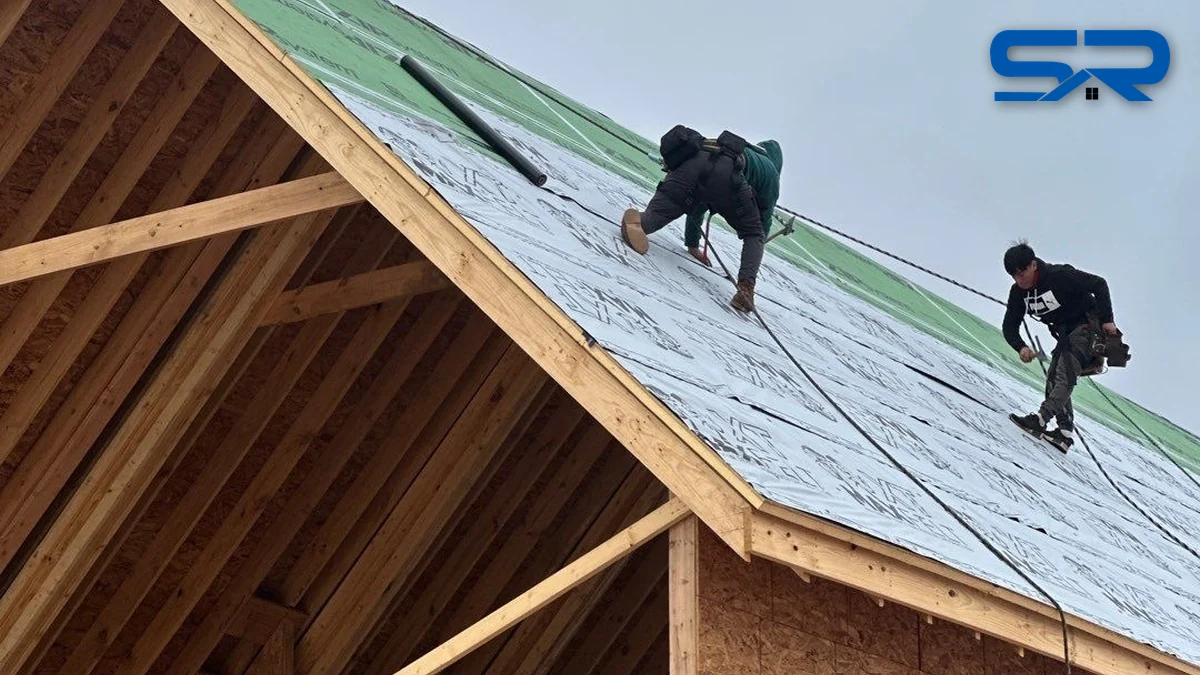
Roof decking and attic ventilation in Justin are the two parts of a premium roof you never see from the street, and they decide how long everything on top of them lasts. Shingles and metal panels get all the attention in a bid. The boards they’re nailed to, and the air moving underneath them, get one line, if they get any line at all.
I’m Blake Snow. I’ve worked on roofs for 30 years as the third generation of a family roofing business that goes back 75 years. Here’s what I look at under the roof on a Justin home, and what I’d want in writing before any re-roof starts.
Why the hidden parts matter more in Justin
North Texas puts a roof through hot attics in summer, hard freezes some winters, and hail in between. On May 24, 2026, NOAA’s Storm Prediction Center logged 1-inch hail about 4 miles west-northwest of Justin (SPC report). A new roof can shrug off weather like that only if it’s fastened to a sound deck and the attic under it isn’t cooking.
Justin also adopted the 2024 International Codes, including the 2024 International Residential Code, effective July 10, 2026 (City of Justin building inspections). Ventilation and decking rules below come from that code.
Roof decking: what it is and what bad decking looks like
The decking (or sheathing) is the plywood or OSB layer nailed to your rafters or trusses. Every nail and screw in your new roof holds only as well as that wood does. The code says asphalt shingles have to be fastened to a solidly sheathed deck (IRC R905.2.1).
Signs of trouble you can check from the attic with a flashlight:
- Dark stains or rings on the underside of the boards, usually around chimneys, valleys, vents and pipe jacks.
- Soft, swollen or flaking OSB where a slow leak has been wicking in.
- Rusty nail tips poking through, a sign of moisture building up in the attic.
- Sagging between rafters you can see as a wave along the roofline from the yard.
- Old 1x plank or skip-sheathing with gaps between the boards, found on some older homes.
What you can’t see from the attic is the top side of the deck. That’s why no roofer can promise how much decking a house needs before tear-off.
How decking gets handled on our re-roofs
Once the old roof is off, we walk the whole deck. When we find bad decking, we photograph it, show you, and replace those sections before anything else goes down. Sound boards stay. Your estimate should spell out how any extra decking is handled before work starts, so there are no surprises on the final bill. Ask any roofer, including us, to put that in writing.
Then the deck gets dried in with underlayment, plus leak barrier in valleys and at the eaves where the system calls for it. I compared the leak barrier products we use in my post on StormGuard, WinterGuard and WeatherLock.
Attic ventilation: intake low, exhaust high
A vented attic works like a chimney. Cooler air comes in low at the soffits, warms up, and leaves high at the ridge. In summer that pushes heat out. In winter it carries out the moisture that rises from the house, the same moisture that rusts nails and rots decking.
The 2024 IRC sets the minimum at 1 square foot of net free vent area for every 150 square feet of attic, or 1 per 300 when 40 to 50 percent of it sits within 3 feet of the ridge and the rest is low in the attic (IRC R806.2). It also requires at least a 1-inch air space between insulation and the roof deck at the vents (R806.3). I worked through the math for a typical house in my post on ridge vents compared.
The problems I find most often:
- Blocked soffits. Blown-in insulation buried the soffit vents, or the soffits were never vented. A ridge vent with no intake does very little. Our soffit and fascia work fixes this from outside.
- Mixed exhaust. A ridge vent plus box vents plus a power fan on the same attic. Vent makers warn against mixing exhaust types because they pull air from each other instead of from the soffits.
- Power fans with no intake. A fan that can’t pull from the soffits pulls cooled air out of your house through ceiling gaps.
- Bath fans dumping into the attic. The code requires them to vent outdoors (IRC M1501.1). Warm, wet bathroom air in the attic shows up later as stained decking.
Shingle makers write ventilation into their install instructions, and poor ventilation can become a warranty problem. A re-roof is the easiest time to fix it, because the ridge is already open.
The same rules apply under standing seam
Metal is our specialty, and I see owners assume a metal roof doesn’t care what’s underneath. It does. We run our own roll formers and our standing seam goes over a solid, flat deck with underlayment, so panels sit true and clips hold. When I switch a house from shingles to metal, taking the shingles off lets us see the decking, replace any bad boards and give the metal a flat, solid surface. See switching from shingles to standing seam for that process.
The attic under metal still needs balanced intake and exhaust, usually with a vented ridge closure at the top. On homes with living space right under the roof, condensation control matters even more; I covered that in condensation control under metal. Every metal roof we install is Class 4 impact rated under UL 2218. There is more on our standing seam in Justin page.
What to get in writing before a re-roof in Justin
- How decking is checked after tear-off, and how replacement sections are approved and billed.
- Photos of any bad decking before it’s covered.
- The underlayment and leak barrier going on, by name.
- The intake and exhaust plan: what’s there now, what’s changing, and whether soffits will be opened up.
- What happens to old box vents or power fans if a ridge vent goes in.
- The warranty in writing. Our workmanship warranty runs from 10 years up to lifetime, depending on the job. Manufacturer NDL warranties typically run from 10 to 40 years, depending on the manufacturer, the system and manufacturer approval.
We’re certified with GAF, CertainTeed, Owens Corning, Atlas, Johns Manville, Carlisle, Tropical Roofing Products, Mule-Hide and Enviroshake, and many other roof manufacturers. We’re fully insured, BBB A+ rated, and have 5.0 stars on Google at all three offices: Bridgeport, Decatur and Rhome.
Get the hidden parts checked in Justin
Start with a free roof inspection. We check the roof, the attic, the vents and the decking we can see and feel, and you get a free digital photo report. If a repair will do, I’ll tell you. If it’s time for a new shingle roof or standing seam, you’ll know what’s under it before we start. If hail came through, our Justin storm damage page covers next steps, and Class 4 shingles in Justin are worth a look.
We also work in Northlake, Argyle, Haslet, Roanoke, Ponder and Krum. Call (817) 733-9228 or request a free estimate.