If you own or manage a retail center, an office building or a church in Fort Worth and you’re pricing a standing seam metal roof, you’ll hear two words that sound like a detail but aren’t: snap-lock and mechanically seamed. Pick the wrong one for your slope and you can end up with a roof that looks right from the parking lot and leaks at the seams a few years later.
I’m Blake Snow. I’ve been in the roofing business for 30 years, I’m the third generation of a family roofing business that goes back 75 years, and my commercial work has included large casino projects. We form standing seam on our own roll formers and standing seam machine, right on the jobsite. Here’s how I’d decide between the two systems on a commercial building.
The short answer
- Steeper roofs (generally 3:12 and up): snap-lock usually does the job and installs faster.
- Low slopes (below about 3:12), long runs and exposed sites: mechanically seamed, usually double-lock.
- Very low slopes: mechanically seamed double-lock with sealant inside the seam, and only with a panel whose published data covers that slope.
That’s the rule of thumb. The rest of this post is about why, and about the parts of a commercial building where the answer changes.
How each one holds the water out
On a snap-lock panel, hidden clips are screwed to the deck and the next panel’s leg snaps down over them. No seaming tool is needed. It’s a water-shedding design: it works because the slope moves water off the roof quickly. Panel makers generally rate snap-lock for 3:12 and steeper, and some profiles are tested down to 2:12.
On a mechanically seamed panel, the clips go on and then a powered seamer runs the full length of every seam and folds the legs together, once (single-lock, about 90 degrees) or twice (double-lock, about 180 degrees). A double-lock seam is built to resist water that sits or backs up at the seam, not just water running past it. That’s why it’s the standard on low-slope commercial roofs. Some manufacturers publish their mechanically seamed panels for slopes as low as 1/2:12 in steel, with continuous sealant inside the seam below 2:12.
For the code side: the International Building Code sets 1/4:12 as the minimum slope for standing seam metal roof systems, and the City of Fort Worth has adopted the 2021 IBC with local amendments. The panel’s own minimum is often higher than the code minimum, and that’s the number that counts. We confirm it for the exact panel we quote. Our snap-lock vs. mechanical-lock page has a side-by-side table.
Where commercial buildings get tricky
The mansard out front and the flat roof behind it
A lot of Fort Worth strip centers and office buildings have a steep metal mansard on the street side and a low-slope roof behind it. Those are two different roofs. The mansard is steep and very visible, so snap-lock can be a good fit there. The roof behind it may be too flat for any standing seam and better suited to TPO or modified bitumen. Where the two meet, the flashing is often where leaks start. We see it on retail center roofs in Fort Worth often.
Open framing vs. a solid deck
Snap-lock is generally meant to go over a solid deck. Many metal buildings have panels running over purlins with no deck. On open framing, you need a panel that is engineered for that use, and that usually means a mechanically seamed system. Purlin spacing, gauge and clip spacing all have to match the panel’s engineering.
Long runs and Texas heat
Steel grows in July and shrinks in January, and a long panel moves more than a short one. One panel maker recommends clips that allow for movement on panels over about 25 feet. On a long commercial run, floating clips let the panel slide while the seam stays locked, and the panel gets pinned at one point so the movement goes the right way. Get that wrong and you hear it: popping, torn clips and stressed trim.
Long panels are also hard to ship. Because we form panels to length on the jobsite, a long run can be one continuous panel from ridge to eave, without an end lap in the middle of the roof.
Rooftop units and penetrations
Office and retail roofs carry HVAC units, exhaust fans and sign wiring. Every curb in a standing seam roof has to be flashed so water goes around it and the panel can still move. On a low slope, those details matter more than the seam type does.
Gauge and finish
Gauge is the thickness of the steel. We install standing seam in 24 or 26 gauge and match it to the building, the spans and the wind exposure. Wider flat pans and roofs with regular foot traffic often call for 24. See 26 gauge commercial metal roofing for how to read gauge on a bid. Every metal roof we install is Class 4 impact rated.
What to check on a commercial standing seam bid
Most bids I see say “standing seam metal roof” and stop there. Ask for these in writing:
- Seam type: snap-lock, single-lock or double-lock, and the seam height.
- The panel’s published minimum slope, and the measured slope of your roof.
- Seam sealant: whether the panel needs it at your slope, and that it’s in the price.
- Clips: fixed or floating, the spacing, and where the panels are pinned.
- Deck or framing: solid deck or open purlins, and whether the panel is engineered for it.
- Gauge and paint system for both panels and trim.
- Panel length: continuous runs or end laps.
- Transitions: how the metal ties into any TPO, parapet walls, gutters and rooftop units.
- Warranty: workmanship terms in writing, plus which manufacturer warranty and term applies.
Keeping the building open
Commercial roofs have tenants under them. We phase the work section by section, dry in each section the same day, schedule noisy work around business hours where we can, and provide certificates of insurance before work starts. See commercial roofing in Fort Worth for how we plan a job around a business.
Warranties
On commercial roofs we put the workmanship warranty in writing, and both 10-year and 20-year NDL (no-dollar-limit) manufacturer warranties are available, priced differently. NDL coverage is issued after the manufacturer’s own inspection, and the project has to qualify for that manufacturer’s program. We’re certified with major roofing manufacturers, and we’ll tell you up front which warranty fits your building.
Retrofit instead of tear-off?
If the building has an old screw-down R-panel roof, a new standing seam roof can sometimes go over it on new framing, so the business below stays dry and open. See metal roof retrofit over an existing roof and mechanically seamed standing seam.
Beyond Fort Worth
We also roof commercial buildings in Southlake, Frisco and Colleyville, and across the DFW Metroplex. For the full lineup, see commercial metal roofing.
Get it looked at before you pick a seam
We’ll measure your slopes, check the deck or framing, fly a drone for hard-to-reach areas and give you a free digital photo report. Then we’ll tell you plainly whether snap-lock, mechanically seamed, a membrane or a mix fits your building. Small repairs are welcome too.
Snow Roofing & Exteriors has offices in Bridgeport, Decatur and Rhome, is A+ rated on the BBB and has 5.0 stars on Google at all three offices.
About the photo
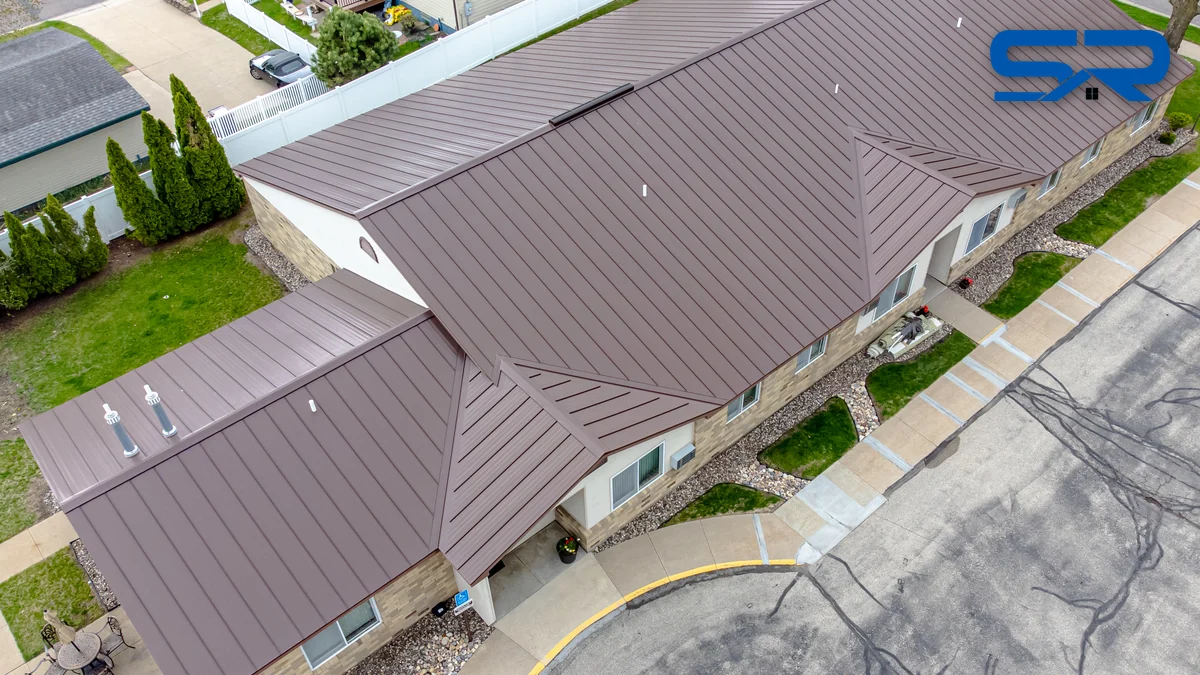
The photo at the top is a public-domain (CC0) photo from Wikimedia Commons of a standing seam roof on a multi-unit building, with our SR mark added. It isn’t a Snow Roofing job and it isn’t in Fort Worth. I use it to show what standing seam looks like across a long, low building with hips and valleys.
Call (817) 733-9228 or request an estimate.