
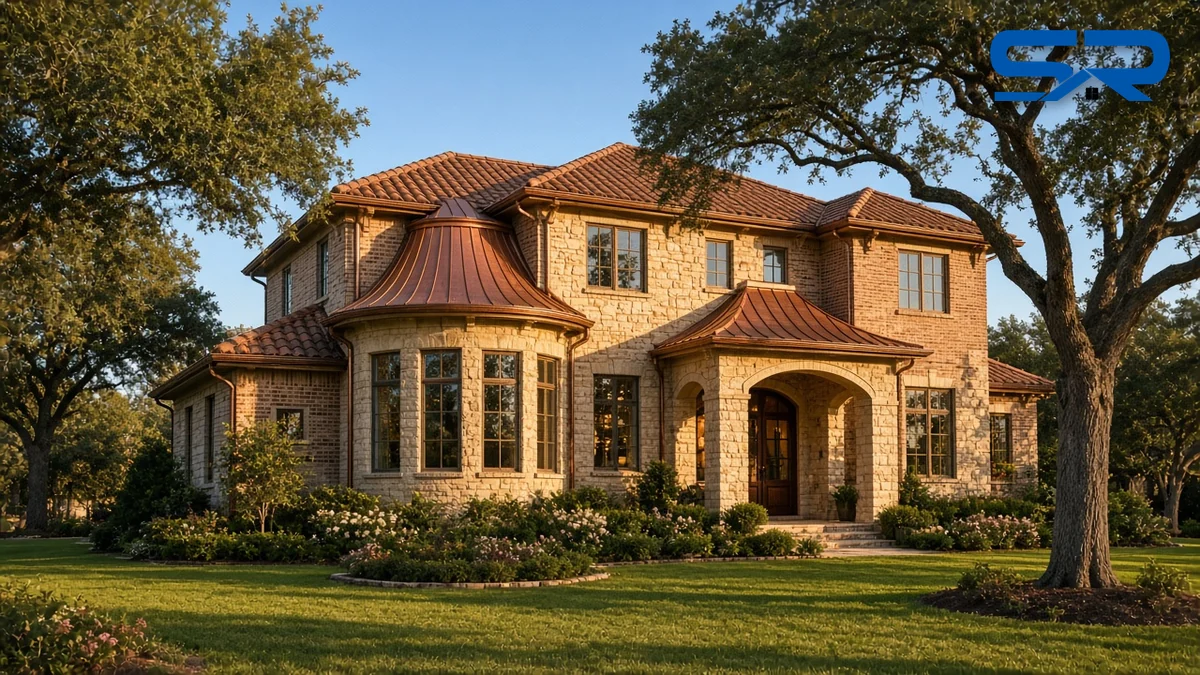
Walk any street in Southlake or Colleyville and you’ll see it: a clay tile or slate roof with a copper roof over the front bay, a copper hood over the entry, or copper dormers catching the afternoon sun. A metal accent is a small part of the roof that gets most of the attention. Done right, it looks like it was always meant to be there. Done wrong, it leaves green streaks on the limestone and eats a hole in the gutter downstream.
I’m Blake Snow, and I’ve been roofing for 30 years. This guide is about pairing an accent metal with the main roof you already have or are planning: clay tile, slate or standing seam. If you want copper ounce weights or a deep look at zinc, read our Revere copper guide and our VMZINC and RHEINZINK zinc guide. Here we’ll stick to how it all fits together on one house.
The short version
| Main roof | Accent that usually looks best | Watch out for |
|---|---|---|
| Clay or concrete tile (terracotta, blended reds) | Copper. Its brown patina warms up with tile and tan stone. | Flashing copper into the tile pan; heavy tile needs walk boards, not boots. |
| Natural slate (gray, black, green) | Copper for a traditional look; zinc for a cooler, quieter look. | Never let copper water reach zinc. Pick one metal for the whole house where you can. |
| Standing seam steel (painted Galvalume) | A painted steel accent in a copper-tone or contrast color, or copper only where its water can’t reach the steel. | Copper runoff corrodes Galvalume, galvanized steel, zinc and aluminum. |
| Enviroshake or synthetic shake | Copper or dark standing seam | Make the metal flashings match the accent, not the field. |
Where accents look right
Accents work best where the eye already goes:
- Bay and box windows. The most common accent in Southlake. A curved or hipped copper bay roof makes a brick or stone elevation look finished.
- The entry and portico. A copper hood or hip roof over the front door frames the house from the street.
- Dormers, turrets and eyebrow roofs. Small, steep or curved shapes that tile and slate can’t easily follow are a natural fit for metal.
- Porches and low roofs. Many porch roofs are too flat for tile or slate, so metal is the right roof there anyway.
- Cupolas, chimney caps and finials. Small details that tie the accents together.
A good rule: two or three accents, repeated on purpose. A copper bay, a copper entry and copper gutters read as one design. Copper on one dormer, zinc on another and painted steel on the porch reads as three different contractors.
Copper or zinc: choose for year ten
Both metals change color, and both are meant to.
- Copper starts bright penny, turns brown within the first few years and, over a long time, moves toward the green patina you see on old buildings. In North Texas that green comes slowly, so plan on living with brown. Brown copper looks rich next to terracotta tile, red brick and tan Austin-style limestone.
- Zinc starts bright or pre-weathered and settles to a soft blue-gray. It looks at home with gray or black slate, white or gray stone and more modern houses. Zinc has rules of its own, like needing a ventilated or separated underside; our zinc guide covers them.
- Painted steel in a copper-tone, bronze or dark gray finish doesn’t patina at all. It’s the choice when you want the look of an accent on a standing seam house without a mixed-metal problem. PVDF finishes generally hold color best; see metal roof colors and finishes.
The water rule that ruins most accent jobs
This is the part most people never hear about until it’s too late. Water that runs off copper carries tiny amounts of dissolved copper, and that water attacks zinc, galvanized steel, Galvalume and aluminum. The Galvanizers Association’s design manual says to design so water flows from galvanized surfaces onto copper, never the other way, and steel panel makers warn that copper runoff causes pitting corrosion on Galvalume-coated roofing and can void their warranties.
On a real house that means:
- No copper above a standing seam steel roof unless its water is caught and piped away first.
- No copper draining into aluminum or steel gutters. If the bay roof is copper, its gutter and downspout should be copper too.
- Copper over zinc is out; zinc over copper is generally fine. Water may flow from zinc onto copper, not from copper onto zinc.
- Don’t mix fasteners. Copper gets copper or stainless steel cleats, nails and screws. Steel gets the fasteners its maker lists. No contact between the two without an isolation layer.
If you want copper on a house with a steel main roof, we plan the water path first. Sometimes the answer is copper on the front entry where it drains to its own gutter, and painted steel everywhere else.
Staining on stone, stucco and trim
Copper runoff can leave blue-green streaks on light limestone, cast stone, stucco, painted trim, concrete steps and drives. Southlake and Colleyville houses have a lot of light stone, so this matters. We send accent water into a gutter and downspout instead of letting it sheet down a wall or splash on a step, and we keep drip edges kicked out past the face of the stone. Zinc runoff is much milder, which is one more reason it suits pale stone houses.
Tying the accent into each main roof
Clay or concrete tile. The accent roof usually meets the tile at a sidewall or a headwall. That joint needs a step or apron flashing under the tile and a counterflashing over it, in the accent metal. Tile is heavy and breakable, so we walk on boards and pull and relay the tile we need to, then set it back. If the tile is near the end of its life, it’s often smarter to do the accents during the reroof. More: tile roofing in Southlake and Colleyville.
Slate. Slate and copper are a classic pair. The accent ties in with copper step flashing and counterflashing, and slate around the joint is set with hooks or copper nails, never steel. Broken slate is replaced with like-kind stone. More: slate roofing, slate in Southlake and Colleyville.
Standing seam steel. Here the accent is often painted steel from the same coil family as the main roof, formed on our own roll formers in 24 or 26 gauge, so the metals match and the water rule never comes up. If you want real copper, it goes where it drains on its own. More: standing seam in Southlake and Colleyville.
Install details that decide whether it lasts
- Weight. 16 oz copper is common for accents; 20 oz resists dents better and suits longer pans and hail country.
- Seams by slope. Folded standing seams on steeper accent roofs; soldered flat-seam work on low, nearly flat bay roofs.
- Room to move. Texas heat makes metal grow and shrink every day. Pans are held with cleats so they can slide, not nailed through the face.
- Underlayment. A high-temperature underlayment under the metal, with a slip sheet where the maker calls for one.
- Curves. A curved bay roof is shop and hand work. Ask to see a curved job the bidder has done.
Hail in Southlake and Colleyville
Northeast Tarrant County gets serious hail. Our Southlake page notes that Tarrant County had more than 500 NOAA hail reports from 2016 through mid-2026, including 5-inch hail in June 2023, and NOAA’s Storm Events Database lists 4-inch hail near Grapevine Reservoir on June 11, 2023. Copper and zinc are soft metals, so big hail can dent them even when they don’t leak. Heavier copper helps. After a storm, have the accents checked with the main roof, and remember Texas claims are generally due within 1 year from the date of loss. Check your policy. See storm damage.
HOA approval and permits
HOA first. Most Southlake and Colleyville architectural committees want to see the metal, the color and where it goes. Bring a sample, a photo of the patina you expect, and a marked-up elevation. If you’re changing from painted steel to copper (or the other way), say so plainly. Our Southlake HOA review post has more tips.
Then the permit. The City of Colleyville requires a permit on every re-roof, and contractors have to be registered with the city. Southlake’s permit list includes replacing roofing materials. If the accent is part of a reroof, it’s covered there. For a stand-alone accent, we check with the city before we start. We pull the permits.
12 questions to ask before you sign
- Copper, zinc or painted steel for my house, and why?
- Where will water from each accent go, and does it touch any steel, zinc or aluminum?
- Will the accent have its own gutter and downspout in the same metal?
- What weight of copper (16 oz or 20 oz) are you quoting?
- Folded standing seam or soldered flat seam for each accent?
- Which cleats, nails and screws will you use?
- How do you flash the accent into my tile or slate?
- How will you keep runoff off my limestone, stucco and steps?
- Who handles the HOA submittal and the city permit?
- Have you built a curved bay roof before? Can I see one?
- How do you protect my tile or slate while you work?
- What’s your workmanship warranty, in writing? (Ours runs from 10 years up to lifetime, depending on the job.)
Related pages
- Copper roofing
- Copper flashing, valleys and gutters on slate and tile in Colleyville
- Standing seam accents on porches, bays and entries
- Copper chimney caps, crickets and dormers
- Standing seam metal roofing, tile roofing and slate roofing
- Southlake and Colleyville
Talk to us about copper or zinc accents
We build copper, zinc and painted standing seam accents on homes in Southlake, Colleyville, Westlake, Grapevine, Keller and Trophy Club, on new builds and reroofs, and on houses that keep their main roof. Every roof is installed to manufacturer specs by certified installers. We’re certified with GAF, CertainTeed, Owens Corning, Atlas, Johns Manville, Carlisle, Tropical Roofing Products, Mule-Hide and Enviroshake, and many other roof manufacturers. We’re BBB A+ rated, with 5.0 stars on Google at all three offices: Bridgeport, Decatur and Rhome. Request a free estimate or call (817) 733-9228.
Sources
- Galvanizers Association: Bimetallic corrosion (copper runoff onto zinc coatings)
- AEP Span: Dissimilar metals (copper and Galvalume/ZINCALUME)
- Copper Development Association: Architectural handbook
- City of Southlake: When is a permit required
- City of Colleyville: Contractor registration
- NOAA NCEI: Storm Events Database