
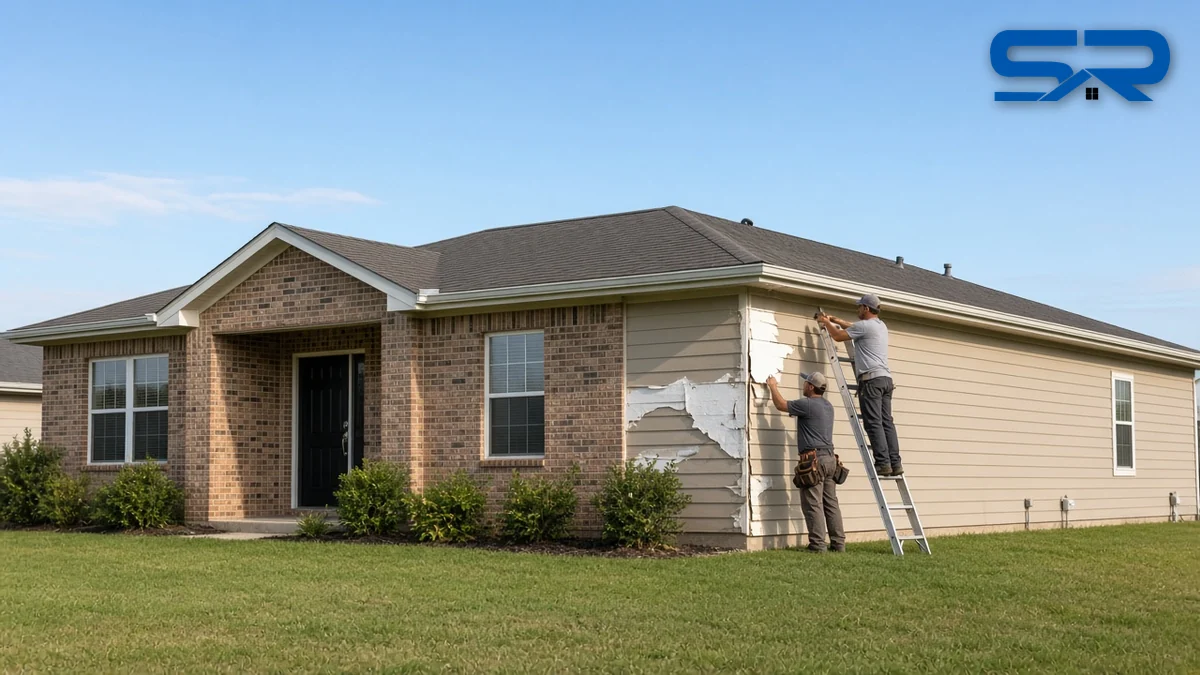
Our Rhome office is a few minutes from most Rhome addresses, so when hail comes through this corner of Wise County, the phone rings about roofs first. But a lot of the houses out here have brick or stone on the front and lap siding on the sides, the back, the gables and around the garage. When the hail rides in on a west or northwest wind, those walls take a direct hit, and the question I get next is always the same: do I fix a few panels, or replace the whole wall?
I’m Blake Snow. I’ve been roofing and building for 30 years, I’m the third generation in a family business that goes back 75 years, and our crews have completed over $80 million in roofing projects. Our own crews also replace siding, trim, soffit, gutters, windows and paint. Here’s how I make the repair-or-replace call on hail-damaged siding around Rhome.
The short answer
- Repair when the damage is a handful of panels or boards and you can still get the same profile, texture and color.
- Replace the wall when the hits are spread across the elevation that faced the storm, or the siding can’t be matched.
- Replace more when the siding was already failing before the storm: swelling at the bottom edges, loose panels, soft wall sheathing.
- Check behind it. A cracked panel is the visible part. Wet house wrap or sheathing is the part that costs you later.
Hail near Rhome isn’t rare
| Date | What NOAA logged near Rhome |
|---|---|
| April 1, 2024 | 2-inch hail at Rhome and at Newark |
| April 8, 2024 | 3-inch hail at Boyd, about five miles away |
| November 24, 2025 | 1.75-inch hail reported in Rhome |
Source: NOAA NCEI Storm Events Database. NOAA lists 20 reports of hail 1.75 inches (golf-ball size) or larger within about 10 miles of Rhome from 2016 through the September 2026 update. A report shows where hail was seen, not whether a given house was damaged.
If your siding hasn’t been looked at since one of those storms, it’s worth a walk around the house.
What hail damage looks like, by siding type
Vinyl. Cracks, splits and clean holes, often near the bottom lock or at the laps. Vinyl gets more brittle in cold weather, so it tends to crack or punch through rather than dent. Some damage hides until a seam opens up months later.
Fiber cement and painted lap siding. Chipped edges and spots where the paint popped off and raw, lighter board shows through. The board may be fine structurally, but bare spots soak up water if they aren’t sealed and painted.
Engineered wood. Fractures at the butt joints and the bottom edge. If water gets into a break, the board swells, and swelling doesn’t go back.
Metal trim, wraps and gutters. Dents in window wraps, trim coil, corner pieces, gutters and downspouts. These are often the easiest proof that hail of a certain size hit that wall.
Repair or replace: how I decide
| What I find | What I usually recommend |
|---|---|
| A few cracked vinyl panels, same color still sold | Unlock and swap those panels |
| Chipped fiber cement, boards still solid | Seal, prime and repaint; replace only broken boards |
| Hits spread across the whole storm-side wall | Replace that elevation |
| Profile or color discontinued | Re-side the wall to a corner, or move matching panels from a hidden wall |
| Swollen, soft or rotting boards at the bottom edge | Replace the wall and check the sheathing |
| Wet or stained sheathing behind removed panels | Fix the wall first, then new wrap and siding |
| Dented window wraps and trim | Replace the trim with the siding so it all lines up |
Matching is the whole game
A patch that’s the wrong shade or the wrong shadow line is obvious from the street. Before I quote a repair, I check:
- Profile and exposure. Double 4, double 4.5, double 5, Dutch lap, board and batten. Exposure is the visible height of each course, and a quarter-inch difference shows.
- Thickness and texture. A thinner builder-grade panel next to a heavier one sits differently, and woodgrain patterns vary by maker.
- Brand marks. The back or nail hem of a removed panel often has a stamp or code.
- Leftover pieces. Check the garage rafters and attic. Original leftovers are the best match you’ll ever get.
- Color in daylight. Vinyl fades, so even the “same” color off the shelf can look new next to a 10-year-old wall.
If there’s no true match, I’d rather run new siding to an inside or outside corner, where the eye expects a break, than leave a mismatched square in the middle of a wall. On painted siding, repainting the whole wall usually hides the repair completely. That’s where our exterior painting crew comes in.
What goes behind the new siding
When panels come off, we look at the wall before anything goes back on:
- House wrap. Torn or missing wrap gets repaired or replaced and lapped correctly.
- Sheathing. Soft, swollen or stained spots get cut out and replaced.
- Windows and doors. If we’re replacing a wall, every window gets flashed into the new wrap. If the windows took hail too, it’s the right time for window replacement.
- Kick-out and step flashing. Where a roof meets a wall, missing kick-out flashing is one of the most common reasons siding rots from behind.
- Trim, soffit and gutters. Dented soffit and fascia and gutters get handled in the same visit so the lines match.
Document it before anything is patched
- Photograph every side of the house from the corners, then straight on.
- Take close-ups of cracks, holes, chips and dents with a coin or tape measure for scale.
- Shoot the dented gutters, downspouts, AC fins and window screens too. They help show hail size.
- Save a broken piece if you can.
- Write down the storm date.
Hail damage to siding is often part of the same claim as the roof, but every policy is different, including how it handles matching. Ask your adjuster. Texas generally gives you 1 year from the date of loss to file a claim; check your policy. Our free digital photo report gives you the photos laid out wall by wall. More on that on our storm damage page.
Permits in Rhome
Inside city limits, the City of Rhome issues building permits under the 2021 codes and uses a third-party inspector, and contractors on permitted work must meet the city’s annual contractor registration requirements, including a surety bond. We’re a registered contractor in Rhome and bonded. Many homes with a Rhome mailing address sit outside city limits in unincorporated Wise County, where the city’s process doesn’t apply. We check which side of the line your house is on before we quote.
If the roof took a hit too
Do the roof first, then the siding, so roofers on ladders and falling debris don’t damage new walls. If you’re replacing the roof anyway, it’s worth looking at metal roofing in Rhome. We form standing seam and R-panel on our own roll formers in 24 or 26 gauge, with a typical lead time of 1 to 2 weeks. Every shingle roof we install is Class 3 or better.
Nearby towns
We handle hail-damaged siding and exteriors all around our Rhome office, including Newark, Boyd, Haslet, Northlake, Aurora, Decatur and Justin.
Let’s look at your siding
We’re certified with GAF, CertainTeed, Owens Corning, Atlas, Johns Manville, Carlisle, Tropical Roofing Products, Mule-Hide and Enviroshake, and many other roof manufacturers, and siding goes on to manufacturer specs. Snow Roofing & Exteriors is fully insured, has offices in Bridgeport, Decatur and Rhome, is A+ rated on the BBB, and has 5.0 stars on Google at all three offices: Bridgeport, Decatur and Rhome. References are available on request. Our workmanship warranty runs from 10 years up to lifetime, depending on the job.
Call (817) 733-9228 or request an estimate. I’ll walk every wall with you, tell you straight whether a few panels will do, and put it all in a free digital photo report.