
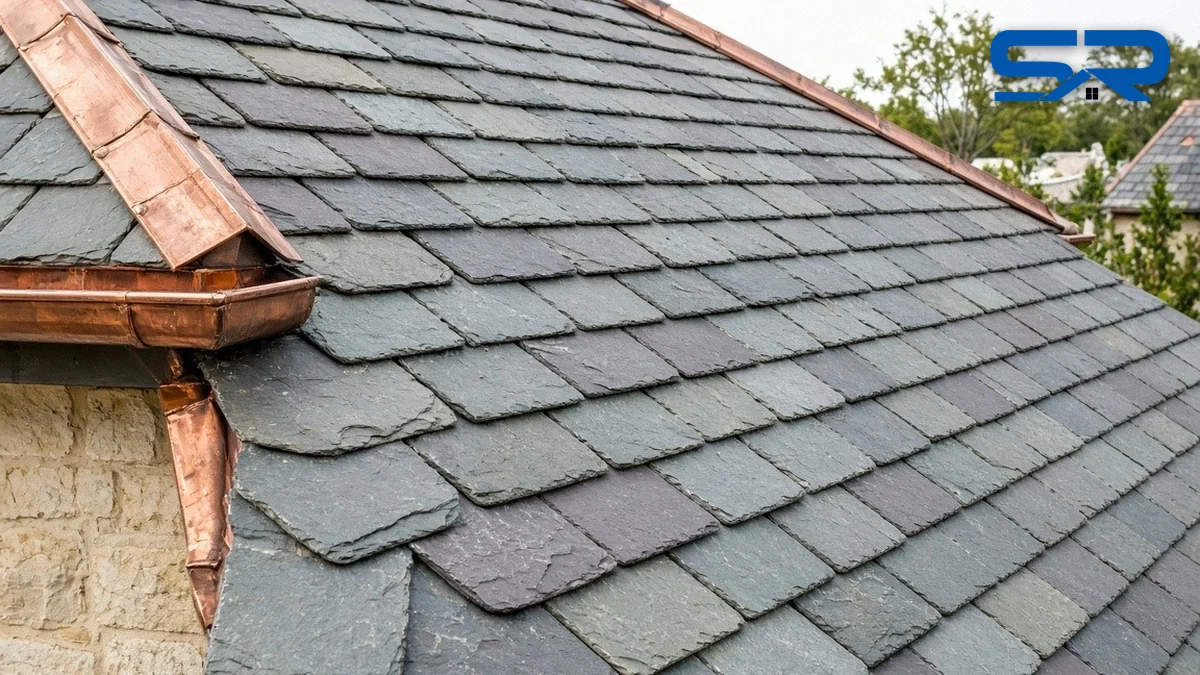
On a natural slate roof, the stone is rarely what fails first. The National Slate Association says slates are meant to hang on their nails, and on old roofs it’s usually the nails, the flashing or a bad repair that gives out while the slate itself still has decades left. So the small question of what holds each slate on ends up deciding how long a Highland Park slate roof really lasts.
I’m Blake Snow. I’ve been roofing for 30 years, and we install and repair natural slate in Highland Park, University Park and Dallas. Here’s how slate should be fastened, using the National Slate Association (NSA) and Slate Roofing Contractors Association (SRCA) guidance, plus how European hook-fixing from a slate maker like CUPA PIZARRAS compares.
Nails for a new or re-laid slate roof
The NSA guide specification starts every slate job from the same nail:
| NSA starting point | When to change it | |
|---|---|---|
| Material | Solid copper | Type 304 or 316 stainless for hard decks that bend copper nails (makes future repairs harder) |
| Gauge | 11-gauge (.120”) | 10-gauge (.134”) for hard decks, larger slates, and longer nails at hips |
| Shank | Smooth | Ring-shank is “generally unnecessary” and makes repairs harder; consider it only with short nails that can’t go through the deck |
| Head | 3/8” flat head | |
| Length | At least 3/4” into the sheathing or through plywood, typically twice the slate thickness plus 1” | Longer at hips and ridges for the extra layers |
| Number | 2 per slate | 4 per slate for slates 3/4” or thicker and 20” or longer (extra pair about 2” above) |
| Not recommended | Galvanized, except short-term repair work |
Here’s how the SRCA turns that length rule into nail sizes:
| Slate thickness | Nail length |
|---|---|
| 3/16” to 1/4” | 1-1/2” |
| 3/8” | 1-3/4” |
| 1/2” | 2” |
| 3/4” | 2-1/2” |
| 1” | 3” |
That last table matters on graduated slate roofs, where the thick courses at the eaves need longer nails than the thin courses near the ridge. A crew that uses one nail size for the whole roof is either under-nailing the thick slates or punching nails through the deck on the thin ones.
How the nails are set
- Hang the slate, don’t pin it. The nail sits in the countersink. NSA’s field guide says not to over-nail or under-nail. An overdriven nail cracks the slate. A proud nail head lifts the slate above and wears through it.
- Hole location. NSA’s spec puts the two holes 1/4 to 1/3 of the slate length down from the head and 1-1/4” to 1-1/2” in from each edge, on the thinner end of the slate.
- Never through flashing. NSA says not to nail slates through flashings. Move the nails up, put both on one side, or use copper wires secured upslope.
- Exposed porch ceilings and open soffits. Where the underside of the deck shows, a 2” nail can poke through or splinter the boards. The NSA’s options are added sheathing (checking the extra load) or shorter nails that don’t go through, possibly ring-shank.
Why copper (and not galvanized)
Copper nails last as long as the stone. They’re also soft enough that a slate ripper can cut them, which is how a good repair starts. The NSA prefers solid copper “for their longevity and ease of future slate repair work,” and says galvanized nails aren’t recommended except for short-term repairs. A slate roof held on by rusting nails is how you get slates sliding into the gutter on a roof whose stone is still fine.
Slate hooks: the right way to replace a broken slate
You can’t nail a replacement slate in the middle of a roof, because the slate above covers where its nails go. That’s what slate hooks are for. NSA’s repair method:
- Cut the broken slate’s nails with a slate ripper and pull it out.
- Drive a slate hook into the deck through the joint between the two slates in the course below, with the hook where the new slate’s bottom edge needs to sit.
- Slide the replacement slate up until it clears the hook, lower it flat and pull it down until it seats in the hook.
Hook specs from the NSA guide spec: 3” long, 10-gauge solid copper, Type 304 stainless, or 304 stainless powder-coated black or bronze, for slates with a 3” headlap and up to 3/4” thick. Hooks come in two standard sizes: a 3/8” hook for slates up to 3/8” thick and a 3/4” hook for slates 1/2” to 3/4” thick. Roofs with headlap over 3” need custom-length hooks. The NSA field guide adds that galvanized hooks rust and stain the roof.
The tip of a hook shows at the bottom edge of the slate. On a dark slate roof, a black or bronze powder-coated hook all but disappears. On a weathered green or purple roof, copper usually blends best. We match the hook to the roof.
Nail-and-bib: when a hook won’t work
On thick slate or unusual headlaps, the NSA says it’s often more practical to use the nail-and-bib method. The replacement slate is nailed through the joint in the course above, and a copper bib slides up under that course to cover the nail head. NSA’s spec calls for 16 or 20 oz copper (ASTM B370) or lead-coated copper, 3” to 4” wide by 8” long, snipped or bent so it doesn’t slide out. The SRCA says field repairs should use stainless or copper hooks, with nail-and-bib when hooks aren’t possible.
What you should never see: a face-nailed slate with a dab of tar or caulk over the nail. That’s a leak waiting to happen and makes the next repair harder.
European hook-fixing (CUPA PIZARRAS) vs. American nailing
If you’re looking at Spanish slate from CUPA PIZARRAS, you’ll see hook-fixing described as a full installation method. CUPA says it’s very common in France and Belgium, with real advantages: less labor, fewer broken slates and simpler replacement. But CUPA’s own fixing guidance comes with limits:
- Not below a 25° roof pitch (about 5.6:12).
- Crimped-shank hooks below 30° (about 6.9:12), to cut capillary water at the joints.
- Stainless steel wire hooks.
- All perimeter slates are both hooked and nailed.
- Hook fixing may not suit large slates, which see more wind uplift.
American slate roofs are traditionally nailed to solid sheathing, and the NSA guide spec is written for nailed roofs. It does note there are “several hook-type systems available,” which can help where the deck isn’t nailable. For a Highland Park home, we stick with copper nails for the field of the roof unless the slate maker’s system, the deck and the slope all line up for hooks, and we’ll show you the maker’s written fixing guide either way.
What we check on an existing slate roof
- Are the nails failing? Slates sliding out across many slopes usually means the nails are done, not the stone. Sound slate can often be stripped and re-laid on new copper nails.
- Past repairs. Face nails, tar, caulk, galvanized hooks and mismatched slates get noted and fixed properly.
- Flashings. Valleys, chimney flashing and step flashing often need replacing long before the slate. See our copper flashing guide for slate and tile roofs.
- Slate thickness and headlap, so the hooks and nails we bring actually fit.
More on slate: repair vs. replacement, slate grades and thickness in a quote, and natural slate sources compared.
What goes on our slate quotes
- Slate source, thickness range and headlap
- Nail material, gauge and lengths (by course on graduated roofs), and nails per slate
- Hook material, size and finish for repairs, or the nail-and-bib method where needed
- Flashing metal and weight
- Underlayment and any deck repairs
- Free digital photo report, and our workmanship warranty from 10 years up to lifetime, depending on the job
Talk to us about your slate roof in Highland Park
We repair, re-lay and install natural slate in Highland Park, University Park and across Dallas. We’re certified with GAF, CertainTeed, Owens Corning, Atlas, Johns Manville, Carlisle, Tropical Roofing Products, Mule-Hide and Enviroshake, and many other roof manufacturers, and every roof is installed to manufacturer specs by certified installers. We’re BBB A+ rated, with 5.0 stars on Google at all three offices: Bridgeport, Decatur and Rhome. If a storm cracked your slate, Texas claims generally have to be filed within 1 year from the date of loss, so check your policy. Request a free inspection or call (817) 733-9228.
Sources
- National Slate Association: Guide Specification Section 07 31 26, Uniform Slate Roofs (2020)
- National Slate Association: Field guide, nails and nailing, and slate repair (slate hook method)
- National Slate Association: Slate roof repair and care
- Slate Roofing Contractors Association: Basic Slate Roof Installation Training (2020)
- CUPA PIZARRAS: Key aspects for a high-quality roof installation
- CUPA PIZARRAS: Roofing Design and Fixing Guide