
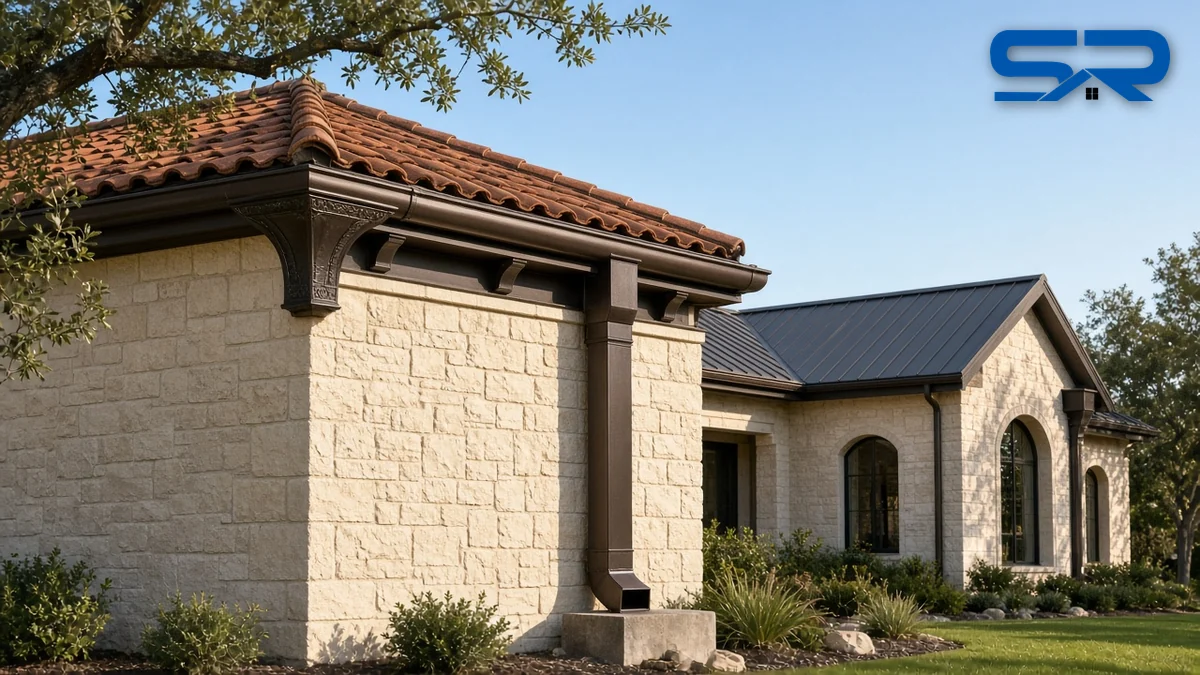
Oversized gutters and downspouts are one of the most overlooked parts of a big tile or standing seam roof in Westlake and Southlake. The roof gets all the attention, but on a large estate the gutters decide where thousands of gallons of storm water land: in the downspout, or over the front of the gutter and onto the stone, the walkway and the foundation.
I’m Blake Snow. I’ve been roofing for 30 years, I’m the third generation in a family business that goes back 75 years, and our crews have completed over $80 million in roofing projects. We install tile, standing seam and gutters across Westlake, Southlake and the towns around them. Here’s how I’d size and plan gutters on a large estate roof.
The short version
- Size each run, not the house. A gutter only carries the roof that drains into it.
- Big, steep runs usually need 6-inch gutters with 3x4 downspouts. That’s about 44% more gutter and twice the downspout.
- Valleys are where overflow starts. Put a downspout near the inside corner and guard the valley.
- More downspouts beat a bigger gutter alone. The outlet is often the real bottleneck.
- Match the metal and the color. Painted to the roof or trim, or copper on a copper-detailed home, never mixed.
Why large tile and metal roofs overflow standard gutters
A typical builder-grade gutter is a 5-inch K-style with 2x3 downspouts. That’s fine on an ordinary house. On an estate in Westlake or Southlake, three things change:
- Bigger roof planes. One long rear slope can drain into a single gutter run.
- Steeper pitches. Tile and standing seam roofs are often steep, so water comes off faster and with more force.
- Slick, fast surfaces. Clay tile, concrete tile and painted metal don’t slow water the way shingle granules do. On standing seam, water runs down the pans in sheets and can shoot past the front of a shallow gutter.
Add valleys that funnel two slopes into one corner, and a 5-inch gutter can overflow in a hard Texas downpour even when it’s perfectly clean.
5-inch vs. 6-inch gutters and 2x3 vs. 3x4 downspouts
This Old House publishes common sizing numbers, rated at 1 inch of rain per hour:
| Part | Roof area it drains (at 1 in/hr) | Notes |
|---|---|---|
| 5-inch K-style gutter | About 5,520 sq ft | Standard on most homes |
| 6-inch K-style gutter | About 7,960 sq ft | About 44% more capacity |
| 2x3 downspout | About 600 sq ft | Pairs with 5-inch |
| 3x4 downspout | About 1,200 sq ft | Twice a 2x3; standard with 6-inch |
Two things to know about that table. First, North Texas storms can rain much harder than 1 inch an hour for short bursts, so the real roof area each part can handle is smaller; we scale it for the run. Second, look at the downspout row. A 2x3 downspout is often the bottleneck, not the gutter. Going to 3x4 outlets, or adding downspouts, fixes a lot of overflow on its own.
How we size gutters on an estate roof
On a big tile or standing seam roof I walk the eaves and map every run:
- Roof area feeding each run, adjusted for pitch, since a steep roof catches more wind-driven rain.
- Valleys and upper roofs that dump onto a lower roof and then into the gutter.
- Run length. Long runs need more than one outlet, and very long runs need an expansion joint.
- Where the water can go. Downspouts have to land somewhere useful: a splash block, an extension or a drain line, away from the foundation and walkways.
Then the plan is usually some mix of 6-inch gutters on the big runs, 3x4 downspouts, extra outlets near valleys, and the standard size on small porch or bay roofs where bigger gutters would look heavy.
Valleys, inside corners and overflow fixes
Most of the overflow calls I get on large homes come from the inside corners under a valley. Fixes that work:
- A downspout at or near the inside corner so the valley water has an exit right where it lands.
- A valley splash guard (a small diverter) to keep fast water from shooting over the gutter.
- A larger outlet on that run, or two outlets instead of one.
- A gutter hung at the right height and pitch under tile, since the tile edge often overhangs farther than shingles do.
On standing seam, I also check how far the panels run past the eave, and whether the drip edge and gutter line up so water drops into the gutter instead of behind it.
Leader heads, half-round and the look of the gutters
On a large home the gutters are part of the facade. A few options to consider:
- Leader heads (conductor heads): a decorative box where the gutter meets the downspout. They add a real outlet and look at home on stone, stucco and Mediterranean houses.
- Half-round gutters with round downspouts: a classic look on slate and some tile homes. Half-round carries less than K-style of the same width, so it often needs to go up a size.
- Rectangular 3x4 downspouts: they handle more water and sit cleaner against stone than a round pipe.
We can quote any of these and match the size to the run, not just the look.
Color and metal: match the roof, never mix the metals
- Standing seam: most owners match the gutter to the roof panels or the fascia so the eave reads as one line.
- Tile: dark bronze, sandstone and similar colors usually pick up the stone or trim better than white.
- Copper: on a slate or copper-detailed home, copper gutters fit. But copper and aluminum or galvanized steel shouldn’t touch or drain onto each other, or the other metal corrodes faster. My post on copper flashing, valleys and gutters on slate and tile in Colleyville covers that in detail.
We install seamless gutters and downspouts in colors matched to your home. Our standing seam in Westlake and standing seam in Southlake pages cover the roof side.
Hail and gutters around Westlake and Southlake
Gutters and downspouts are soft metal, so they’re often the first thing hail dents. NOAA’s Storm Events Database lists 4-inch hail near Grapevine Reservoir on June 11, 2023. On May 27, 2024, NOAA logged 2-inch hail near the Roanoke and Keller airports, and on April 28, 2026, 1.25-inch hail was reported in Southlake itself.
Dented gutters and downspouts help show hail size during an inspection, and they’re usually part of the claim with the roof. If a storm hit your home, Texas generally gives you 1 year from the date of loss to file a claim; check your policy. Our storm damage inspections start with a free digital photo report, and my tile roof hail check for Westlake and Trophy Club explains what we look for on tile.
Do gutters with the roof, or after?
If you’re planning a new roof, it’s the best time to fix the gutters. The drip edge, flashing and gutter all meet at the eave, and rotten fascia shows up once the old gutters come off. We can replace soffit and fascia at the same time.
The City of Southlake requires a building permit to replace a roof. The Town of Westlake says every reroof needs a permit through its online system with a site plan, the roofing material and an official HOA approval letter. If the gutter color or style is changing, include it in your HOA submittal. We pull the permits and help with the HOA paperwork. My post on planning a clay tile reroof in Trophy Club and Westlake covers the roof side of a tile project.
Questions to ask before you replace gutters on a large home
- Did you size each run by the roof area draining into it?
- Is it 5-inch or 6-inch, and why for each run?
- Are the downspouts 2x3 or 3x4, and how many per run?
- What happens at the inside corners under the valleys?
- Where does each downspout discharge?
- Will the gutter, drip edge and flashing tie in with the roof?
- Is the gutter metal compatible with the flashing and valleys?
- How are the gutters hung, and how far apart are the hangers?
- Is it seamless?
- Will the color match the roof or trim?
- Will you replace rotten fascia if you find it?
- What’s the workmanship warranty, in writing?
Areas we serve
We install gutters, tile and standing seam on homes in Westlake, Southlake, Colleyville, Trophy Club, Keller and nearby. See tile roofing in Westlake and tile roofing in Southlake.
Let’s look at your roof and gutters
We’re certified with GAF, CertainTeed, Owens Corning, Atlas, Johns Manville, Carlisle, Tropical Roofing Products, Mule-Hide and Enviroshake, and many other roof manufacturers. Snow Roofing & Exteriors is fully insured, has offices in Bridgeport, Decatur and Rhome, is BBB A+ rated, and has 5.0 stars on Google at all three offices: Bridgeport, Decatur and Rhome. References are available on request. Our workmanship warranty runs from 10 years up to lifetime, depending on the job.
Call (817) 733-9228 or request an estimate. I’ll walk the roof and eaves with you and give you a free digital photo report and a gutter plan in writing.