Repair or replace metal roof: that’s the question I get on older metal roofs around Springtown, and my honest answer is that it depends on how the roof was put on in the first place. Here’s my answer, word for word with only the speech-to-text cleaned up:
“This really depends on the initial install, if it was installed properly and flashings were done properly, like the valleys and the chimneys. A lot of times you can just redo the boot flashing, and if it’s exposed fasteners, you can just remove and replace the exposed fasteners and it should last even longer. It really depends if it’s an ag panel or R-panel, PBR panel, or standing seam, the thickness and the gauge of the metal. Lots of variables. If it’s leaking everywhere, it probably needs to be replaced. If you have one or two leaks, it probably can be repaired. It really depends on a cost analysis, how long you’re gonna stay in the home, if you’re looking to sell the home. There are many factors to go on, and everyone has a different need and budget at the time, so accommodating that is super important.”
I’m Blake Snow. I’ve been around and in the roofing business for almost 40 years, and the Snow family roofing legacy has been in this market for 75 years. Here’s how I walk through that decision on a Parker County home, step by step.
The short answer
- One or two leaks on a roof that was installed right: it can probably be repaired.
- Leaking everywhere: it probably needs to be replaced.
- Exposed-fastener roof with tired screws: replace the fasteners and it should last even longer.
- Everything in between: it comes down to panel type, gauge, a cost analysis, and how long you plan to stay.
1. Was it installed right the first time?
This is the first thing I look at, because it tells me whether a repair will hold. A metal roof that was laid out straight, lapped the right way and flashed properly at the valleys, chimneys and walls is a roof worth fixing. A roof where the panels wander, the laps are gapped, or the flashings were faked with caulk is a different story. You can chase leaks on a poorly installed roof for years and never catch up.
I check the details where water actually gets in:
- Valleys, where two slopes meet and carry the most water.
- Chimneys and walls, where the flashing has to turn up and be counter-flashed.
- Pipe boots, the rubber collars around plumbing vents. A lot of times the fix is just redoing the boot flashing.
- Ridge and eave trim, where wind starts working on a roof.
If those were done right and only one has failed, that’s a repair. If they were never done right anywhere, I’ll tell you that too. My post on metal roof flashing details goes deeper on what “done right” looks like.
2. What kind of panel is it?
Not all metal roofs age the same way, so the panel type changes the answer.
| Panel type | Where it usually fails | Typical fix |
|---|---|---|
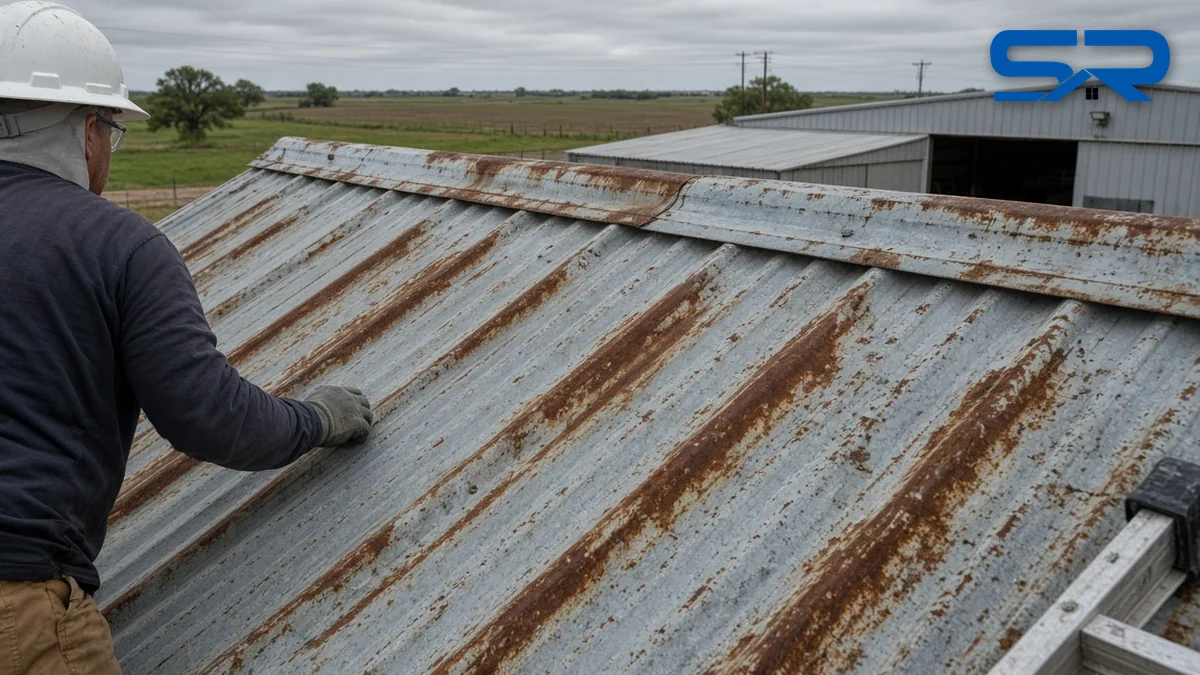
| Ag panel / corrugated | Screw washers, rust at laps and eaves | Replace fasteners; swap rusted sheets; re-panel if rust is widespread |
| R-panel or PBR | Screw washers, end laps, trim | Remove and replace exposed fasteners; reseal laps |
| Standing seam | Flashings, pipe boots, valleys, trim | Repair the detail; the panels themselves rarely fail first |
On an exposed-fastener roof, the rubber washers under the screws usually wear out long before the steel does. Removing and replacing those fasteners, with the right screw driven to the right depth, can make that roof last even longer. Smearing caulk over old screws is not a repair. On a standing seam roof, the fasteners are hidden, so the trouble is almost always at a detail, and the detail is what we fix. If you’re weighing the two systems for the future, I compared them in hidden fasteners vs. exposed screws.
3. How thick is the metal?
The thickness and gauge of the metal matter. Heavier panels hold a fastener better, take hail and foot traffic better, and are worth repairing. Thin, light-gauge panels that are rusting through or torn don’t hold a repair as long. When we replace a roof, we run 24 or 26 gauge on our own roll formers, and every metal roof we install is Class 4 impact rated under UL 2218.
4. How many leaks are there?
This is the simplest test, and it’s honest. If you have one or two leaks, it probably can be repaired. Water travels, so one stain on the ceiling might come from a spot several feet away, but it’s still one source. If it’s leaking everywhere, it probably needs to be replaced. At that point you’re paying to patch a roof that is telling you it’s done.
5. The cost analysis: how long will you stay?
This is where every homeowner is different, and accommodating that is super important.
- Staying 20 years or more? If the roof is near the end, replacing it once usually makes more sense than repairing it every few years. A new standing seam roof is a long-life roof; see how long a metal roof lasts in North Texas.
- Selling in the next year or two? A sound roof with a solid repair and a dated photo report may be all you need. If the roof is worn out, a buyer’s inspector will find it, and that becomes part of the deal.
- Tight budget right now? We can fix the active leaks first, and plan the bigger job for later. Sometimes a metal roof coating over properly replaced fasteners buys time on a roof that’s still structurally sound.
I won’t push you into a new roof you don’t need. I’ll show you what I find and lay out the repair and the replacement side by side, so you can pick what fits.
What our inspection includes
Every look starts with a free roof inspection and a free digital photo report. I walk the roof, check the panels, fasteners, seams, valleys, chimney and wall flashings, pipe boots and trim, and look underneath where I can. You get photos of every problem, what caused it, and what it takes to fix it. If the honest answer is a repair, that’s what you’ll hear. Our metal roof repair and restoration page covers the repair side, and if it’s a barn or shop instead of the house, see re-screw or re-panel an old metal barn. For a closer look at leaks at screws, seams and flashing, read my Azle metal roof repair guide.
Why Springtown homeowners call us
Snow Roofing started as a tier-one commercial company doing only large-scale work, then expanded into residential. We’ve done multimillion-dollar projects down to the average home. No job is too big or too small, Snow Roofing does them all. Our workmanship warranty runs from 10 years up to lifetime, depending on the job, and manufacturer NDL warranties typically range from 10 to 40 years, depending on the manufacturer and system approval. We’re fully insured, BBB A+ rated, references are available on request, and we have 5.0 stars on Google at all three offices: Bridgeport, Decatur and Rhome.
We build lifetime relationships, not one-and-done jobs. We honor our warranty, and we’re around whenever you need us. We work across Springtown and nearby Azle, Reno, Weatherford, Boyd and Paradise. Call (817) 733-9228 or request a free estimate, and I’ll tell you straight whether your metal roof needs a repair or a new roof.