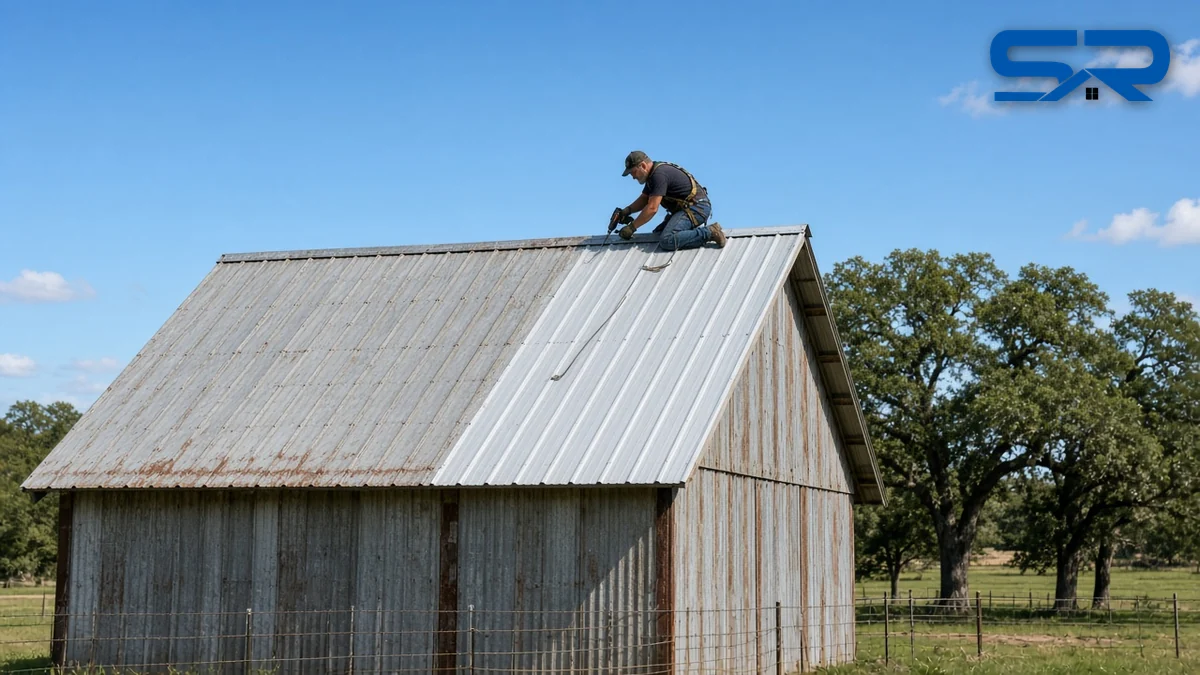
Drive the county roads around Springtown and you’ll pass plenty of metal barns that have been standing for decades. Most of them still have their original roof. Sooner or later, one of them starts dripping on the hay, the tractor or the tack, and the owner asks me the same question: do I need a new roof, or just new screws?
I’m Blake Snow. I’ve been roofing for 30 years, I’m the third generation in a family roofing business that goes back 75 years, and our crews have completed over $80 million in roofing projects. We form R-panel and standing seam on our own roll formers in 24 or 26 gauge, and our own crews install them. Here’s how I decide between a re-screw, a panel swap and a full re-panel on an old barn.
The short answer
- Re-screw when the panels are solid and the leaks follow the screw lines.
- Swap panels when a few sheets are rusted through, torn or kinked, and the rest of the roof is sound.
- Re-panel the whole barn when rust is widespread, the roof has already been re-screwed once with oversized screws, or you’re changing how the barn is used.
- Fix the framing first. No screw holds in a split or rotten purlin.
- Plan for wind. Around Springtown, wind takes more barn roofs than hail does.
How I decide: a quick table
| What I find on the barn | What I usually recommend | Why |
|---|---|---|
| Drips along screw rows, panels solid, washers cracked or flattened | Full re-screw with new, oversized sealing screws | The washers fail long before the steel does |
| A few screws spinning or backed out | Replace those with oversized screws, then check the rest | Retightening a stripped screw doesn’t hold |
| Light surface rust, no holes | Re-screw, treat the rust, and consider a metal roof coating | Buys years if the steel is still there |
| A few panels rusted through at the eave or torn by wind | Swap those panels and re-secure edge trim | Matching R-panel is easy to form |
| Rust-through on many panels, holes you can see daylight through | Re-panel the barn | Patching won’t keep up |
| Roof already re-screwed once with oversized screws | Re-panel, or new metal over the old on new framing | There’s no bigger screw left to step up to |
| Barn being closed in for horses, a shop or living space | Re-panel with condensation control | Bare steel over a closed-in space drips |
| Purlins split, pulled off the trusses, or rotten | Repair framing first, then decide | Screws need something solid to grab |
Re-screwing: what it is and what it isn’t
On an R-panel or PBR barn roof, the screws go through the face of the panel and the rubber washer under each head does the sealing. Sun, heat and years of the steel growing and shrinking wear those washers out. Some screws were overdriven the day they went in, which crushes the washer. Others were never driven tight enough to seal. Either way, the leaks show up in neat rows along the purlins.
A proper re-screw is not someone walking the roof with a drill tightening everything. Here’s how we do it:
- Walk the barn from inside first. I look at the purlins and trusses, find the wet spots and stains, and check whether any framing is split, rotten or pulled loose.
- Pull and replace the screws, row by row. Every failed screw comes out.
- Step up in size. The old hole is worn. Industry guidance published in Metal Construction News is to go up about two sizes into wood (a #10 becomes a #14) and about one size into steel (a #12 becomes a #14). The bigger screw grabs fresh material, and its washer covers the worn hole.
- Drive them right. The washer should seal snug without bulging out from under the head. We use screw guns with depth control so every screw is set the same.
- Re-secure the edges and ridge. That’s where wind starts peeling a roof back.
What a re-screw is not: a tube of caulk smeared over the old screw heads. The Metal Construction Association’s installation manual is blunt about it. A stripped fastener must be replaced, and sealant on the surface over the screw is never an acceptable repair. It might stop a drip for a season, but it hides the rust starting underneath and makes the real repair harder later.
When a few new panels are enough
Sometimes the roof is mostly fine and a handful of sheets are the problem: rust-through along the bottom eave where water and dirt sit, a panel kinked by a falling limb, or a corner lifted by a storm. We form matching R-panel on our own roll formers, so swapping a few panels is straightforward. We cut out the bad sheets, lap the new ones in the right direction, re-screw them with fresh fasteners and re-secure the trim around them.
One thing to know: new panels will be bright next to 30-year-old steel. It’s a cosmetic difference, not a leak problem. If the look bothers you, that’s a reason to think about doing the whole slope.
When it’s time to re-panel the whole barn
I recommend a full re-panel when:
- Rust has eaten through in many places, not just a few eave sheets.
- The roof has already been re-screwed with oversized screws. There’s no bigger screw left, so the next re-screw won’t hold.
- Wind has worked the panels loose across a slope, and the holes are elongated.
- You’re changing how the barn is used. Once you close it in for horses, a shop or living space, it needs condensation control, and that’s easiest to do with new panels. See barndominium, shop and ag building roofs.
There are two common ways to re-panel:
- Tear off and re-panel. The old steel comes off, we repair or add purlins where needed, and new R-panel or PBR goes on with new screws into solid framing. This is usually my first choice when the framing needs work anyway.
- New metal over the old. If the framing is sound, new panels can go over the old roof on new purlins or spacers, so the new screws hit solid wood or steel instead of the old holes. It saves tear-off and disposal, but I only recommend it after I’ve been inside and checked the framing.
When we re-panel, we form the panels in long one-piece runs from ridge to eave on our own roll formers, in 24 or 26 gauge. 26 gauge is the common choice for barns. 24 gauge is heavier and stiffer between purlins. Metal lead time is typically 1 to 2 weeks.
What about a coating?
For a barn whose steel is still solid, a restoration coating over a proper re-screw can add years. Snow Roofing & Exteriors is an American WeatherStar Approved Contractor, and their published detail for exposed fasteners follows the same order I do: tighten every fastener, replace missing ones with the next size larger, then encapsulate the screw head and washer in mastic before coating. The coating goes on top of the repair, not instead of it. It isn’t the right answer when panels are rusted through. Read more on our metal roof coating page and in my post on American WeatherStar restoration systems.
Wind is the real enemy of old barns around Springtown
Hail gets the headlines, and NOAA did record 2.5-inch hail just northeast of Springtown on April 1, 2024. But when I read NOAA’s Storm Events Database for the Springtown area, the entries that worry me for barns are about wind:
- December 13, 2022: large metal panels were peeled back on a large metal barn near Poolville.
- September 19, 2023: reports of blown sheet metal and damaged metal sheds northwest of Springtown.
- March 4, 2025: estimated 85 mph winds lifted the carport awning off the Springtown Senior Center and peeled back the attached roof.
- April 25, 2026: an EF-1 tornado started west-northwest of Springtown and tracked almost 10 miles southeast, with rear-flank winds of 80 to 100 mph just outside its path.
An old barn with loose screws is exactly what wind lifts first. Once air gets under one panel at an eave or gable, it peels the next one. That’s why every barn repair we do includes the edges, the gable trim and the ridge, not just the leaks you can see. If a storm already got to your barn, see our storm damage page. For insurance, Texas claims generally have to be filed within 1 year from the date of loss, but check your policy.
Permits: inside or outside city limits
- Inside Springtown city limits. The City’s fee schedule lists a reroof permit at $50, and accessory buildings like barns have their own permit fee. All permit applications and inspection requests go through City Hall, which coordinates inspections with the City’s third-party inspection firm. See the City’s building inspections page. The fee schedule also says work done without a permit is charged double.
- Outside city limits. A lot of acreage with a Springtown address is in unincorporated Parker or Wise County, where the rules are different.
We check which rules apply to your property and handle the paperwork.
Questions to ask before you sign
- Did you go inside the barn and check the purlins?
- Are you replacing every screw, or just tightening them?
- What size and type of screw are you using, and is it written on the estimate?
- Are you re-securing the eaves, gables and ridge for wind?
- If panels are being swapped, what gauge, and are they formed to match?
- If you’re recommending a full re-panel, why won’t a re-screw work?
- Who pulls the permit?
- What workmanship warranty do you give, in writing?
Why Springtown property owners call us
- Our own roll formers and our own crews for R-panel and standing seam, 24 or 26 gauge. We also offer corrugated and PBR panels.
- Metal lead time is typically 1 to 2 weeks.
- American WeatherStar Approved Contractor for roof restoration coatings.
- Certified with GAF, CertainTeed, Owens Corning, Atlas, Johns Manville, Carlisle, Tropical Roofing Products, Mule-Hide and Enviroshake, and many other roof manufacturers.
- 5.0 stars on Google at all three offices: Bridgeport, Decatur and Rhome.
- BBB A+ rated and fully insured.
- Workmanship warranty from 10 years up to lifetime, depending on the job.
No job is too small: a few loose panels on a hay barn is still worth a call. And if you’ve got a bigger project, like re-paneling a big hay barn, a shop and the house at once, that’s where our roll formers save you the most.
More reading: our barn roofing page, my post on metal roof repair at screws, seams and flashing in Azle, and my post on pole barn and hay barn roofs in Wise County. We also work in Azle, Reno, Weatherford, Boyd and Paradise.
Get your barn roof looked at
Tell me about the barn: how old it is, where it drips, and what you keep in it. I’ll go inside and on top, check the purlins, and tell you straight whether it needs screws, a few panels or a new roof. Every inspection starts with a free digital photo report. Request an estimate or call (817) 733-9228.