
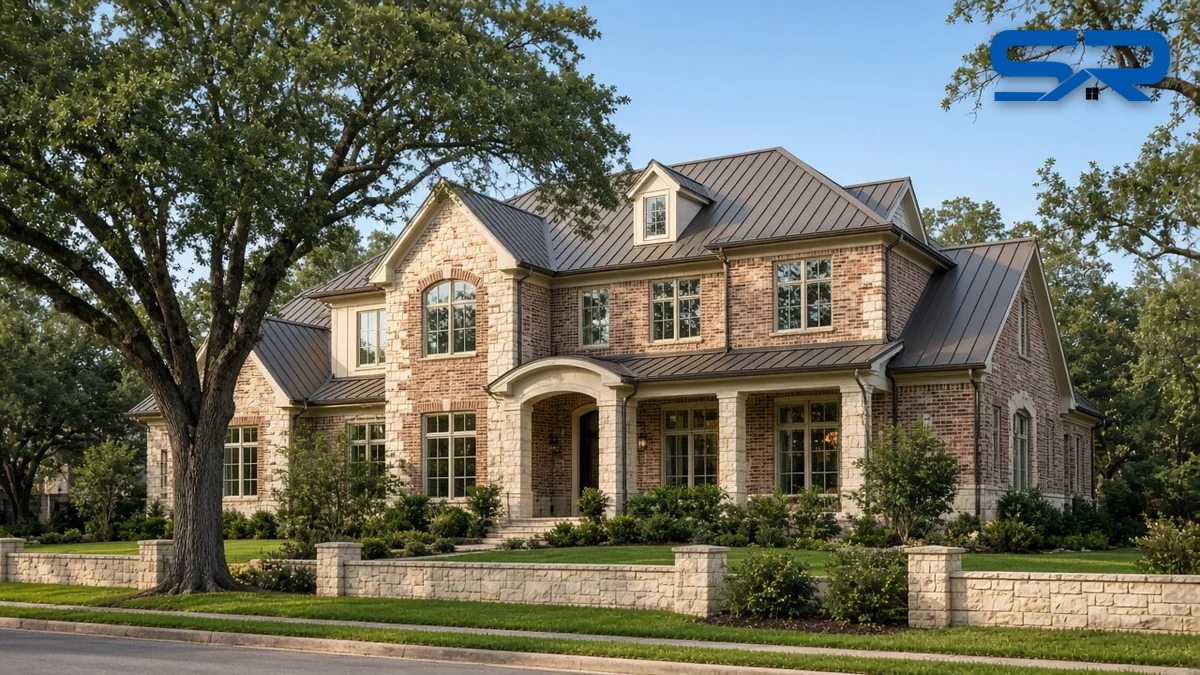
On a brick or limestone home in Colleyville or Keller, the roof is the biggest single block of color you can see from the street. Brick and stone aren’t changing. The roof color has to work with them for the next 40 years, and with standing seam, you can’t hide a bad pick under texture the way a shingle can.
I’m Blake Snow. I’ve been roofing for 30 years, and we form standing seam to length on our own roll formers in 24 or 26 gauge. This post is only about choosing the color and finish for a standing seam roof on a brick or limestone home. If you want the paint chemistry (PVDF vs. SMP and their warranties), read Kynar 500 vs. SMP. If you’re working with a stone ranch house out west, see metal roof color and trim on a stone ranch house.
The short version
- Start with the masonry, not the color chart. Match the roof to the undertone of your brick or stone, warm or cool.
- Pick from the darkest tone in the wall or the mortar. Copying the brick face usually looks a little off.
- A whole roof reads lighter and brighter than a chip. Judge real samples outside, against your wall, morning and afternoon.
- Low-gloss or matte usually wins on standing seam. Glossy and dark panels show waviness more.
- Order the whole job at once. Metallic and mica finishes can vary from run to run.
- Plan trim, gutters, soffit and fascia with the roof, not after it.
- Get the HOA’s color approval in writing before anything is ordered.
Step 1: Read your brick and limestone
Stand at the curb at mid-morning, then again in late afternoon. Ask three questions:
- Warm or cool? Red, orange, rose and tan brick lean warm. Cream and buff limestone lean warm too. Gray brick, white-painted brick and gray limestone lean cool.
- What’s the darkest tone? Most brick has dark flecks or flashed ends. That dark tone is often the best roof color.
- What color is the mortar? A dark mortar line ties nicely to a dark roof. A white or cream mortar gives you more room for a lighter roof.
Then look at what else is permanent: window frames, stone trim around the doors, the front door, and any copper you already have. The roof has to work with all of them.
Color by masonry: what usually works
| Your house | Roof colors that usually work | Use care with |
|---|---|---|
| Red or orange brick | Dark bronze, deep brown, warm charcoal, matte black on modern-leaning homes | Cool blue-grays (they push the brick toward orange); bright reds that compete with the wall |
| Tan or brown brick | Dark bronze, warm brown, warm charcoal | Very light roofs that wash the house out |
| Mixed / multi-color brick | The darkest tone in the brick, usually charcoal or dark bronze | Anything that copies just one brick color |
| Cream or buff limestone (Austin stone look) | Warm gray, soft charcoal, dark bronze | Stark black on a small, busy front elevation |
| Gray limestone | Charcoal, slate gray, matte black | Warm browns that fight the gray |
| Brick plus limestone together | Pick for the material that covers most of the front; test against both | Colors that only work with one of them |
| Painted white brick | Matte black, charcoal, slate gray | Mid-tone browns that look muddy against white |
These are starting points, not rules. Your brick has its own mix, and only a real sample against your real wall will tell you.
Finish: matte, low-gloss, mica and metallic
Color gets the attention, but finish changes how standing seam looks from the street.
Low-gloss and matte. Standing seam has long, flat pans. All flat metal can show some waviness, called oil canning. The National Roofing Contractors Association lists low-gloss finishes among the ways to make it less visible, and the oil canning bulletin from the Metal Construction Association says the same. Panel maker Petersen’s technical bulletin adds that oil canning is more noticeable on darker colors. Low gloss also reads closer to slate or aged metal, which is why it works so well next to brick and stone.
Standard gloss. Fine on many roofs, but you’ll see more reflection on big south- and west-facing planes in the afternoon.
Mica and metallic. Coating makers like Sherwin-Williams offer mica, metallic and other effect finishes in their PVDF lines. They can look rich on a bay, entry or porch roof. Two cautions from panel makers: color can vary from order to order, and some metallic panels must be installed facing the same direction. That’s why we order every panel and all the trim coil for the job at once.
Natural copper. If you want metal that ages instead of a painted color, see our copper roofing page and the accent roof post. Copper accents look right next to a dark bronze or charcoal main roof.
Dark vs. light: what to expect in North Texas
A darker roof absorbs more of the sun’s heat; a lighter or more reflective one sends more of it back. Many coating makers publish a solar reflectance number for each color, and some dark colors are made with reflective pigments. If heat matters to you, compare those numbers on the coating maker’s chart or the Cool Roof Rating Council directory.
One note so nobody oversells you: the ENERGY STAR roof label ended June 1, 2022. Under the old label, a steep-slope roof needed an initial solar reflectance of at least 0.25. That number is still a fair yardstick, but a current product can’t carry the label.
What a darker roof gives you is presence. On a big two-story brick house, a dark bronze or charcoal roof anchors the house. On a smaller front elevation, a soft charcoal or warm gray can keep the house from looking top-heavy.
Trim, gutters, soffit and fascia
This is where most color mistakes show up.
- Roof trim: we bend the rakes, eaves, ridge and valley trim from the same painted coil as the panels, so the edges match.
- Gutters and downspouts: on brick and stone homes, gutters read as part of the roof line. Matching the roof is the quiet choice. Matching the fascia or trim color is the other good choice. See our gutter services.
- Soffit and fascia: if they’re painted wood or fiber cement, choose that paint after the roof sample is approved. See soffit and fascia and exterior painting.
- Accent roofs: porches, bays and entries can match the main roof or contrast on purpose. Our Westlake accents post covers where accents look right.
- Flashing into masonry: where the roof meets brick or stone, the counterflashing shows. It should be the roof color, cut neatly into the joint. More on that in our Keller flashing details post.
How to pick the color without regretting it
- Narrow it to two or three colors with the table above.
- Get physical samples in the finish you want, not paper chips. Screens and printed charts don’t show color or gloss well.
- Hold each sample at roof angle against the wall, in morning and late-afternoon light, on the front and the west side.
- Step back to the street. A large roof plane usually reads lighter and brighter than a small sample.
- Look at a finished standing seam roof in that color if you can. We’ll help you find one.
- Pick the gutter, trim and soffit colors at the same time.
- Send the final pick to your HOA with the sample and product sheet.
Decision table: which way to lean
| If you want… | Lean toward |
|---|---|
| The most timeless look on red brick | Dark bronze or warm charcoal, low-gloss |
| A crisp, modern look on painted white brick | Matte black or charcoal |
| Quiet and HOA-friendly on limestone | Warm gray or soft charcoal |
| Less visible waviness on big, flat planes | Low-gloss or matte, mid to darker color with heavier gauge and careful install |
| A richer look on a bay or entry | Mica or metallic finish, or natural copper |
| More heat reflected | A lighter or reflective color; compare published solar reflectance |
HOA color approval
Most deed-restricted neighborhoods in Colleyville and Keller review the roof material and the color, and some have approved palettes. Get written approval before anything is ordered. A strong submittal has:
- The color name and the paint system (PVDF or SMP)
- A physical sample and the product sheet
- Photos of the house, marked to show where the color goes, including gutters and trim
- A photo of a finished roof in that color, if you have one
Our Southlake HOA review post has more on getting standing seam through architectural review.
Permits
- Colleyville: the city requires a permit on every re-roof, and contractors must be registered with the city.
- Keller: the city’s building inspections FAQ says a permit is required to alter or repair a building and lists residential roof repairs that don’t include decking as exempt. A full re-roof is a bigger scope, so we confirm with Keller Building Services and pull what’s required.
What goes on our standing seam quote
- Panel profile, width and gauge (24 or 26)
- Color name, finish (matte, low-gloss, mica) and paint system
- Trim, gutters and downspouts, with their colors
- Underlayment, clips and how the panels are attached
- Flashing details at walls, chimneys and valleys
- Permit and HOA submittal
- Manufacturer paint warranty and our workmanship warranty
Metal lead time is typically 1 to 2 weeks. See standing seam cost for what drives the price.
12 questions to ask before you sign
- Will you bring physical samples in the exact color and finish?
- Which paint system is it, PVDF or SMP, and what are the fade and chalk warranty terms?
- Is the finish low-gloss, matte, standard or mica?
- Will the panels and all trim come from the same painted coil and the same order?
- If it’s a metallic or mica finish, how will you keep panel direction consistent?
- What gauge and panel width, and what are you doing to limit oil canning?
- Are the gutters and downspouts included, and what color are they?
- How will you flash into my brick and limestone, and what color is the counterflashing?
- Will you help with the HOA submittal?
- Who pulls the permit?
- Can I see a finished roof in this color?
- What are the manufacturer and workmanship warranties, in writing?
Nearby towns
We install standing seam across northeast Tarrant County, including Southlake, Westlake, Trophy Club and Grapevine. See standing seam in Colleyville, standing seam in Keller, metal roofing in Colleyville, metal roofing in Keller and our metal roof colors and finishes page. Comparing contractors in Colleyville? Read questions to ask before you sign.
Let’s pick your color together
Every roof is installed to manufacturer specs by certified installers. We’re certified with GAF, CertainTeed, Owens Corning, Atlas, Johns Manville, Carlisle, Tropical Roofing Products, Mule-Hide and Enviroshake, and many other roof manufacturers. Snow Roofing & Exteriors is fully insured, has offices in Bridgeport, Decatur and Rhome, is BBB A+ rated, and has 5.0 stars on Google at all three offices: Bridgeport, Decatur and Rhome. References are available on request. Our workmanship warranty runs from 10 years up to lifetime, depending on the job.
Call (817) 733-9228 or request a free estimate. We’ll bring real samples to your house, hold them against your brick and stone, and help you get the color through your HOA.
Sources
- NRCA: Understanding oil canning
- Metal Construction Association oil canning technical bulletin (via Coated Metals Group)
- Petersen: Oil canning in metal roof and wall systems technical bulletin
- Sherwin-Williams: Fluropon coil coatings family (finishes)
- Central States: Panel-Loc Plus color chart notes on ordering and metallic panel direction
- ENERGY STAR: Roof Products Version 2.0 specification
- ENERGY STAR: Roof Products sunset letter
- Cool Roof Rating Council
- City of Colleyville: Building Inspections & Permits
- City of Keller: Building inspections FAQ