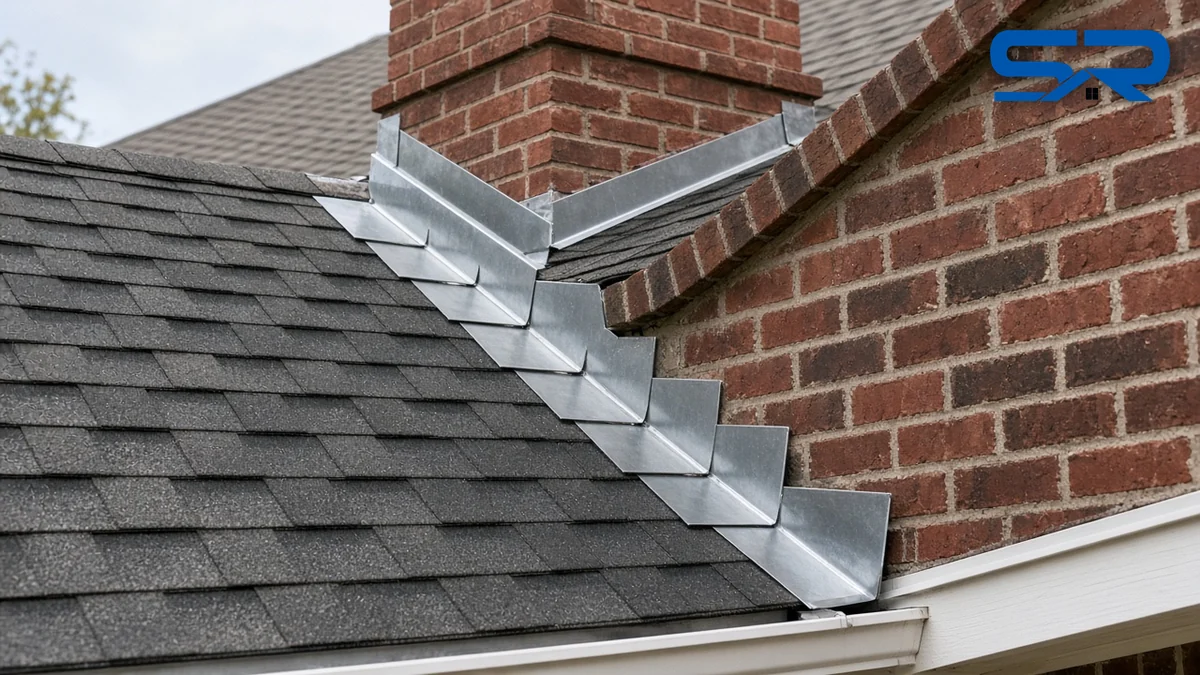
What counter flashing is and where it goes
Counter flashing, also called cap flashing, is the upper piece that covers the top edge of the step or base flashing. On a brick or stone wall or chimney, it should be set into the masonry — either into a cut mortar joint (a reglet, sometimes called a raggle) or built in as the wall was laid — and then folded down over the base metal. The Brick Industry Association describes inserting it about 3/4 to 1 inch into the joint, mortaring it solid, and lapping the base flashing by at least 3 inches. The two layers are not fastened to each other. CertainTeed's applicator instructions say not to fasten the cap flashing to the roof deck or to the step flashing, because the roof and the wall need to be able to move on their own.
The International Residential Code, Section R905.2.8.3, requires counter flashing at anchored masonry veneer sidewalls, in addition to the base or step flashing. On siding, the "counter" is often the siding itself lapped over the wall leg, ending a bit above the roof so debris can wash out. On commercial membranes, counter flashing often covers a termination bar.
How counter flashing fails
The failure we see most is counter flashing that was never cut into the wall. A surface-mounted piece, or just a thick bead of caulk over the top of the step flashing, dries, splits and lets water in behind the base metal. Mortar in an old reglet also cracks and falls out. Surface-mounted counter flashing can work on some commercial details when it is fastened correctly and kept sealed, but on a house chimney it is a weaker substitute for a cut-in reglet. Reused counter flashing that was pried out on a tear-off is often kinked and no longer sits tight in the joint.
What we do on every counter flashing job
- On masonry, we cut a reglet into the mortar joint, set new counter flashing into it, and seal the joint so the cap covers the base flashing below.
- We do not nail the counter flashing to the step flashing or to the roof deck.
- We replace damaged or pried-out cap flashing on a reroof instead of trying to rebend it into a joint it no longer fits.
- Where a cut-in joint is not possible, we tell you so and use a surface-mounted counter flashing only when that is the sound option, with fasteners and sealant that can be maintained.
We're certified with GAF, CertainTeed, Owens Corning, Atlas, Johns Manville, Carlisle, Tropical Roofing Products, Mule-Hide and Enviroshake, and many other roof manufacturers.
Counter flashing on metal roofs
On standing seam, the sidewall or headwall trim is the base flashing. Counter flashing still covers that wall leg on brick, stone or stucco, so water running down the masonry never gets behind the trim. We install the metal-roof trim and the masonry cap as one system.
Call (817) 733-9228 or request a free estimate for counter flashing repair in Decatur, Fort Worth or anywhere we work in DFW.
Residential warranty: a workmanship warranty from 10 years up to lifetime, depending on the job, with manufacturer warranties up to lifetime. Manufacturer coverage depends on the product and brand, and on the project qualifying for that manufacturer's program. We put the exact warranty for your roof in writing.
Certified, with 30 years installing every major roofing brand, a family roofing business going back 75 years, and over $80 million in completed roofing projects. 5.0 stars on Google at all three of our offices.
Request a free inspection or call (817) 733-9228. Small repairs are welcome too.