Foam types under ASTM C1029
ASTM C1029 classifies spray-applied rigid polyurethane insulation by minimum compressive strength. The International Building Code's sprayed polyurethane foam roofing section allows Type III or Type IV (or foam meeting ASTM D7425) for roofing.
| ASTM C1029 type | Minimum compressive strength | Used for roofing? |
|---|---|---|
| Type I | 15 psi | No |
| Type II | 25 psi | No |
| Type III | 40 psi | Yes |
| Type IV | 60 psi | Yes; for heavier traffic |
Compressive strengths from the ASTM C1029-20 abstract; code requirements from the IBC sprayed polyurethane foam roofing section (as published on UpCodes).
Density
Density is the weight of a cubic foot of cured foam, and it tracks strength: denser foam is stiffer and resists dents and foot traffic better. Roofing foam data sheets commonly list nominal densities around 2.5 to 3.0 pounds per cubic foot, well above wall foams. The data sheet for the exact product tells you its density, its C1029 type and its compressive strength; ask for it with the bid.
R-value and thickness
Roofing foam data sheets commonly list aged R-values around 6 to 7 per inch, so 2 inches of foam is roughly R-12 to R-14 and 3 inches roughly R-18 to R-21, depending on the product. Because SPF is sprayed in passes, it can be thicker in low areas to build slope toward the drains. Your city's adopted energy code sets the minimum insulation for a re-roof that removes insulation; we size the foam to it and put the thickness in the proposal.
| Spec item | What to look for |
|---|---|
| Foam type | ASTM C1029 Type III or IV, or D7425 |
| Density | From the product data sheet, typically around 2.5 to 3.0 lb/ft³ for roofing foam |
| Thickness | Minimum at the high points, plus added foam to build slope |
| Slope | At least 1/4 inch per foot for drainage, per the code section |
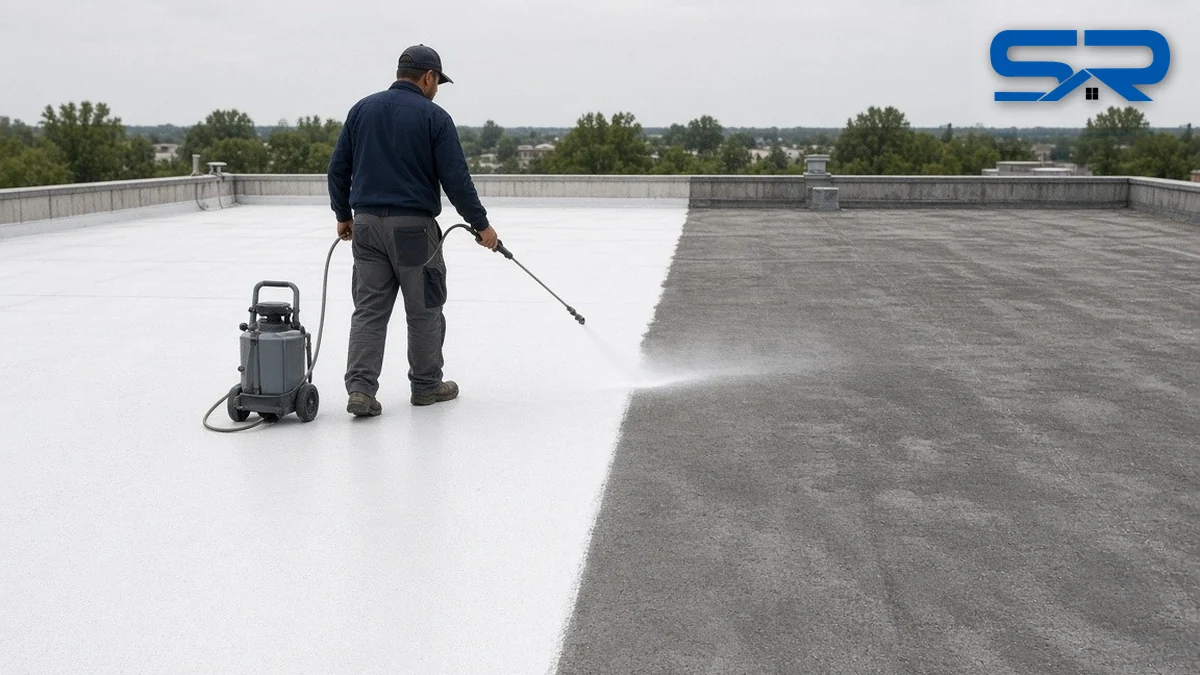
| Coating | ASTM D6083 acrylic, D6694 silicone or D6947 urethane, applied 2 to 72 hours after the foam; see coating dry film thickness |
| Granules / walk pads | Where foot traffic and equipment service are expected |
Hail, foot traffic and recoats
- Denser foam and a thicker coating resist hail bruising better; granules broadcast into the coating help too
- Small hail punctures and bruises are repairable; the key is sealing them before water and UV reach the foam
- The coating is the wear layer. Plan on inspections and recoats over the life of the roof
- Bare foam breaks down in sunlight, which is why the code sets a 72-hour limit on coating
Is SPF right for your building?
SPF can go over many existing roofs, adds insulation and slope in one step, and has no seams. It isn't the answer over wet insulation or a deteriorated deck, and it needs a contractor who controls overspray around vehicles, walls and HVAC intakes. Under the 2021 IBC reroofing rules (Section 1512), a new roof generally can't be laid over an existing roof that is water-soaked or deteriorated, or over one that already has two or more layers. A moisture survey and a core cut tell us which applies. We compare it with TPO, coatings and metal retrofits on one page with our multi-option bids.
Who we are
Owner Blake Snow has almost 40 years in the business, and the Snow family has been roofing in this market for 75 years. Snow Roofing started as a tier-one commercial company doing only large-scale work, including casino properties on the Mississippi Gulf Coast such as the Imperial Palace in 2006, right after Hurricane Katrina, before it expanded into residential. We've also done full exterior and interior rehabs on national-brand hotel properties around the DFW Metroplex. No job is too big or too small, Snow Roofing does them all. We're certified with GAF, CertainTeed, Owens Corning, Atlas, Johns Manville, Carlisle, Tropical Roofing Products, Mule-Hide and Enviroshake, and many other roof manufacturers. We have hands-on experience with coating systems from American WeatherStar (we're an American WeatherStar Approved Contractor), Carlisle and Tropical Roofing Products, plus EpoxyFlex, our own private-label coating, and we apply every major brand. We offer same-day response in almost every case, and we answer leak and storm calls 24/7 at (817) 733-9228.
Up to: spray foam roofing · SPF and coatings · commercial roofing.
Code sections and standards are summarized in plain English from the published documents. Your building official, the manufacturer's current specification and the warranty document have the final word.
Commercial warranty: a workmanship warranty from 10 years up to lifetime, depending on the job, plus manufacturer NDL (no-dollar-limit) warranties that typically run from 10 to 40 years, depending on the manufacturer, the system, and manufacturer approval of the finished job (we do not promise a specific NDL term until that approval is in place). Manufacturer coverage depends on the product and brand, and on the project qualifying for that manufacturer's program. We put the exact warranty for your roof in writing.
Certified, with almost 40 years in the business for owner Blake Snow, installing every major roofing brand, a family roofing legacy going back 75 years, and over $80 million in completed roofing projects. 5.0 stars on Google at all three of our offices.
Request a free inspection or call (817) 733-9228. Small repairs are welcome too.