
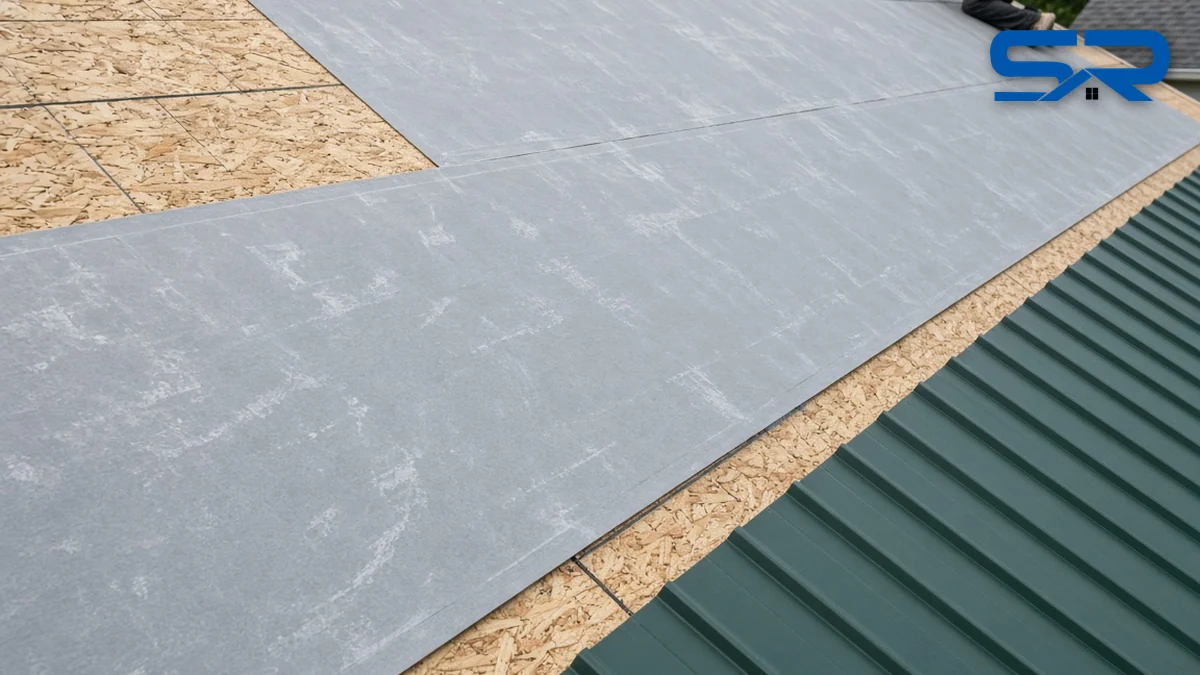




High-temp underlayment under standing seam is the part of a Westlake or Southlake metal roof you’ll never see again once the panels go on. It’s also the part that keeps water out if wind-driven rain ever gets past a seam, a flashing or a penetration.
I’m Blake Snow. I’ve been roofing for 30 years, and Snow Roofing & Exteriors is certified with Carlisle, GAF, CertainTeed and Owens Corning. All four make a high-temperature self-adhered underlayment that works under metal. This post puts their current data sheets side by side so you can read a bid and know what’s going under your panels.
The short answer
- Metal roofs need a high-temp membrane, not a standard peel-and-stick. Each maker sells one made for the heat under metal panels.
- Temperature ratings run 250°F to 260°F: Carlisle WIP 300HT and GAF StormGuard at 250°F; CertainTeed Vycor Ice & Water Shield HT and Owens Corning WeatherLock Specialty Tile & Metal at 260°F.
- Exposure limits range from 60 days to 6 months. It matters if a job gets held up, not much when panels are formed on site.
- They act as vapor barriers. Full-deck coverage needs proper ventilation.
- The panel maker’s instructions and the underlayment maker’s instructions both apply. Neither one replaces the other.
Side by side
| Carlisle CCW WIP 300HT | GAF StormGuard | CertainTeed Vycor Ice & Water Shield HT | CertainTeed WinterGuard HT X | Owens Corning WeatherLock Specialty Tile & Metal | Owens Corning Titanium PSU30 | |
|---|---|---|---|---|---|---|
| Type | Rubberized asphalt, polyolefin film top | Fiberglass-reinforced, film-surfaced | Rubberized asphalt, polymeric film top | SBS-modified asphalt, tear-resistant film top | Self-adhered, polyester non-woven top | High-temp self-adhered, Sure-Foot walking surface |
| Temperature rating | Up to 250°F | 250°F thermal stability | Up to 260°F | “Formulated to resist high roof temperatures under metal roofs” | Up to 260°F | Sold as high-temp; no °F figure on the May 2026 data sheet |
| Thickness | 40 mils | Meets ASTM D1970 (min. 40) | Not listed on product page | Not listed on install sheet | 65 mils | 45 mils |
| UV exposure before cover | 60 days (black), 120 days (white) | Up to 90 days | Up to 120 days | 6 months max | Up to 180 days | 180 days |
| Under metal, minimum slope | Full deck under metal at 1/2:12 and up (per Carlisle) | Not listed on data sheet | Not listed on product page | As low as 0.5:12 (some metal products need more) | See current install guide | 1/2:12 or greater |
| Metal notes | For copper and COR-TEN, consult Carlisle; don’t let it contact flexible PVC | Suitable for most metal; for copper or other non-asphaltic roofs contact GAF | Lists metal, slate, tile, cedar shakes and shingles | Film top “won’t scratch metal roofing applied over it” | “Without fusing or degrading overlying metal roofing” | Under standing seam and lapped, non-soldered metal with lap sealant |
| Code listings named | ICC-ES ESR-2206, ASTM D1970, FL6782 | ESR-1322, ASTM D1970, Miami-Dade, meets TDI requirements | Meets key self-adhered code requirements (per CertainTeed) | ASTM D1970 (per CertainTeed’s Florida-filed instructions) | ASTM D1970, Miami-Dade, Florida, TDI listed | CCRR-1024, Florida, Miami-Dade, FORTIFIED Roof, TDI |
Sources are listed at the bottom. Data sheets change, so we attach the current sheet for the product in your bid.
Why the temperature rating matters in North Texas
On a sunny summer day, the metal panels on a dark standing seam roof get much hotter than the air. The membrane sits right under them. A standard asphalt-based peel-and-stick isn’t made for that heat. Owens Corning says WeatherLock Specialty Tile & Metal is designed to withstand 260°F “without fusing or degrading overlying metal roofing.” That’s the whole point of a high-temp membrane: it stays put and doesn’t stick to or stain the panels above it.
GAF puts a warning in its StormGuard instructions that applies to every brand: not all building materials are made to touch each other. Incompatible leak barriers can soften, flow and drip, and that can stain fascia, gutters and the outside of the house. Using the right high-temp membrane, and not mixing in random sealants, is how you avoid that.
Brand by brand
Carlisle CCW WIP 300HT. Carlisle’s data sheet describes a 40-mil rubberized asphalt membrane rated to 250°F, made for metal including copper and COR-TEN (consult Carlisle first), and also usable under synthetic tile and asphalt shingles. It comes in black or white. Black can stay exposed up to 60 days; white up to 120. Carlisle says to install it when the deck is dry and 40°F or warmer, and under water-shedding metal or low-slope metal at 1/2:12 and up, to cover the full roof deck. It must not touch flexible PVC. The ICC-ES evaluation report, ESR-2206, reissued June 2026, lists Henry, a Carlisle company, as the report holder. It also lists the same underlayment sold under metal-panel brand names, including PAC-CLAD HT, Drexel Metals MetShield HT High-Temp Underlayment and AEP Span Underlayment HT. If your panel maker’s spec names one of those, you’re looking at the same evaluated product.
GAF StormGuard Film-Surfaced Leak Barrier. GAF’s data sheet says StormGuard’s high-temperature compound works with asphalt shingles and most metal roofing systems, with 250°F thermal stability and UV exposure up to 90 days. It’s fiberglass-reinforced with a blue patterned walking surface. For copper and other non-asphaltic roofs, GAF says to call its technical support. GAF lists ESR-1322, Miami-Dade approval, and says it meets Texas Department of Insurance requirements. Its install instructions call for a dry deck, air temperature between 45°F and 120°F, and back-nailing every 18 inches in the selvage edge. Under approved non-asphaltic roofs, GAF lists a 10-year limited warranty for StormGuard.
CertainTeed Vycor Ice & Water Shield HT. CertainTeed rates it to 260°F with up to 120 days of exposure. It’s a rubberized asphalt membrane with a polymeric film and a slip-resistant embossed surface. CertainTeed lists it for metal, slate, tile, cedar shakes and shingles, with side laps of at least 3.5 inches and end laps of at least 6 inches, applied at 40°F or warmer.
CertainTeed WinterGuard HT X. “HT” stands for High Tack, High Temperature. CertainTeed says it’s specially formulated to resist high roof temperatures under metal, with a tear-resistant film top that won’t scratch metal laid over it. CertainTeed’s installation instructions allow it under metal at slopes as low as 0.5:12, note that some metal products require more, cap exposure at 6 months, and say it’s a vapor barrier: if it covers the whole roof, the space under the deck needs enough ventilation to prevent condensation. CertainTeed’s product page doesn’t print a degree rating for HT X, so when we want a published 260°F number from CertainTeed, Vycor Ice & Water Shield HT is the one.
Owens Corning WeatherLock Specialty Tile & Metal. Owens Corning’s data sheet lists 65 mils, a 260°F rating, up to 180 days of exposure, a polyester walking surface and Texas Department of Insurance listing. It’s the thickest membrane in this group. Owens Corning also says it self-seals around fasteners used for building-applied solar panels, which matters if solar is in your plans.
Owens Corning Titanium PSU30. Owens Corning calls it a high-temp self-adhered underlayment with Sure-Foot technology for walking on steep slopes. The May 2026 data sheet lists 45 mils, 180 days of UV exposure, use on 1/2:12 and steeper, and notes it’s for use under standing seam panels and lapped, non-soldered seam metal roofs with applied lap sealant. It lists FORTIFIED Roof approval and Texas Department of Insurance. Owens Corning offers a Lifetime Limited Warranty on it. The data sheet doesn’t print a degree rating, so we go by Owens Corning’s high-temp label and the technical team.
Full coverage or just eaves and valleys?
This is the question that separates bids.
- Carlisle tells installers to cover the full roof deck under water-shedding metal and low-slope metal at 1/2:12 and up.
- They all act as vapor barriers. Every product here is listed to ASTM D1970, which sets a very low maximum vapor permeance, and Carlisle lists WIP 300HT at 0.02 perms. CertainTeed and Carlisle both say a roof with the membrane over the deck needs proper ventilation.
- The panel maker’s install guide can require a specific underlayment, coverage or slip sheet. We follow both sets of instructions.
On a Westlake or Southlake standing seam roof, we decide coverage by slope, the panel maker’s guide, the attic and ventilation, and where water concentrates: eaves, valleys, wall transitions, chimneys and skylights. Low-slope porches and modern low-pitch sections usually get full coverage. If a bid says “ice and water at the eaves,” ask what’s going over the rest of the deck, and whether the product is rated for metal.
How it ties into flashing
Underlayment is the backup; flashing is the first line. On metal, the membrane goes on before the trim, laps the right way, and runs up the walls behind the counter flashing. The details that leak most are wall transitions, chimneys and valleys. See our flashing pages, my metal roof flashing details post for Keller, and my step-by-step on switching from shingles to standing seam.
What goes in our standing seam proposals
- The exact underlayment by brand and product name, with the current data sheet attached
- Coverage: full deck, or which areas get the high-temp membrane and what goes over the rest
- Panel: 24 or 26 gauge, formed on site with our own roll formers, profile and seam type, color and finish
- Every metal roof we install is Class 4 impact rated under UL 2218
- Flashing details at walls, chimneys, valleys and skylights
- Ventilation plan, since the membrane is a vapor barrier
- Our workmanship warranty, from 10 years up to lifetime, depending on the job
A standing seam roof usually lasts a minimum of 40 to 50 years, so we want the layer under it to be right the first time. Our metal lead time is typically 1 to 2 weeks.
For panel brands, finishes and HOA review, see my posts on PAC-CLAD, Englert, Drexel and McElroy standing seam in Westlake, PVDF vs. SMP paint in Southlake, standing seam HOA review in Southlake and, if solar is coming, S-5! clamps for solar on standing seam.
Permits and storms in Westlake and Southlake
The Town of Westlake and the City of Southlake both review building work, and many neighborhoods have architectural committees. We confirm the current permit and HOA requirements and pull what’s required.
After hail, get the roof inspected before anyone patches it. Every inspection we do comes with a free digital photo report, with drone and thermal imaging. In Texas you generally have 1 year from the date of loss to file a claim, but check your policy. You can look up past storms for Tarrant and Denton Counties in NOAA’s Storm Events Database.
Talk to us about a standing seam roof in Westlake or Southlake
We install standing seam across Westlake, Southlake, Trophy Club, Colleyville, Keller and Roanoke. We’re certified with GAF, CertainTeed, Owens Corning, Atlas, Johns Manville, Carlisle, Tropical Roofing Products, Mule-Hide and Enviroshake, and many other roof manufacturers. We’re fully insured, BBB A+ rated, and have 5.0 stars on Google at all three offices: Bridgeport, Decatur and Rhome.
See our standing seam page, Westlake standing seam and Southlake standing seam pages, use the estimate form below, or call (817) 733-9228.
Sources
- Carlisle CCW: WIP 300HT product data sheet
- ICC-ES: ESR-2206, CCW WIP 300HT Underlayment (reissued June 2026)
- GAF: StormGuard Film-Surfaced Leak Barrier data sheet
- GAF: StormGuard installation instructions
- GAF: StormGuard product page
- CertainTeed: Vycor Ice & Water Shield HT
- CertainTeed: WinterGuard HT X
- CertainTeed: WinterGuard HT X installation instructions (Florida Product Approval FL48262)
- Owens Corning: WeatherLock Specialty Tile & Metal data sheet
- Owens Corning: Titanium PSU30 technical data sheet (May 2026)
- Owens Corning: Titanium PSU30 product page
- NOAA NCEI Storm Events Database