
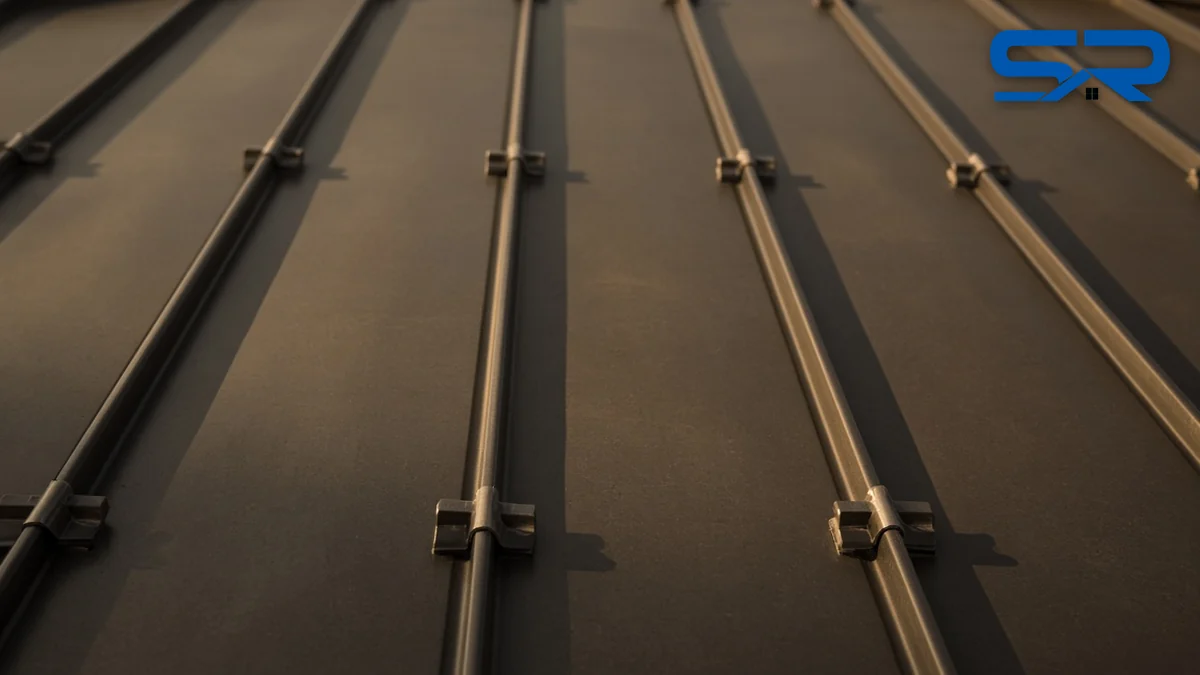
S-5! clamps for solar on a standing seam metal roof are how we answer the question Southlake and Westlake homeowners ask right after they sign for metal: “Can we still put solar on it later without drilling holes in our new roof?”
Yes, you can. I’m Blake Snow. I’ve been roofing for 30 years, and we form our standing seam panels on site with our own roll formers. A standing seam roof is built to move. The panels expand and contract with the heat, and the clips underneath let them slide. Screwing a solar rack straight through those panels into the deck does two bad things: it puts holes in a roof that didn’t have any, and it pins panels that are supposed to move. Seam clamps avoid both.
The short answer
- S-5! clamps grip the seam, not the panel. Setscrews press into the side of the raised seam. Nothing goes through the panel.
- The clamp has to match the seam. S-5! makes several clamps, and the right one depends on your seam’s shape and height.
- Mini clamps for solar, standard clamps for heavy loads. Minis use one setscrew; standard clamps use two and are built for jobs like snow retention.
- PVKIT 3.0 mounts solar to the clamps without rails. Fewer parts on the roof and a lower look.
- Plan it before the clamps go on. Southlake requires a permit for solar, and your HOA may have layout rules. A clamp moved later may not hold the same.
Why we don’t want holes in a standing seam roof
S-5! puts it plainly on its solar page: on a modern standing seam roof, the first rule is to do the roof no harm. That means don’t penetrate it and don’t keep it from moving with temperature changes. S-5! says anchoring through the roof to the structure threatens weather-tightness and pins the panels to the building.
Every hole added to a finished roof is one more spot that has to be sealed and flashed and stay that way. See my post on why most roof leaks start at the flashing and our metal roof flashing details post for Keller.
S-5-U vs. S-5-E vs. Mini clamps
These are the clamps that come up most on homes. From S-5!‘s current product pages:
| S-5-U | S-5-E | Mini versions (U Mini, E Mini) | |
|---|---|---|---|
| What it fits | Most standing seam profiles made in North and South America, including structural and architectural profiles. Can be turned 90° for many horizontal seams | Traditional 1” and most 1.5” double-folded standing seam (European style), in coated steel, aluminum and other metals | Same seams as the full-size version |
| Setscrews | Two T-30 Torx round-point setscrews | Two T-30 Torx round-point setscrews | One T-30 Torx round-point setscrew |
| Bolt | One M8 bolt included | One M8 bolt included | No bolt included |
| Built for | Heavy-duty jobs such as snow retention | Snow retention and other heavy-duty jobs | Light and medium duty: utility mounting and solar PV |
| How S-5! tests it | Load parallel to the seam (drag load) | Load parallel to the seam | Pull-up (negative load normal to the seam) |
| Listings S-5! shows (standard clamps only) | ICC-ES, UL 2703, LA County | ICC-ES, FPA HVHZ, IAPMO/UES, UL 2703, DIBt, CE | S-5! says its certifications apply to standard clamps only |
S-5! also makes other clamps for other seam types. Its S-5-U page names the S-5-V, S-5-E and S-5-S as more economical options for vertical seams. We use S-5!‘s clamp-to-seam selector and load tables to pick the clamp for the exact panel we’re installing.
What S-5! clamps won’t fit: S-5! says its clamps won’t fit face-fastened trapezoidal rib or corrugated panels (it has brackets for those), or hollow batten-seam panels. If you have an R-panel or PBR roof on a shop or barn, it’s a bracket job, not a clamp job.
Setscrew torque: the detail that matters most
The clamp only holds if the setscrews are tightened right. S-5! says its setscrews make a small dimple in the seam, and that’s what gives the clamp its holding strength.
- S-5! normally tests at 115 inch-pounds of setscrew tension.
- When the tested torque is 115, S-5! recommends installing in a window of 130 to 150 inch-pounds so the tested value is reached.
- Some heavier-gauge profiles are tested at higher torque, and then the window is higher too. The installation instructions for each clamp list the right number.
That means a calibrated driver, not “good and tight.” When we’re on the roof with a solar crew, this is one of the things we check.
How much load a clamp holds, and why clip spacing matters
S-5! says holding strength ranges from about ±300 lbs to ±4,000 lbs, depending on the load direction, the seam profile, the roof material and the clamp model. That’s why it tells installers to identify the exact panel, seam and gauge and check its load tables before a critical job.
There’s a second half to this. S-5! notes that loads pulling along the seam all add up at the panel’s point of fixity, and the panels have to be attached well enough to resist them. In plain terms, the clamps are only as good as the clips and fasteners holding the panels down. We set clip spacing for the roof’s wind design when we install it. If solar or snow guards are coming, tell us up front and we’ll plan the clip layout with those loads in mind.
On our roofs that’s 24- or 26-gauge steel, formed on site, and every metal roof we install is Class 4 impact rated under UL 2218. Gauge and profile both go into the load table, so we hand the solar designer the exact panel specs.
PVKIT 3.0: rail-less solar on the seams
PVKIT 3.0 is S-5!‘s rail-less solar mounting system. The modules attach straight to S-5! clamps (or brackets on exposed-fastener roofs) without rails. From S-5!‘s PVKIT 3.0 page:
- Uses S-5! clamps and brackets as the roof attachment (“DirectAttach”)
- Fits module frames from 1.0 to 1.4 inches (26 to 35 mm)
- Standard low-profile setup, with an optional 50 mm riser for more airflow or wiring room
- Preassembled parts that install with a single tool
- UL 2703-compliant bonding and grounding
- Not limited to purlin locations, which gives the designer more layout freedom
- S-5! says it uses 70% fewer components than rail-mounted systems and cuts mounting-system weight by 85%
Rail-based solar works too. S-5! clamps can carry a rail system on the same seams. Your solar designer picks the racking; we make sure it attaches to the roof the right way.
Other add-ons: snow guards, HVAC, signs
The same clamps carry more than solar. S-5! says its clamps and brackets mount everything from HVAC units to snow guards. The one that comes up most in North Texas is snow retention after an ice storm. Sheets of ice can slide off a metal roof all at once onto a porch, walkway or car.
S-5!‘s ColorGard 2.0 snow guard is a bar system that clamps to the seams. S-5! says it uses a strip of the actual roof material in the bar so the color matches, works with all standing seam profiles, and carries a free lifetime material/defect warranty, with a limited lifetime performance warranty available. S-5! also warns that guards only over a doorway don’t work well. Snow and ice shear diagonally, so the guard ends up holding a much bigger wedge than you’d expect. We lay out snow guards along the whole run above the area you’re protecting.
Metals have to match
S-5! says galvanic compatibility is “extremely important.” Mixing the wrong metals can cause rapid corrosion and void material warranties. S-5! says its aluminum clamps are compatible with painted or unpainted Galvalume and G-90 galvanized steel, among others, and it makes a brass clamp for copper. On a copper accent roof, that’s the clamp to ask for.
Southlake permits and Westlake reviews
Southlake. The City of Southlake’s permit list includes solar panels, EV chargers and battery storage. Its solar PV checklist asks for:
- A roof plan with the equipment locations, any fire setbacks, and the percentage of roof covered by the array
- A side view showing the array follows the roof slope with its top edge parallel to the roofline
- The make, model and quantity of modules, inverter and racking, with racking certified to UL 2703
- The method of sealing or flashing for roof penetrations
- A note that plumbing vents can’t end under the array; they have to be moved or changed
Southlake’s checklist also lets you choose third-party plan review and inspection. With seam clamps, that “roof penetrations” line is a short answer: there aren’t any through the panels.
Westlake. The Town of Westlake reviews building permits too, and many Westlake neighborhoods have their own architectural review. We confirm the current town and HOA requirements before anything goes on your roof.
Your HOA and Texas law. Under Texas Property Code Section 202.010, a property owners’ association generally can’t ban solar. For roof-mounted panels it can still require that they stay at or below the roofline, follow the roof slope with a top edge parallel to the roofline, and have frames, brackets and visible wiring in a silver, bronze or black tone. It can also enforce rules against devices that void material warranties as installed or that went in without required HOA approval. Clamped, rail-less mounts on a standing seam roof fit those rules well. For the full HOA process on metal roofs, see my post on standing seam for luxury homes and HOA review in Southlake.
What to ask a solar installer before they touch your standing seam roof
- Which S-5! clamp, and how did you match it to my seam? Ask for the clamp model and the load table they used.
- Will anything go through the panels? On standing seam, the answer should be no.
- What torque will the setscrews get, and with what tool? It should match S-5!‘s instructions for that clamp.
- Is the racking certified to UL 2703? Southlake’s checklist asks for it.
- Where do the wires and conduit go? No loose wiring dragging across the panels, and no new holes for conduit without a plan for flashing it.
- Who do I call if there’s a leak? Get it in writing. We’re glad to walk the layout with your solar company before they start.
Plan it with the roof, not after
The easiest time to plan solar is when the roof is being designed. Here’s what we do on a standing seam job when solar or snow guards are coming:
- Choose a seam profile that works with the clamp and the solar layout
- Set clip spacing with the added loads in mind
- Hand the solar designer the panel gauge, profile and seam dimensions
- Leave room for the array to stay below the roofline and parallel to it
- Plan vent and flashing locations so nothing ends up under the array
A standing seam roof usually lasts a minimum of 40 to 50 years, which means it can outlast more than one set of solar panels. Our metal lead time is typically 1 to 2 weeks.
Talk to us about solar-ready standing seam in Southlake or Westlake
We install standing seam across Southlake, Westlake, Colleyville, Keller, Trophy Club and Grapevine. We’re certified with GAF, CertainTeed, Owens Corning, Atlas, Johns Manville, Carlisle, Tropical Roofing Products, Mule-Hide and Enviroshake, and many other roof manufacturers. We’re fully insured, BBB A+ rated, and have 5.0 stars on Google at all three offices: Bridgeport, Decatur and Rhome. Our workmanship warranty runs from 10 years up to lifetime, depending on the job.
Every inspection comes with a free digital photo report, with drone and thermal imaging. If hail has already hit your roof, in Texas you generally have 1 year from the date of loss to file a claim, but check your policy.
See our standing seam page, Southlake standing seam and Westlake standing seam pages, and my post on why we form metal panels on site. Use the estimate form below or call (817) 733-9228.
Sources
- S-5!: S-5-U clamp (product page, specs, setscrew torque and load FAQs)
- S-5!: S-5-E clamp
- S-5!: PVKIT 3.0 rail-less solar mounting
- S-5!: Solar panels on metal roofs
- S-5!: ColorGard 2.0 snow guards
- City of Southlake: When is a building permit required?
- City of Southlake: Solar Photovoltaic (PV) System Checklist
- Texas Property Code Section 202.010: Regulation of solar energy devices