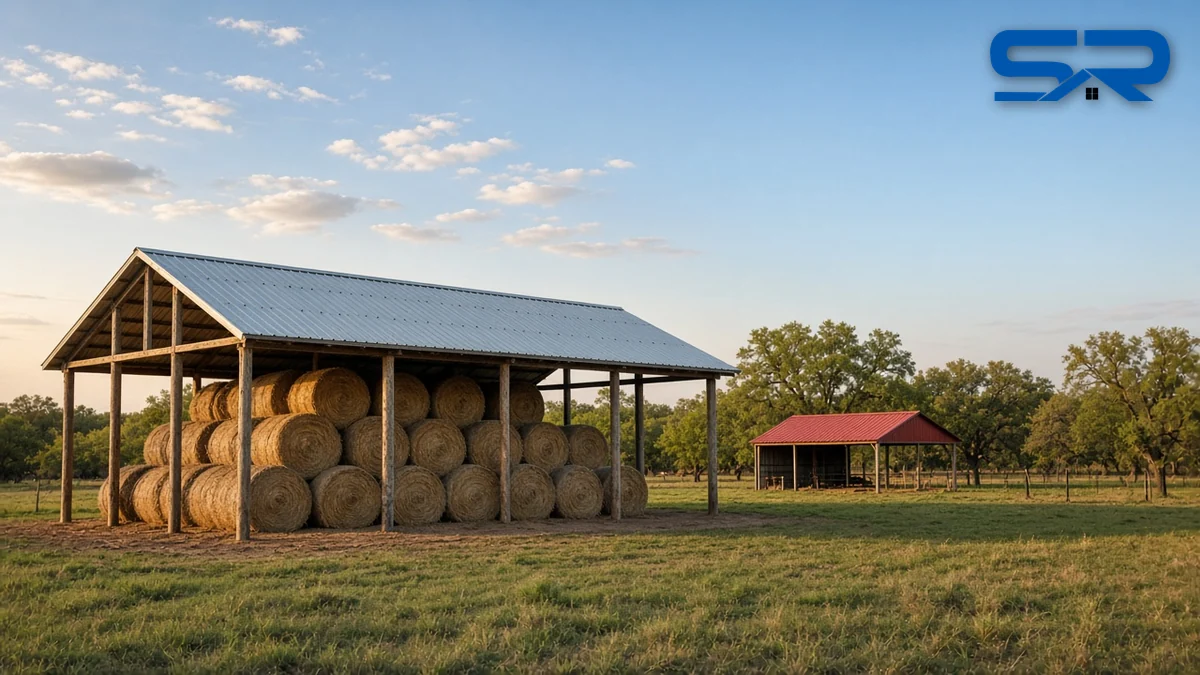
Drive any county road out of Decatur and you’ll count pole barns faster than houses. Some hold round bales, some hold a tractor and a shredder, and some do a little of everything. They’re simple buildings: posts in the ground, trusses or rafters on top, purlins across, and a metal roof. Because they’re simple, the roof is almost the whole building. When the roof goes, whatever is underneath goes with it.
I’m Blake Snow. I’ve been roofing for 30 years, I’m the third generation in a family business that goes back 75 years, and our crews have completed over $80 million in roofing projects. We have offices in Bridgeport, Decatur and Rhome, so Wise County barns are home turf for us. Here’s what I tell owners around Decatur, Bridgeport, Alvord, Boyd, Chico, Paradise and Slidell before they put a new roof on a pole barn or hay barn.
A pole barn roof is different from a house roof
On a house, shingles sit on solid decking, and the decking spreads the load. On a pole barn, the metal panel spans open air from one purlin to the next. That changes what matters:
- Purlin spacing decides which panel and gauge will carry the load and hold the screws. Panels are rated for a certain span. If the purlins are spread too far apart for the panel, the roof can flex, oil-can and work its screws loose.
- Every screw has to hit wood or steel. A screw that misses the purlin is a leak and a weak spot at the same time.
- The building is usually open on one or more sides. That changes how the wind treats the roof, which I’ll get to next.
- There’s often no ceiling, insulation or vapor barrier. Whatever happens on the underside of the steel happens right over your hay.
Our barn roofing page covers the full range of barns we roof. This post sticks to pole barns and hay barns.
Open sides and wind uplift
An enclosed shop has the wind pushing on its walls and pulling across its roof. An open-sided hay barn also lets the wind get underneath the roof and push up. That’s why pole barn roofs so often fail at the open eave, at the corners and along the rakes first. Once one sheet lifts, the next one goes easier.
What we do about it:
- Fasten to the panel maker’s schedule for the building, with tighter spacing at eaves, rakes, ridges and corners, where uplift is strongest.
- Close the edges with proper trim. Eave trim, rake trim and ridge cap keep the wind from grabbing the end of a sheet.
- Check the connections we can see. Purlins that are loose on the rafters, or rafters that are loose on the posts, will take a new roof with them. If the framing needs work, I’ll tell you up front.
Wise County gets real storms. NOAA records show 2-inch hail at Decatur on March 26, 2017, and 3-inch hail at Boyd on April 8, 2024. You can look up your own area in NOAA’s Storm Events Database. Big hail can dent any metal, but a 24 or 26 gauge panel doesn’t crack or shed granules the way shingles do, and a well-fastened roof is much harder for the wind to peel.
Panel choices for a pole barn
Most pole barns and hay barns get an exposed-fastener panel like R-panel or PBR. They span open purlins well, go on fast over big footprints, and can be repaired a sheet at a time. PBR adds a purlin bearing leg at the side lap so the overlap sits tight on the purlin, which I like on wide-open buildings. Corrugated is there if you want a classic barn look.
We run 24 or 26 gauge. On a hay barn sitting out in open pasture, taking the full wind, I’ll often steer you toward the heavier side.
If the barn sits near the house and you want it to match, we can do the house in standing seam and the barn in R-panel or PBR in the same color. That’s a common setup on Wise County acreage, and we covered it in our post on roofing the house and the shop together.
Hay barns: keep the bales dry
Hay is worth too much to lose to a roof problem. Three things matter most:
Condensation. Bare steel over open framing can sweat on cool, humid nights and drip onto the top row of bales. Panels with a drip-stop backing, or a vapor barrier or insulation under the steel, stop most of it. Airflow at the eaves and ridge helps too. Our post on condensation control in Chico explains why it happens.
Overhang on the weather side. Rain blowing in under the eave soaks the outside bales. A wider overhang, or a lean-to on the side that takes the weather, keeps more of the stack dry. We add lean-tos and extend overhangs in matching panel and color.
Water off the roof. A long barn roof dumps a lot of water at the eave. If it lands where you stack hay or park equipment, we can add gutters or redirect it. Our gutter services team handles that on the same trip.
Re-roof, repair or re-screw?
A lot of the pole barns around Decatur are 20, 30 or more years old. When an owner calls, the question is usually whether to patch it or start over. Here’s how I sort it out on site:
- Re-screw and spot repair when the panels are sound, the leaks are at old screws and washers, and only a few sheets or some trim are damaged.
- Re-panel the roof when rust has eaten through the panels or the laps, the screw holes are worn out, or several runs are bent or torn loose.
- Fix the framing first when purlins are rotted, sagging or loose. New steel on bad purlins won’t last.
Our metal roof repair and restoration page goes deeper on leaks at screws, seams and flashing. Up in Montague County, we wrote about ag building roofs around Bowie, which covers the re-screw versus re-panel call in more detail. I’ll give you a straight answer, even when the smaller job is the right one. No job is too small, whether it’s a full hay barn or a few sheets on a loafing shed.
Panels made to length, on our own roll formers
Long barns have long roof runs. We run our own roll formers and our own crew, so we form panels cut to the length each run needs. Most runs go in one piece from ridge to eave with no end laps to leak. We explained why that matters in our post on long panel runs in Graham. Metal lead time is typically one to two weeks.
If a storm damaged your barn
If your barn is insured and a storm damaged it, take photos and call your agent. In Texas, claims generally need to be filed within one year from the date of loss, but check your policy. We give you a free digital photo report of the roof, so you can see the damage without climbing up.
Wise County barns, start to finish
We roof pole barns, hay barns, shops and barndominiums, equestrian barns and arenas, and commercial buildings across Wise County, the DFW Metroplex and towns within about 65 miles of Bridgeport. Our workmanship warranty runs from 10 years up to lifetime, depending on the job. We’re certified with GAF, CertainTeed, Owens Corning, Atlas, Johns Manville, Carlisle, Tropical Roofing Products, Mule-Hide and Enviroshake, and many other roof manufacturers. We’re BBB A+ rated and have 5.0 stars on Google at all three offices: Bridgeport, Decatur and Rhome.
Call (817) 733-9228 or request an estimate. I’ll come out, walk the barn with you, check the panels, screws, purlins and framing, and tell you straight whether it needs a repair or a new roof.