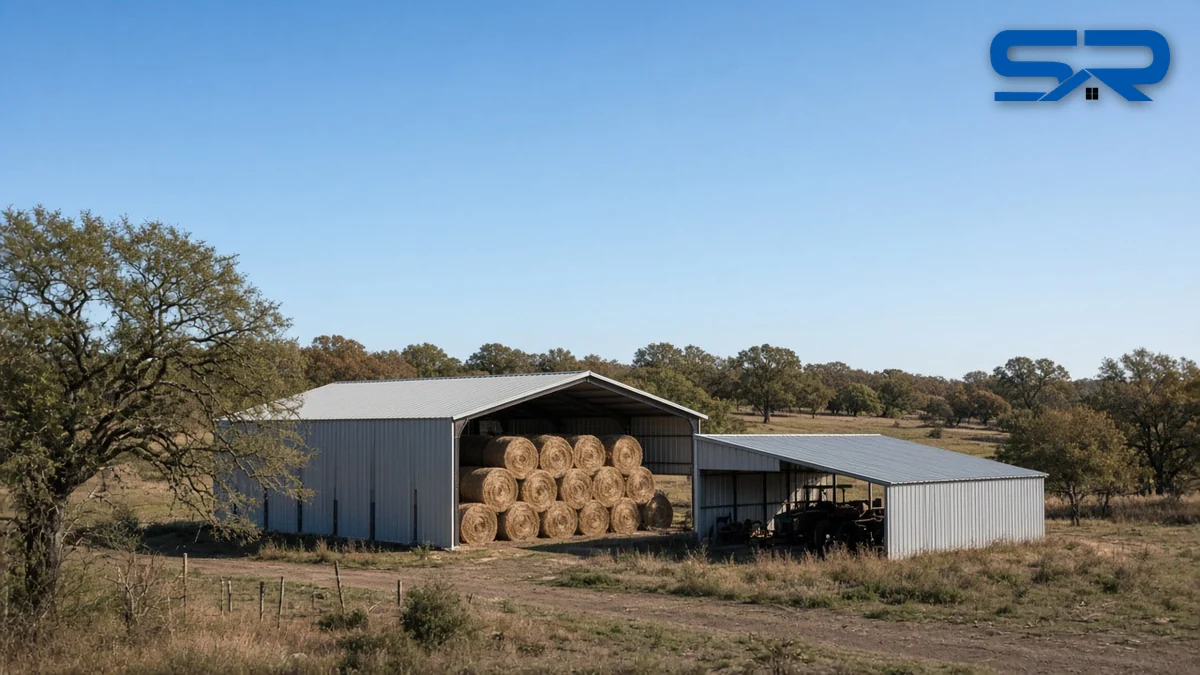
Drive US-287 through Bowie and you’ll pass more hay barns, equipment sheds, loafing sheds and working shops than houses. Out here an ag building isn’t a side project. It protects hay, feed, equipment and livestock that a family depends on, and the roof is the part that takes the beating.
I’m Blake Snow. I’ve been roofing for 30 years, I’m the third generation in a family business that goes back 75 years, and our crews have completed over $80 million in roofing projects. Here’s what I tell folks around Bowie, Nocona, Montague, Saint Jo and Sunset when they ask about roofing a barn or shop the right way.
Wind is the real test in Montague County
Hail gets the headlines, but on ag buildings the wind does a lot of the damage. Open-sided barns and sheds catch air underneath the roof, and that pushes up on the panels while the wind pulls across the top. When a roof fails, it usually starts at an edge, a corner or a loose run of screws, and then whole sheets peel back.
You don’t have to look far for an example. The NOAA Storm Prediction Center’s preliminary report for November 2 to 3, 2026 lists a tin roof blown off a building in downtown Nocona. That wasn’t our building, but it’s a good reminder of what a strong line of storms can do to metal that isn’t tied down well.
Here’s what keeps a metal ag roof on:
- Screws in the right place. Every screw has to land in a purlin, not just in the panel. Misses leave a hole that leaks and a panel that isn’t held.
- Tighter fastening at the edges. Eaves, rakes, ridges and corners see the strongest uplift, so they need the most attention. We fasten to the panel maker’s schedule for the building.
- Good trim. Eave trim, rake trim and ridge cap aren’t just for looks. They close the edges so wind can’t get a grip on the end of a sheet.
- Solid framing. A new roof is only as strong as the purlins under it. If the old purlins are rotted, bent or loose, we’ll tell you before we put new steel on top.
R-panel, PBR or something else
Most barns and sheds around Bowie get an exposed-fastener panel like R-panel or PBR. Both have tall ribs and flat pans and go on quickly over open purlins. PBR (purlin bearing rib) adds a small leg at the side lap so the overlap sits on the purlin and stays tight, which I like on wide-open buildings. We also offer corrugated panel for a more classic barn look.
We run 24 or 26 gauge steel. On a building that sits out in the open and takes the full wind and hail, I’ll often steer you toward the heavier side.
If the building is a shop with living space, an office or a barndominium, standing seam is worth a look. It hides the fasteners under the seams, so there are no screws through the face to check later. We covered the tradeoffs in our post on barndominium roofs in Boyd, and our shop and ag buildings page goes deeper.
Re-screw or re-panel?
After a windstorm, a lot of barn owners figure they need a whole new roof. Sometimes that’s true. Often it isn’t. Here’s how I sort it out on site:
Re-screwing and spot repair can make sense when:
- The panels are flat, sound and not rusted through.
- The damage is limited to a few sheets, some trim or one corner.
- The screw holes aren’t badly worn, or we can step up to a larger screw.
- The purlins are solid.
Re-paneling makes more sense when:
- Rust has eaten through the panels or the laps.
- Screw holes are worn out across the roof and leaks keep coming back.
- Several runs have been bent, creased or torn loose.
- The old panel profile can’t be matched for clean repairs.
Our metal roof repair page covers fixes at screws, seams and flashing. I’ll give you a straight answer about which one fits your building, even when the smaller job is the right one. And no job is too small, whether it’s a full barn or a few sheets on a lean-to.
Condensation, livestock and hay
Bare steel over open purlins can sweat on cool, humid nights and drip onto whatever is below. On a hay barn or an equipment shed, that drip means moldy bales or rusty equipment. A drip-stop backing on the panels, a vapor barrier or insulation can stop it. We wrote more about this in our post on condensation control in Chico.
If animals will be kept inside an enclosed building, tell me up front. Many Galvalume panel warranties exclude enclosed animal confinement buildings, so we’ll pick a panel and finish that suits the use.
Long runs, made on site
Big barns have long roof runs. We run our own roll formers and our own crew, so we form panels on the job, cut to the length each run needs. Most runs go in one piece from ridge to eave with no end laps to leak. That matters on a long barn roof, and we explained why in our post on long panel runs in Graham. Metal lead time is typically one to two weeks.
If a storm hit your building
If your barn or shop is insured and a storm damaged it, document the damage with photos and call your agent. In Texas, claims generally need to be filed within one year from the date of loss, but check your policy. We give you a free digital photo report of the roof, so you can see the damage without climbing up.
Bowie and Montague County
We serve Bowie, Nocona, Montague, Saint Jo, Sunset, Forestburg and the rest of Montague County from our offices in Bridgeport, Decatur and Rhome. We cover the DFW Metroplex and towns within about 65 miles of Bridgeport. Barns, shops, arenas, churches and commercial buildings are all part of what we do. If you have horses, our post on equestrian barns and arenas in Paradise is worth a read.
Let’s look at your barn
Our workmanship warranty runs from 10 years up to lifetime, depending on the job. We’re certified with GAF, CertainTeed, Owens Corning, Atlas, Johns Manville, Carlisle, Tropical Roofing Products, Mule-Hide and Enviroshake, and many other roof manufacturers. We’re BBB A+ rated and have 5.0 stars on Google at all three offices: Bridgeport, Decatur and Rhome.
Call (817) 733-9228 or request an estimate, and I’ll come out, walk the building with you, check the panels, screws and purlins, and tell you straight whether it needs a repair or a new roof.