
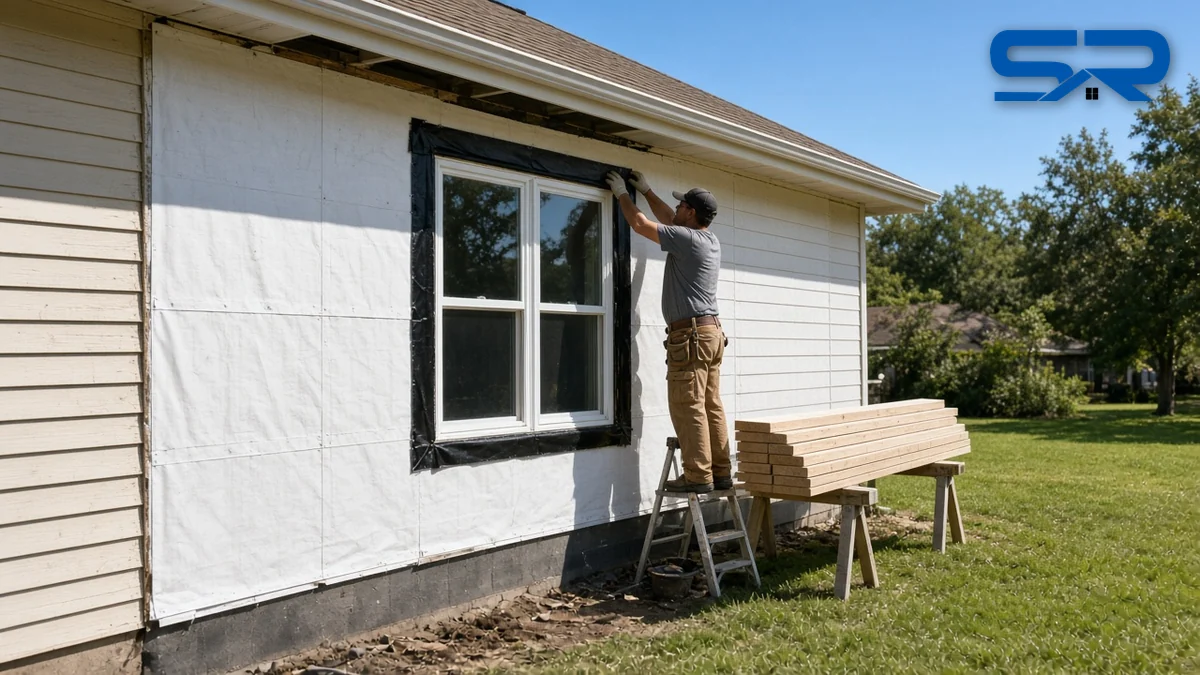
When a house in Decatur is getting new siding, the old windows are suddenly easier to reach than they will ever be again. The siding is off, the house wrap is exposed and every opening is right there. That’s the best time to decide about replacement windows, and the most important part of the job is the part nobody sees once the trim goes back on: the flashing.
I’m Blake Snow. I’ve been roofing and building for 30 years, I’m the third generation in a family business that goes back 75 years, and our crews have completed over $80 million in roofing projects. Our office is right here in Decatur, and our own crews do siding, windows, trim, soffit, gutters and paint. Here’s how I handle windows on a re-sided house so they stay dry for the life of the siding.
The short answer
- If the windows are tired, do them with the siding. You won’t get easier access again.
- Use full-frame windows when the siding is off. Pull the old unit, fix the opening, flash it right.
- Flash bottom to top. Sill first, sides next, head last, so every layer sheds water onto the one below.
- Caulk is a backup. It isn’t what keeps water out of the wall.
- Finish with trim and siding that leave room to drain.
Full-frame or insert?
| Insert (pocket) window | Full-frame window | |
|---|---|---|
| What comes out | Sash and stops; old frame stays | The whole unit, down to the rough opening |
| Works best when | Old frame is solid and the siding is staying | Siding is coming off, or the frame or sill is rotten |
| Flashing | Relies on the old frame’s flashing, plus sealant | New flashing lapped into new house wrap |
| Glass area | Slightly smaller | Same as, or close to, the original |
| What I check | Frame, sill and interior trim | Rough opening, sill framing and sheathing |
On a re-side, I almost always recommend full-frame. With the siding already off, it’s the one chance to look at the framing under every window. If water has been getting in, that’s where you’ll see it.
Why window flashing matters
Most wall leaks I find don’t start in the middle of a wall. They start at a window corner, under a sill or where a roof line dies into a wall. The International Residential Code (section R703.4) requires flashing at exterior window and door openings, installed so water is directed to the outside, and the industry’s window installation standard, ASTM E2112, lays out how it’s done. The idea is simple: water will get past the siding sometimes, so the layers behind it have to send it back out.
The flashing order, step by step
Here’s how our crews set a new full-frame window into a wall that’s being re-sided:
- Pull the old window and inspect the opening. Soft or stained framing and sheathing get cut out and replaced.
- Prep the house wrap. The wrap is cut so a flap at the top of the opening can fold up out of the way and come back down over the head flashing later.
- Sill first. Flashing tape or a formed sill pan goes on the sill, turned up the sides of the opening and lapped out over the wrap below. Any water that gets under the window has a way out.
- Set the window. Plumb, level and square on shims, fastened through the fin per the manufacturer. The bottom fin is left so water can drain out over the sill flashing.
- Jambs next. Side flashing tape goes over the side fins and laps over the sill flashing.
- Head last. Head flashing goes over the top fin and laps over the side flashing. Then the wrap flap folds down over the head flashing and gets taped.
- Head flashing on the trim. A drip cap or head flashing above the trim keeps water off the top of the window.
- Siding and trim. Siding is cut to leave the clearances the siding manufacturer calls for at the trim, and sealant goes only where the manufacturer calls for it.
Every lap follows the same rule as shingles on a roof: upper layers over lower layers, never behind them.
Common mistakes I see on re-sides
| Mistake | What happens |
|---|---|
| New siding over old windows that were never flashed | Leaks keep going behind brand-new siding |
| House wrap tucked behind the sill flashing | Water runs into the wall instead of out |
| Sill fin taped shut | Water under the window has nowhere to drain |
| Caulk used instead of flashing | Fine for a year or two, then it cracks |
| No head flashing or drip cap over trim | Water sits on top of the trim and rots it |
| Insert windows in rotten frames | The rot keeps spreading where you can’t see it |
Hail, glass and screens
Decatur sees real hail. NOAA recorded 2-inch hail at Decatur on March 26, 2017, and 3-inch hail at Boyd, about seven miles south, on April 8, 2024 (NOAA NCEI Storm Events Database). Hail can crack glass, dent metal window wraps and shred screens. If the windows took hail along with the siding, photograph everything before repairs and ask your adjuster how your policy handles windows and siding. Texas generally gives you 1 year from the date of loss to file a claim; check your policy. More on our Decatur storm damage page.
Doing it in the right order
- Roof first, if it’s due, so roof work doesn’t damage new walls. If you’re thinking about metal roofing in Decatur, we form standing seam and R-panel on our own roll formers in 24 or 26 gauge.
- Tear off siding and inspect the walls.
- Windows and flashing.
- House wrap repairs, siding and trim.
- Soffit and fascia and gutters.
- Paint.
One crew handling it all means nobody blames the last trade when a window leaks.
Before you sign: questions for any window and siding bid
- Are the windows full-frame or insert, and why?
- Who inspects and repairs the rough openings?
- Is a sill pan or sill flashing included at every window?
- What flashing tape and house wrap are you using, and in what order?
- Is head flashing or a drip cap included over the trim?
- Who handles the permit?
- What are the window, siding and workmanship warranties, in writing?
Nearby towns
We replace windows and siding all around our Decatur office, including Bridgeport, Paradise, Boyd, Alvord, Chico, Rhome and Newark.
Let’s look at your windows
We’re certified with GAF, CertainTeed, Owens Corning, Atlas, Johns Manville, Carlisle, Tropical Roofing Products, Mule-Hide and Enviroshake, and many other roof manufacturers, and we install all brands of windows and siding to manufacturer specs. Snow Roofing & Exteriors is fully insured, has offices in Bridgeport, Decatur and Rhome, is A+ rated on the BBB, and has 5.0 stars on Google at all three offices: Bridgeport, Decatur and Rhome. References are available on request. Our workmanship warranty runs from 10 years up to lifetime, depending on the job.
Call (817) 733-9228 or request an estimate. I’ll walk the house with you, check every window opening and give you a free digital photo report.