
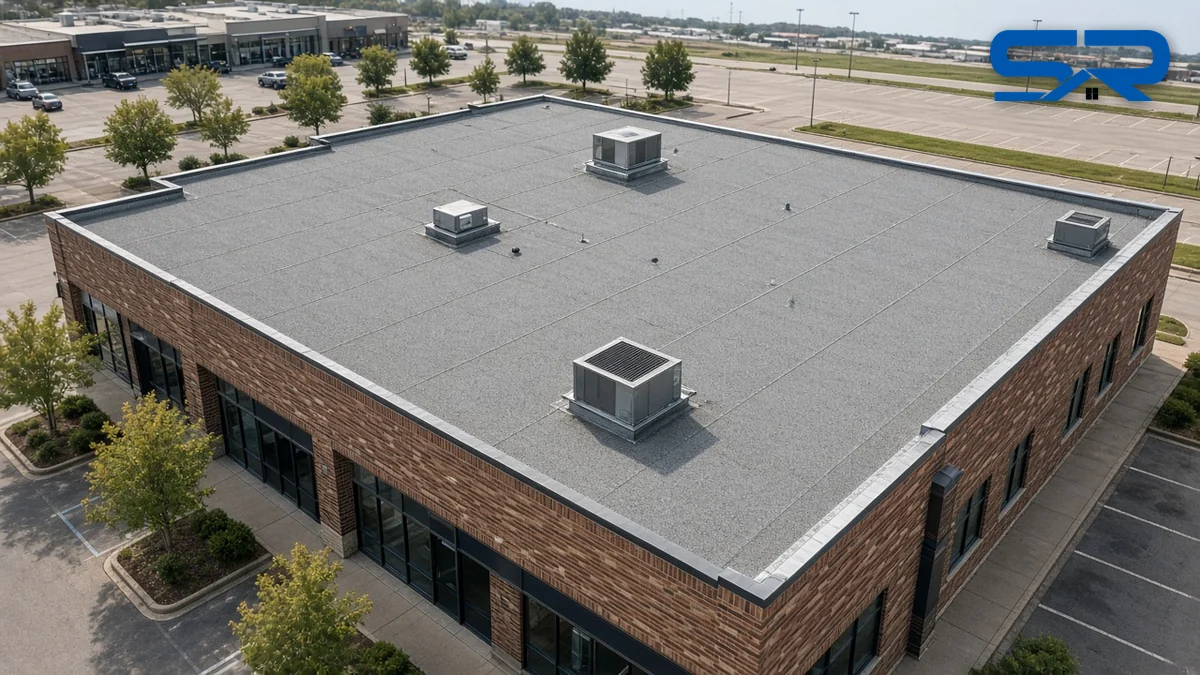
In Southlake, Westlake and the nicer parts of Fort Worth, commercial roofs get specified differently. Medical offices, private schools, Class A office buildings, retail with rooftop terraces, and mixed-use buildings with plaza decks over parking all tend to get heavy multi-ply roofs, and Siplast’s SBS systems show up on a lot of those specs. Siplast’s North American headquarters is in Dallas, so their reps and field techs are close by.
I’m Blake Snow. I’ve been roofing for 30 years, and we’ve worked on and repaired Siplast SBS roofs. If you’re comparing Siplast’s granulated cap sheet against GAF, CertainTeed, SOPREMA and others, read my granulated mod-bit cap sheet comparison first. This post is different: it explains the three Siplast SBS systems you’ll see on Southlake and Fort Worth specs, Paradiene 20/30 FR, Teranap and Veral, what each is for, and what Siplast’s current guarantee guide says about them.
The short answer
- Exposed low-slope roof on an office, school, medical or retail building: Paradiene 20/30 FR, a two-ply, granule-surfaced SBS roof.
- Plaza deck, rooftop terrace, pool deck over occupied space, or vegetated roof: Teranap waterproofing, a Paradiene 20-series base ply with a Teranap 1M finish ply under pavers, ballast, insulation or soil.
- Flashings everywhere, plus finish plies on roofs with at least 1/2-inch slope: Veral, the aluminum-faced SBS sheet. Siplast says it’s commonly used as the flashing sheet in Paradiene, Parafor and Paratech systems.
These aren’t really competitors. On a big Southlake project you can see all three: Paradiene on the main roof, Teranap on the terrace, and Veral on the walls and curbs.
Side-by-side: Siplast’s published data
| Paradiene 20 (base ply) | Paradiene 30 FR (finish ply) | Teranap 1M GS (waterproofing ply) | Veral Aluminum | |
|---|---|---|---|---|
| Role | Base ply / base flashing ply | Granulated finish ply | Finish ply under overburden; GS version also listed as a Paradiene finish ply option | Foil-faced finish ply and flashing sheet |
| Reinforcement | Lightweight random fibrous mat | Lightweight random fibrous glass mat | Fiberglass scrim / nonwoven polyester mat composite | Fiberglass scrim / fiberglass mat composite |
| Surface | Mineral parting agent | No. 11 ceramic granules (standard A-720 white) | No. 11 ceramic granules (Sand and Film versions also made) | Continuous aluminum foil |
| Thickness | 87 mils min. (91 avg.) | 137 mils min. | 180 mils (data sheet minimum) | 146 mils min. (150 avg.) |
| Standard | ASTM D6163 Type II, Grade S | ASTM D6163 Type I, Grade G | ASTM D6162 Type II, Grade G | ASTM D6298 |
| Laps | 3 in. sides and ends | 3 in. sides and ends | 4 in. sides and ends | 3 in. sides and ends |
| Application | Torch, cold adhesive, SFT adhesive, hot asphalt, self-adhered versions | Cold adhesive (PA-311 series or SFT); torch-grade (TG) and self-adhesive (SA) versions in the family | Torch; Sand and GS also in cold adhesive or hot asphalt; Film is torch only | Torch preferred; SFT Adhesive in approved systems |
| Low-temp flexibility | -15°F | -15°F | -5°F | -18°C (about 0°F) |
| Listings | UL 790 classified, FM Approved (listed assemblies) | UL 790 classified, FM Approved; passes ASTM D5849 cyclic fatigue bonded to Paradiene 20 | Passes ASTM D5849 cyclic fatigue alone or bonded to Paradiene 20 | FM 4470 for listed steel and concrete deck assemblies; UL 790 classified |
Sources: Siplast’s Paradiene 20 and Paradiene 30 FR data sheets (©2026), the Teranap 1M GS data sheet, Teranap torch-applied product page and Teranap installer’s guide, and the Veral Aluminum data sheet and Veral brochure. Values are Siplast’s typical or minimum published values.
Paradiene 20/30 FR: the exposed roof
This is the Siplast system most Southlake and Fort Worth building owners will actually walk on. Two plies of SBS-modified bitumen give you redundancy: if the top ply gets punctured by a dropped tool or a hailstone, there’s a full second ply under it. The white No. 11 ceramic granules protect the asphalt from UV and keep the roof cooler than a dark cap.
What to look at on a Paradiene bid:
- Which base ply. Siplast’s guarantee guide ties guarantee length to the base ply. Standard Paradiene 20-series base plies are listed up to 25 years over approved cover boards; the Paradiene 20 HT and 20 EG base plies are listed up to 30 years.
- How it’s attached. Paradiene can be torched (TG versions), set in Siplast’s cold adhesives (PA-311 series or SFT), self-adhered (SA versions) or set in hot asphalt. On an occupied medical or school building, cold or self-adhered application avoids open flame at the walls and penetrations.
- What’s under it. The guarantee guide lists approved cover boards (Parabase, DensDeck types, Securock and others). The cover board matters as much as the membrane for hail.
Teranap: plaza decks, terraces and green roofs
Teranap is the system for horizontal waterproofing that ends up buried: pavers on pedestals over a parking garage, a rooftop amenity deck, a ballasted protected roof, or a vegetated roof. Siplast describes the Teranap assembly as two SBS layers: a Paradiene 20-series base ply fully adhered to the concrete, then a Teranap 1M finish ply fully adhered to the base ply.
Things that make Teranap different from an exposed roof:
- Flood or electronic leak testing before the overburden goes on. Siplast’s installer guide describes an ASTM D5957 flood test (drains plugged, 1 to 2 inches of water for at least 24 hours, on surfaces sloped no more than 1/4 inch per foot) or electronic leak detection. Once pavers and soil are down, finding a leak is expensive. Testing first is the whole point.
- Wider laps: Teranap 1M GS is lapped 4 inches at sides and ends, versus 3 inches for Paradiene and Veral.
- Protection course required: the guarantee guide lists approved protection layers like drainage mat, protection board, XPS over polyethylene, or a root barrier for vegetated roofs.
- Exposed flashings still need a UV-rated sheet: Siplast says UV-exposed flashings can be done with Veral, Parafor 30 or 50, or Paradiene 40 FR sheets, or Siplast’s liquid flashings.
- Guarantee: Siplast’s guide lists Teranap waterproofing with overburden up to 30 years over primed structural concrete or Insulcel RT. Siplast also offers optional overburden removal and replacement coverage for a fee, with limits on what overburden qualifies (for example, not poured concrete toppings or tile in a setting bed).
Veral: foil-faced finish ply and flashing
Siplast says it introduced Veral in 1958 as the first high-performance foil-clad roofing product. Today’s Veral Aluminum is an SBS sheet with a continuous aluminum foil face over a fiberglass scrim/mat. The foil protects the SBS from UV and heat, and Siplast says it allows for differential expansion and contraction, which is why it shows up on parapet walls, curbs and other high-stress flashing areas.
Two rules worth knowing:
- Slope: Siplast’s guarantee guide allows a Veral finish ply in place of a granule-surfaced finish ply only with at least 1/2-inch slope. On a dead-flat roof, plan on granules.
- Base ply: Siplast says the Veral system typically pairs a smooth base ply, Irex 40 or Paradiene 20, with the Veral finish ply. Torching is the preferred application, with SFT Adhesive allowed in approved systems.
Siplast’s Veral brochure lists guarantee options up to 30 years for qualified systems.
Which Siplast system fits which Southlake or Fort Worth building
| Building | Main roof | Terraces / decks | Flashings |
|---|---|---|---|
| Medical or professional office, flat roof | Paradiene 20/30 FR (cold or self-adhered near occupied space) | — | Veral or Paradiene flashing sheets |
| Retail or mixed-use with a rooftop amenity deck | Paradiene 20/30 FR | Teranap under pedestals and pavers | Veral at walls and curbs |
| Building over a parking structure with a plaza | — | Teranap on structural concrete, flood tested | Veral at exposed walls |
| Sloped low-slope roof (1/2 inch per foot or more) where the owner wants foil | Veral system over Irex 40 or Paradiene 20 | — | Veral |
Siplast guarantees: what to get in writing
Siplast’s site says its roof membrane guarantees come in 10-, 20-, 25- and 30-year terms depending on the assembly, and its waterproofing guarantees in 5-, 10- and 20-year terms depending on the system. The guarantee guide (rev. 9/2026) adds that “full system” coverage including insulation requires all components to be purchased from Siplast, and Siplast’s comparison chart treats ponding water differently depending on the guarantee type and whether the membrane is exposed or protected.
Siplast’s Teranap installer guide says only properly trained Siplast Select Contractors experienced in these systems should install them. So before you sign, ask the bidder for the exact guarantee name, term, and Siplast’s approval of the project. We’ll tell you up front how we’d handle your building, and we can also price an equivalent multi-ply SBS roof from manufacturers we’re certified with, including GAF, CertainTeed and Johns Manville, so you can compare.
Questions to ask on a Siplast bid
- Which base ply (Paradiene 20, 20 HT, 20 EG, 20 TS, SA) and which finish ply?
- How is it attached: torch, cold adhesive (which one), self-adhered, or hot asphalt?
- What cover board and insulation, and is the insulation in the guarantee?
- For terraces: Teranap with what protection course, and will you flood test or leak-scan before overburden?
- Does the roof have at least 1/2-inch slope anywhere Veral is used as a finish ply?
- What’s the exact Siplast guarantee name and term, and has Siplast approved the project?
- How are drains, crickets and ponding handled?
- Who does the final inspection?
Hail, storms and claims
Southlake and northeast Tarrant County get real hail. A two-ply SBS roof has redundancy, but hail can still bruise or fracture the membrane, and the damage isn’t always obvious from the ground. Get it inspected and documented; our FAA-certified drone pilot can fly the roof (see our drone roof inspection page). Check storm history in the NOAA NCEI Storm Events Database. In Texas it’s generally 1 year from the date of loss to file a claim, but check your policy.
Talk to us about a commercial roof in Southlake or Fort Worth
We install, repair and replace low-slope commercial roofs across Southlake, Westlake, Grapevine, Colleyville, Keller, Trophy Club and Fort Worth. We’re certified with GAF, CertainTeed, Owens Corning, Atlas, Johns Manville, Carlisle, Tropical Roofing Products, Mule-Hide and Enviroshake, and many other roof manufacturers. Commercial jobs can carry 10- and 20-year NDL warranties, and our workmanship warranty runs from 10 years up to lifetime, depending on the job. We’re fully insured, BBB A+ rated, and have 5.0 stars on Google at all three offices: Bridgeport, Decatur and Rhome.
See our modified bitumen page, Southlake commercial roofing page and Fort Worth commercial roofing page, read my Polyglass mod-bit and TPO post, use the estimate form below, or call (817) 733-9228.
Sources
- Siplast: SBS-modified bitumen products
- Siplast: Paradiene 20 data sheet
- Siplast: Paradiene 30 FR data sheet
- Siplast: Teranap, torch-applied
- Siplast: Teranap 1M GS data sheet
- Siplast: Teranap waterproofing systems installer’s guide
- Siplast: Veral, torch-applied
- Siplast: Veral Aluminum data sheet
- Siplast: Veral brochure
- Siplast: Roofing and waterproofing guarantee guide (rev. 9/2026)
- Siplast: Guarantee information
- NOAA NCEI Storm Events Database