
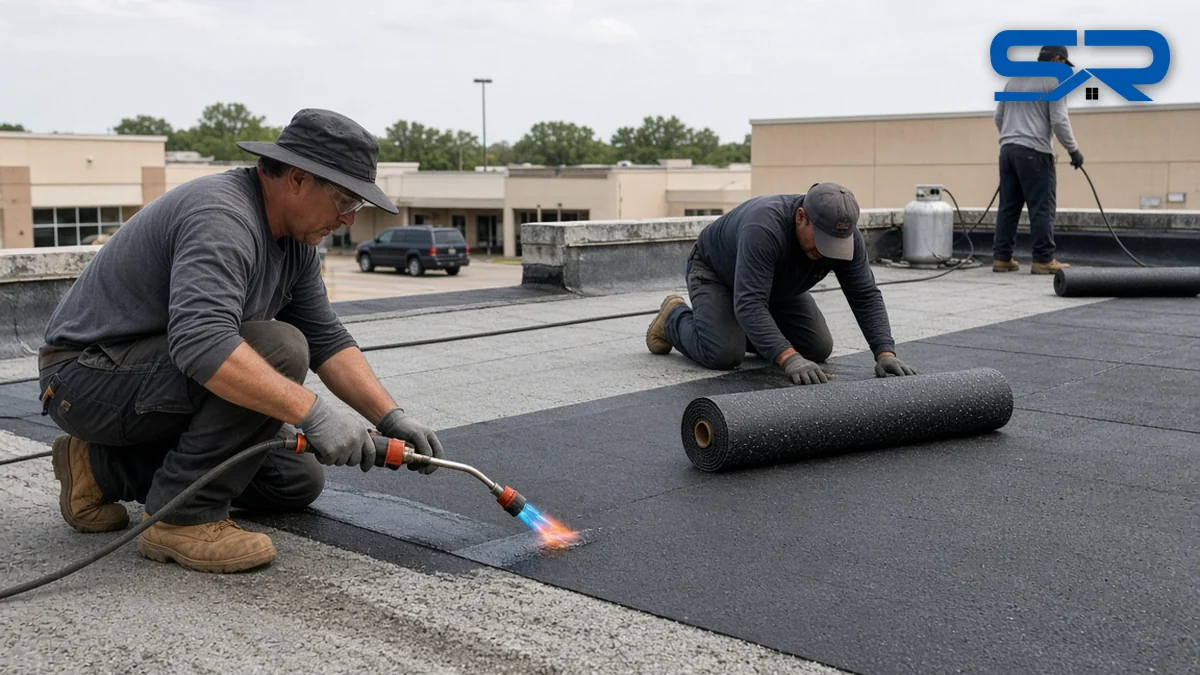


Around Bridgeport and across Wise County, modified bitumen is still one of the most common roofs on commercial and institutional buildings: the low-slope sections on churches, older strip retail along US 380, small offices, school additions and a lot of shops with a flat roof tied into a metal one. When it’s time to re-roof, owners get bids naming four or five different cap sheets, and every one of them is described as “premium.” The names don’t tell you much.
I’m Blake Snow. I’ve been in roofing for 30 years. We’re certified with GAF and CertainTeed, and we’ve installed and repaired SOPREMA and Siplast mod-bit systems too. This post puts the granulated cap sheets you’re most likely to see on a Bridgeport-area bid side by side, using each manufacturer’s own published data, and explains which differences actually matter. If you’re comparing Polyglass specifically, read my Polyglass mod-bit post.
The short answer
- The cap sheet is the top layer, not the whole roof. Compare the full system: base sheet(s), cap sheet, how they’re attached, and the warranty behind them.
- Three choices matter more than the brand: SBS or APP asphalt, polyester or glass reinforcement, and torch, hot-mop, cold adhesive or self-adhered installation.
- All four of these manufacturers make good sheets. The best one for your building is the one whose system fits your deck, your occupants and your warranty goals, installed to the manufacturer’s specs.
The cap sheets side by side
| Product | Maker | Asphalt | Reinforcement | Thickness (published) | How it goes down |
|---|---|---|---|---|---|
| Flintlastic GTA | CertainTeed | APP | Polyester | 160 mils (4.0 mm), 103 lb per square | Torch |
| Flintlastic SA Cap | CertainTeed | SBS | Polyester | 4.0 mm (157 mils), about 95 lb per roll | Fully self-adhered |
| RUBEROID Mop Granule | GAF | SBS | Polyester | 140 mils | Hot asphalt or cold adhesive |
| RUBEROID 30 Granule FR | GAF | SBS, fire-resistant | Fiberglass | Per GAF data sheet | Per GAF system spec |
| RUBEROID EnergyCap HW 30 Granule FR | GAF | SBS, fire-resistant | Fiberglass | Per GAF data sheet | Heat-welded, bright white granules |
| RUBEROID Torch Granule | GAF | APP | Polyester | 165 mils | Torch |
| SOPRALENE FLAM 250 FR GR | SOPREMA | SBS, fire-retardant | Non-woven polyester | Per SOPREMA data sheet | Heat-welded (burn-off film underside) |
| Paradiene 30 FR | Siplast | SBS | Glass mat | 137 mils minimum | Cold adhesive or torch-applied Paradiene 20/30 systems (per Siplast) |
Sources: CertainTeed Flintlastic GTA and Flintlastic SA Cap product pages and data sheet; GAF RUBEROID Mop Granule data sheet, RUBEROID 30 Granule FR, EnergyCap HW 30 Granule FR and RUBEROID Torch Granule; SOPREMA SOPRALENE FLAM 250 FR GR; Siplast Paradiene 30 FR data sheet. Values are the makers’ typical or minimum values, not guarantees for every roll.
What each maker is known for
CertainTeed Flintlastic. CertainTeed calls Flintlastic GTA its “workhorse” APP torch cap and offers it in eight colors plus CoolStar reflective surfacing. Flintlastic SA Cap is the cap sheet of CertainTeed’s fully self-adhered Flintlastic SA system: no torch, no kettle, just a weighted roller. CertainTeed’s data sheet lists SA Cap as UL 2218 Class 4 and in 11 colors, and notes a Texas Department of Insurance listing (RC-47). CertainTeed says its asphaltic warranties run 10 to 25 years, including its Integrity Roof System NDL warranty, depending on the system.
GAF RUBEROID. GAF has the broadest lineup here. RUBEROID Mop Granule is a 140-mil polyester SBS cap that goes down in hot asphalt or cold adhesive, with a Texas Department of Insurance listing (RC-49). RUBEROID 30 Granule FR is a glass-mat, fire-resistant SBS cap that GAF says needs no coating for a UL Class A rating, with typical guarantees up to 15 years and select systems up to 20. EnergyCap HW 30 Granule FR adds bright white granules for a reflective roof, and RUBEROID Torch Granule is GAF’s APP torch cap.
SOPREMA SOPRALENE. SOPREMA describes SOPRALENE FLAM 250 FR GR as an SBS cap ply on a non-woven polyester mat with ceramic-coated granules on top and a polyolefin burn-off film underneath for heat welding. It’s used as both the field cap and the flashing cap in SOPREMA multi-ply assemblies.
Siplast Paradiene. Siplast’s Paradiene 30 FR is the finish ply of the Paradiene 20/30 FR system: a glass-mat SBS sheet with No. 11 ceramic granules (white is standard), 3-inch side and end laps, FM Approved and UL classified assemblies. Siplast’s data sheet says the finish ply bonded to the Paradiene 20 base ply passes ASTM D5849 cyclic fatigue testing.
SBS vs. APP in a Wise County summer
Both work in Texas. The practical differences:
- SBS stays rubbery in the cold and can be installed several ways, including cold and self-adhered systems. Most of the sheets above are SBS.
- APP is designed for torching, and CertainTeed notes APP’s toughness in high-UV climates and its popularity in the South and West.
What matters more in our heat is what’s on top: granule color and reflectance. A dark granulated cap can run very hot in July. White or reflective granules (CertainTeed CoolStar, GAF EnergyCap, Siplast’s standard white) keep the surface cooler. If a cool roof matters for your building, ask for a reflective cap by name.
Torch, mop, cold or self-adhered?
This is the question I spend the most time on with Bridgeport owners, because it’s about safety and disruption as much as the roof:
- Torch / heat-weld (Flintlastic GTA, RUBEROID Torch Granule, EnergyCap HW, SOPRALENE FLAM 250 FR GR): fast and proven, but it’s open flame. On wood decks, around combustible details or on occupied buildings, it needs strict fire-watch practices.
- Hot asphalt (RUBEROID Mop Granule and others): the classic built-up method. It means a kettle and asphalt fumes on site.
- Cold adhesive (RUBEROID Mop Granule, Paradiene 30 FR and others): no flame and no kettle, but cure time depends on weather.
- Self-adhered (Flintlastic SA Cap): no flame, no kettle, low odor. CertainTeed’s pitch is speed and safety on occupied buildings.
For a church with services on Sunday, a daycare, a restaurant or a building with a wood deck, I usually start the conversation with cold-applied or self-adhered systems.
Which cap sheet I’d look at, building by building
| Your Bridgeport-area building | What I’d usually look at | Why |
|---|---|---|
| Occupied church, school addition or daycare | CertainTeed Flintlastic SA system, or a cold-applied SBS system | No open flame, low odor |
| Strip retail with lots of rooftop units | SBS polyester cap (e.g., RUBEROID Mop Granule or SOPRALENE FLAM 250 FR GR) over a proper base sheet | Polyester stretches and resists tearing around traffic and curbs |
| Building where a cool, white roof matters | GAF EnergyCap, CertainTeed CoolStar or Siplast white granules | Reflective surfacing |
| Low-slope section that shows from the ground next to a shingle roof | Flintlastic SA Cap or GTA in a color that blends | CertainTeed offers several true-blend colors |
| Owner or architect asking for a high-end multi-ply system with a long guarantee | Siplast Paradiene 20/30 FR or a GAF/CertainTeed NDL system | Full-system testing and longer guarantee options |
| Wet insulation or a failing deck | Fix the deck and insulation first | No cap sheet fixes wet insulation |
Hail, warranties and what we put in writing
A Class 4 lab rating (like the one CertainTeed lists for Flintlastic SA Cap) is good to have, but it’s not hail coverage. Most manufacturer warranties exclude hail; that’s what your property insurance is for.
On warranties, the system decides the term. CertainTeed’s asphaltic warranties run 10 to 25 years by system; GAF lists up to 15 years typical on RUBEROID 30 Granule FR and up to 20 on select systems; Siplast and SOPREMA publish their own guarantee programs. On our commercial bids we offer 10-year and 20-year NDL (No Dollar Limit) warranty options at different prices, and our own workmanship warranty runs from 10 years up to lifetime, depending on the job. Every bid names the base sheet, the cap sheet, the attachment method and the warranty behind it.
What to ask before you sign a mod-bit bid
- Which cap sheet by exact product name, and which base sheet(s)?
- SBS or APP? Polyester or glass mat?
- How is each layer installed: torch, hot asphalt, cold adhesive or self-adhered?
- If it’s torched, what’s the fire-watch plan?
- Is the new roof going over the old one, or is it a tear-off? What did the moisture survey show?
- What insulation and cover board are going down, and how are they attached?
- What granule color, and is it a reflective cap?
- What warranty, how many years, and is it NDL?
- How are walls, curbs, drains and the metal edge flashed?
- Who pulls the permit and schedules the inspection?
If you’re weighing mod-bit against TPO or a coating, see our TPO vs. mod-bit vs. coating guide. If your old roof is gravel built-up, my APOC, Henry and Karnak post covers when that roof can be coated instead.
After a storm
Get the roof inspected and documented before anyone patches it. Our commercial hail claims page covers what to photograph and record. In Texas you generally have 1 year from the date of loss to file a claim, but check your policy.
Talk to us about a mod-bit roof in Wise County
We install and repair modified bitumen roofs on commercial buildings across Bridgeport, Decatur, Chico, Boyd, Paradise, Rhome and Runaway Bay. We’re certified with GAF, CertainTeed, Owens Corning, Atlas, Johns Manville, Carlisle, Tropical Roofing Products, Mule-Hide and Enviroshake, and many other roof manufacturers. We’re fully insured, BBB A+ rated, and references are available on request. We have 5.0 stars on Google at all three offices: Bridgeport, Decatur and Rhome.
See our modified bitumen roofing and Bridgeport commercial roofing pages, use the estimate form below, or call (817) 733-9228.