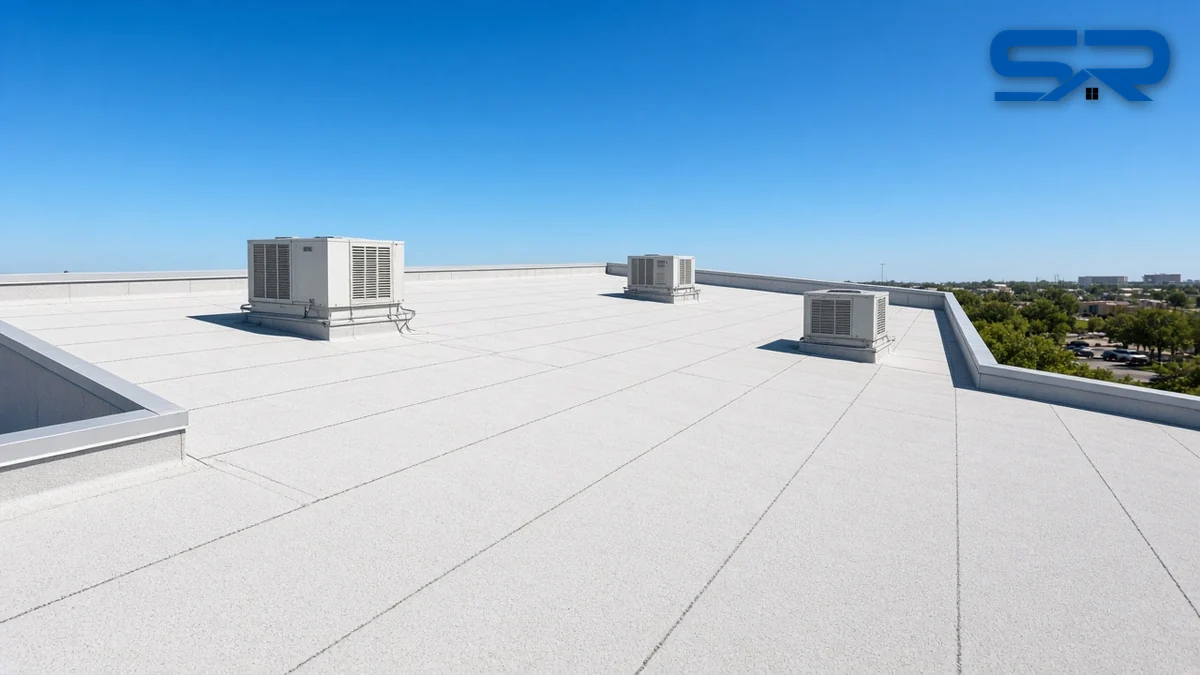
Fort Worth has a lot of low-slope roofs: strip centers, warehouses, churches, schools, medical offices and older downtown buildings. When an owner or property manager asks me about a two-ply modified bitumen roof, Polyglass is one of the names that comes up.
I’m Blake Snow. I’ve been roofing for 30 years, and we have experience installing and repairing Polyglass systems. This post sticks to what Polyglass itself publishes, then adds what I’d check before signing a Polyglass proposal on a Fort Worth building.
Who Polyglass is
From Polyglass’s 2026 commercial roofing systems brochure:
- Polyglass is an ISO 9001:2015 certified maker of modified bitumen roofing and waterproofing, with over 30 years in the U.S.
- It has been part of the Mapei Group since 2008.
- North American headquarters is in Deerfield Beach, Florida. The brochure lists U.S. manufacturing in Fernley, NV; Hazleton, PA; Winter Haven, FL; Waco, TX; and Phoenix, AZ, plus European headquarters in Italy.
That Waco plant is a practical point for Fort Worth owners. It’s a short haul up I-35, and Polyglass says its plant network can service most of the country in a few days.
The Polyglass product families, in plain English
| Polyglass line | What it is | Where it fits on a Fort Worth building |
|---|---|---|
| APP membranes (Polyflex family) | Modified bitumen made with atactic polypropylene; base, interply and granulated cap sheets | Heat-welded or torch-applied two-ply roofs; self-adhered versions too |
| SBS membranes (Elastoflex family) | Modified bitumen made with styrene-butadiene-styrene rubber; more flexible | Two-ply systems, flashings, self-adhered base sheets |
| ADESO self-adhered (SA) membranes | Patented dual-compound sheets: APP or SBS on top, self-adhesive compound on the bottom | Torch-free installs on occupied buildings, schools, near combustible walls |
| Polyfresko cap sheets | Reflective “thin film” granulated cap sheets in torch, SBS and SA versions | Cool-roof cap sheet over a Polyglass base |
| Polystick underlayments | Self-adhered underlayments made with ADESO | Under steep-slope metal, tile and shingles |
| Mapeplan TPO | Polyglass’s single-ply TPO line | Single-ply option with its own warranty matrix |
| Coatings | Acrylic and silicone roof coatings | Restoring existing roofs; can extend some warranties |
Polyglass lists self-adhered membranes such as Polyflex SA P, Elastoflex SA V, Elastoflex SA V Plus and Polyfresko G SA, and two cold-weather “Polar” products (Elastoflex SA V Polar Base and Elastoflex SA P Polar Cap) that it says can go down at temperatures as low as 25°F. That’s useful on a North Texas winter job where a standard self-adhered sheet won’t bond well.
Polyfresko: the reflective cap sheet
A dark granulated cap sheet bakes in a Fort Worth August. Polyglass’s answer is Polyfresko, which it describes as a cap sheet with a factory-applied reflective thin film over the granules. The brochure lists a CRRC rating for the rated product of 0.77 initial / 0.68 aged solar reflectance and 0.90 / 0.88 thermal emittance, and says the cap sheets are FM Approved, UL Classified, Miami-Dade approved and listed with the Texas Department of Insurance (check the data sheet for each product’s exact approvals). As part of a Polyglass multi-ply system, Polyglass lists a Class A fire rating.
Reflectivity numbers like these are what building owners need for energy codes, LEED points or just lower cooling bills on the top floor.
Why self-adhered matters on occupied buildings
Polyglass says its ADESO sheets use a true APP or SBS weathering compound on top and an aggressive self-adhered compound on the bottom, with patented lap features (it calls one SEALLap). The practical benefits:
- No open flame on the field of the roof. That’s a big deal on churches, restaurants, schools and buildings with wood parapets or rooftop equipment.
- No kettle and no hot-asphalt smell pulled into rooftop air intakes.
- Faster, cleaner installs while tenants keep working below.
Polyglass also lists hybrid assemblies: a self-adhered base with a torch-applied premium cap. We pick based on the building, the substrate and the warranty you want.
The warranty tiers most proposals don’t explain
Polyglass’s technical guide describes three kinds of coverage. They’re very different.
| Warranty type (Polyglass) | What it covers | Terms | Who can offer it |
|---|---|---|---|
| Limited Material | Membrane free from manufacturing defects that affect watertightness; liability capped at the original cost of the defective membrane | 10, 12, 15, 20, 30 yr | Any installer |
| Labor & Material | Same defect coverage, plus the labor to install replacement membrane; capped at membrane cost plus that labor | 10, 12, 15, 20, 25, 30 yr | Polyglass Registered, Preferred and Quantum contractors (no cost) |
| Roofing System Warranty (NDL) | The membrane is free of defects and the roof stays watertight for the term | 10, 12, 15, 20, 25, 30 yr | Preferred and Quantum contractors only; fees apply |
The 2026 brochure adds extended self-adhered assemblies: for example, 20 years with an Elastoflex SA V Plus base and a Polyglass SA cap, and 25 or 30 years with an interply sheet and specific caps, which it says are available only to Preferred and Quantum contractors. Polyglass also says highly reflective coatings can extend warranty terms.
For Mapeplan TPO, Polyglass’s 2026 warranty matrix lists 10, 15 and 20 years for 60 mil; up to 25 years for 60 mil MT and 80 mil; and up to 30 years for 80 mil MT and the 60 and 80 mil Hybrid Systems. It says 25- and 30-year terms are for Premio Pro contractors only and require Mapeplan accessories and metal flashings, and that NDL warranties are for non-residential low-slope roofs unless Polyglass approves otherwise in writing.
What that means for you: two “20-year Polyglass roof” quotes can be completely different promises. Ask which form you’re getting, by name, and ask for a sample. Polyglass posts sample warranties on its warranty page, along with owner maintenance guidelines. Follow those guidelines and keep the records, because maintenance is part of keeping coverage.
Hail and Fort Worth commercial roofs
No manufacturer warranty is hail insurance. A defect warranty covers manufacturing problems, not storm damage. After a hail storm, get the roof inspected and documented before anyone patches it. Granule loss, bruised cap sheet and fractured mat can be hard to see without a close look and sometimes a core cut. In Texas you generally have 1 year from the date of loss to file a claim, but check your policy. See our commercial roof hail damage and insurance claims page.
Polyglass mod bit vs. TPO vs. coating
Polyglass itself argues that a multi-ply modified bitumen system gives several layers of defense and keeps its thickness over time. Single-ply TPO is lighter and often cheaper per square foot, and a coating can buy years on a sound roof. Each has a place. Our TPO vs. modified bitumen vs. coating guide walks through the trade-offs, and we’ve also written about Holcim Elevate TPO and EPDM, Duro-Last PVC and Versico TPO and EPDM on Fort Worth roofs.
What goes on our Polyglass proposals
- System by name: base, interply (if any) and cap sheet, and install method (self-adhered, torch, heat-weld or hybrid)
- Insulation and cover board, with attachment method
- Flashing details at walls, curbs, drains and edge metal
- The exact warranty form and term, and whether it’s material, labor and material, or NDL
- Core cuts and moisture check on re-roofs
- Free digital photo report, plus our workmanship warranty from 10 years up to lifetime, depending on the job. Commercial jobs offer 10- and 20-year NDL warranties.
Talk to us about your Fort Worth roof
We roof commercial buildings in Fort Worth, Denton, Decatur, Bridgeport and across DFW, from small flat sections to big low-slope roofs. We’re certified with GAF, CertainTeed, Owens Corning, Atlas, Johns Manville, Carlisle, Tropical Roofing Products, Mule-Hide and Enviroshake, and many other roof manufacturers. We’re BBB A+ rated, with 5.0 stars on Google at all three offices: Bridgeport, Decatur and Rhome. Request a free inspection or call (817) 733-9228.