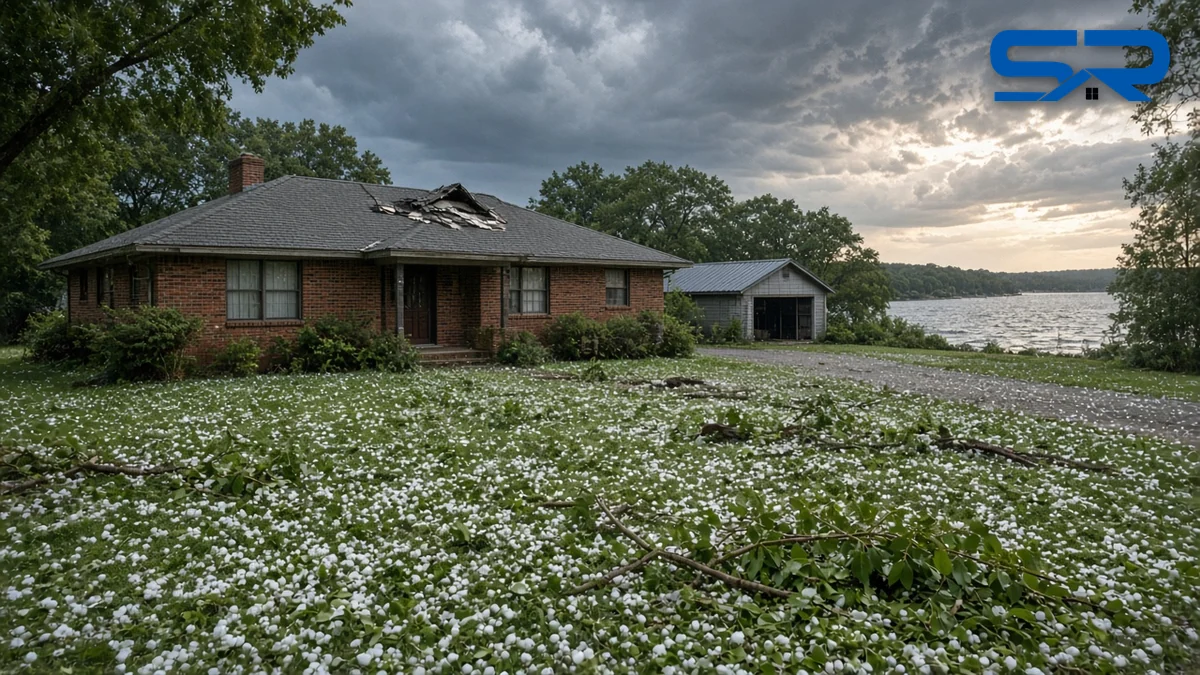
Shady Shores is a small town on I-35E right at the edge of Lewisville Lake, southeast of Denton. It incorporated in 1960 and is home to about 3,000 people today, by Census estimates. It’s also more rural than its neighbors. The town issues permits for water wells, septic systems, loafing sheds, carports, garages and even hangars. So when a storm comes across the lake, it usually isn’t just one roof that needs looking at.
I’m Blake Snow. I’ve been roofing for 30 years, I’m the third generation in a family business that goes back 75 years, and our crews have completed over $80 million in roofing projects. Our Rhome office is about 29 road miles from Shady Shores. Here’s what I’d tell you after wind or hail comes through.
What NOAA’s records show near Shady Shores
You don’t have to guess how often big storms hit here. NOAA’s Storm Events Database lists 52 reports of hail 1.75 inches (golf-ball size) or larger within about 10 miles of Shady Shores from 2016 through its September 2026 update. The storms that came closest:
- March 26, 2017: 4.25-inch hail near Corinth, less than two miles from the center of Shady Shores, with 2.75-inch and 2.5-inch hail about two miles away the same night. It’s the largest hail NOAA lists that close to town.
- April 11, 2016: 2.75-inch hail about a mile and a half from Shady Shores, 2.75-inch hail near Little Elm across the lake, and 4-inch hail in Denton about five miles north.
- June 11, 2023: 3-inch hail near Lewisville about seven miles south, and 3.5-inch and 4.25-inch hail near Bartonville to the southwest.
- March 14, 2024: 3.5-inch hail near Bartonville, and on April 1, 2024, 2-inch hail near Argyle.
- Smaller hail keeps coming close: 1.25-inch hail about two miles away on May 28, 2024, and 1-inch hail under a mile from the center of town on June 8, 2025.
Wind is the other half of the story. Shady Shores sits on the shoreline, so wind has a long run across open water before it reaches the first row of roofs. NOAA’s records nearby:
- July 10, 2019: a weather station at the North Central Texas College campus in Corinth, a little over a mile away, measured a 77 mph gust. A month earlier the same campus recorded 64 mph.
- March 2, 2023: a 67 mph gust was measured in Lake Dallas, about three miles away, and an older restaurant building partly collapsed near Little Elm, across the lake.
- May 18, 2025: law enforcement reported numerous trees and limbs blown down across Denton, just north of town.
Two honest notes. A report is where someone measured hail, not the edge of the storm, so hail a mile away can be bigger or smaller. And NOAA’s finalized database runs months behind, so for a storm last week, the Storm Prediction Center’s daily preliminary reports are the place to look.
Wind damage and hail damage aren’t the same job
Most storm pages lump them together. On the roof they look different, and they’re fixed differently.
Hail bruises and cracks shingles, knocks granules loose, splits vent caps and skylights, and dents gutters, flashing and thin metal panels. It tends to hit every slope that faced the storm.
Wind works the edges. It lifts shingles at the eaves, rakes and ridge, breaks the seal strips so tabs flap in the next storm, peels back drip edge and trim, and pulls exposed screws loose on older metal shops and carports. Limbs come down with it, and Shady Shores has a lot of big trees. A limb strike can crack decking even when the shingles over it look fine.
When we inspect after a lake storm, we look hardest at the windward eaves and rakes, the ridge cap, any metal trim, and the shops, carports and hangars, because loose panels and open-sided buildings are where wind gets in.
Right after the storm: what to do first
- Stay off the roof. Wet shingles and steep pitches put people in the hospital every storm season.
- Write down the storm date and time. The date of loss matters for any claim.
- Walk the lot. Look for dented gutters and downspouts, dented AC fins, torn screens, granules at the bottom of downspouts, shingles in the yard, and limbs on or against any roof.
- Check inside. Fresh ceiling stains, damp insulation in the attic, drips around vents and skylights.
- Take photos and video of everything, including the shop and carport. Don’t throw damaged items away yet.
- Stop active leaks. If water is coming in, a tarp over the damaged area protects the house until repairs. Keep the receipts. The Texas Department of Insurance notes your policy may pay for reasonable temporary repairs.
Then call for an on-roof inspection. We give you a free digital photo report, slope by slope and building by building, so you can see what we saw.
One storm, several roofs
On a Shady Shores lot, the same storm often hits the house, a detached garage or shop, and a carport or loafing shed. A policy may treat each one differently. That’s why we document each building separately in the photo report, with its own photos and measurements, instead of one lump estimate.
If you replace the house roof with standing seam, we can roof the shop or carport in R-panel or PBR in the same color while the crew is there. We form both on our own roll formers in 24 or 26 gauge, and metal lead time is typically one to two weeks. For older metal outbuildings that lost screws or panels in the wind, our barn roofing crew can re-screw, re-panel or re-roof them.
Shady Shores permits after a storm
The town’s roofing permits page says most re-roofing requires a permit. Replacing a few shingles doesn’t, but if any decking is replaced, a permit is required, and the decking has to be sized under the 2021 International Residential Code. That matters after limb strikes and wind damage, because we often don’t know what the deck looks like until the old roof is off. We photograph it so you can see what was replaced and why.
A few more rules worth knowing:
- The 2026 fee schedule lists the roof permit at $150. Patio covers and accessory buildings are permitted separately.
- Your HOA’s approval goes in with the application if you have an HOA.
- Inspections are a plan review and a final. If the house has gas, the inspector checks the attic at the final, so we leave access clear.
- Every permit must be approved and paid for before work begins.
We file the roof permit and any shop, carport or patio permits so nothing holds up the final.
How the insurance side works in Texas
- Deadline: generally 1 year from the date of loss to file. Check your policy.
- You own the claim. Texas doesn’t let a contractor act as your public adjuster, so we won’t negotiate your claim. We’ll meet the adjuster on the roof if you want, show what we found and walk through our estimate.
- Your deductible is yours. Texas law makes it illegal for a contractor to waive, absorb or rebate it. If someone offers, that’s a red flag.
- Don’t sign blank contracts, and don’t pay in full up front.
Rebuilding for the next storm
Since you’re putting a roof back on anyway, think about the next storm off the lake. Every shingle roof we install is Class 3 or better, and Class 4 impact-resistant shingles are a step up. Standing seam has hidden clips instead of exposed screws, so there’s nothing for wind to back out, and we set clip spacing at the eaves and rakes for the exposure. Some insurers offer discounts for Class 4 roofs, so ask your agent. See Class 4 metal roofs and insurance for more.
Our workmanship warranty runs from 10 years up to lifetime, depending on the job, and we’re installed to manufacturer specs by certified installers. We’re BBB A+ rated and carry 5.0 stars on Google at all three offices: Bridgeport, Decatur and Rhome.
Get a storm inspection in Shady Shores
If wind or hail came across the lake and you’re not sure what it did to your roof, shop or carport, request an estimate or call (817) 733-9228. We’ll get on the roof, photograph every building and give you a straight answer. See our Shady Shores storm damage page, metal roofing in Shady Shores and roof repair for more.