
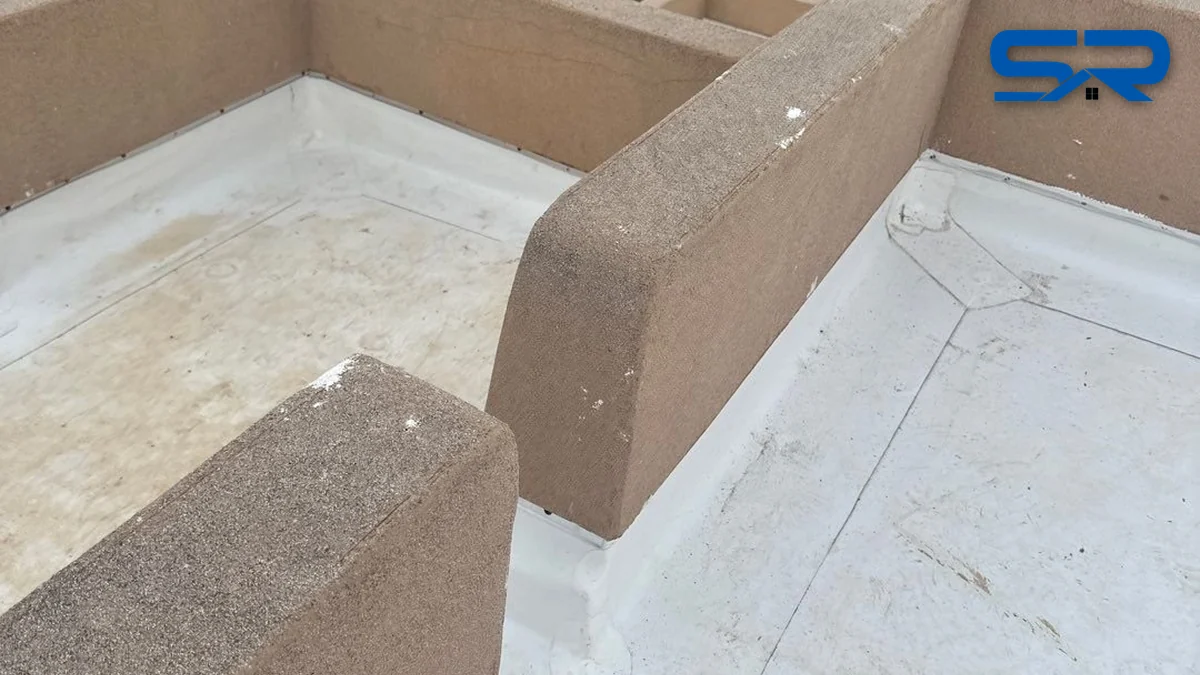
A lot of Southlake homes have a roof most owners never see: the flat or nearly flat section behind a parapet, over a back porch, on a newer addition, above a carport or tucked between two pitched roofs. When that section starts leaking, someone usually suggests “just coat it.” Sometimes that’s the right answer. Sometimes it’s money down the drain.
I’m Blake Snow. I’ve been roofing for 30 years, and we work on flat and low-slope sections on homes across Southlake, Westlake, Colleyville and Grapevine. APOC is one of the most common coating brands you’ll see on a store shelf or in a quote, so here’s what APOC’s own data sheets say, and how I decide whether a coating belongs on your roof at all.
Who makes APOC
APOC is made by Gardner-Gibson, Inc. of Tampa, Florida. That’s printed on every APOC technical data sheet, and the APOC website credits ICP Group. The roof line includes white acrylic elastomerics (241, 243, 246, 247, 248, 252, 258), silicones (576 and the 585 to 587 Armor Flex products), aluminum coatings and black asphalt coatings. For a home’s flat section, the three I get asked about most are 243, 246 and 576.
APOC 243 vs. 246 vs. 576 at a glance
| APOC 243 (acrylic) | APOC 246 (acrylic) | APOC 576 (silicone) | |
|---|---|---|---|
| Chemistry | Advanced elastomeric acrylic | Premium elastomeric acrylic | 100% silicone |
| Solids by volume | 52% | 47% | 97% ± 3% |
| Ponding water | Not allowed over 48 hours | Not allowed over 48 hours | Made for it (1:12 pitch or less) |
| Coats | Two coats mandatory | Two coats mandatory | One coat on surfaces in good condition |
| Coverage | About 90 sq ft per gallon per coat | About 90 sq ft per gallon per coat | About 71 sq ft per gallon |
| Reflectivity / SRI | 90% / 112 | 0.87 initial, 0.76 at 3 years / 110 | 90% / 115 |
| Elongation | 320% | 275% | 315% |
| Application temperature | Above 55°F for 24 hours and rising | Above 60°F | 35°F to 120°F |
| Material warranty | 10 years | 12 years | Life of the existing roof (if sound) |
| Standards listed | ASTM D6083 | ASTM D6083, Title 24 | Exceeds ASTM D6694, ASTM D7281, Title 24 |
All figures are from APOC’s current (C25) technical data sheets, linked below.
The rule that decides most jobs: does water sit?
Both acrylic data sheets say the roof must have proper drainage and must not hold ponding water longer than 48 hours. Acrylic coatings soften and fail where water sits. The 576 data sheet is the one written for low-slope roofs at 1:12 pitch or less and areas with ponding water.
So the first thing I do on a Southlake flat section is look for ponding: dirt rings, algae lines, birdbaths after a rain. If water sits, acrylic is off the table. Then the question is whether to coat with silicone or fix the drainage (crickets, tapered insulation, a new drain or scupper) as part of a new membrane.
One thing to know before choosing silicone: once a roof is silicone, it pretty much stays silicone. Most other coatings don’t bond well to cured silicone, so future recoats and patches are silicone too. APOC’s own repair product for 576 is its 581 Silicone Roof Patch.
What APOC can go over (and what it can’t)
APOC’s data sheets list these substrates for 243, 246 and 576: metal, aged modified bitumen, built-up roofing, concrete, tile, aged TPO and EPDM, and existing acrylic, asphalt emulsion and aluminum coatings. Things to watch:
- Never on shingles. The 243 and 246 sheets say it plainly: “Do not use on shingle roofs.” If someone offers to coat the shingles on your main roof, that’s not what these products are for.
- Primer by age. The acrylic sheets say the age of the surface decides whether a primer such as APOC 296 is needed, and to test adhesion on a small area first. We do an adhesion test before we quote a whole roof.
- Rusty metal gets wire-brushed and primed (APOC 291) first.
- Asphalt surfaces can bleed through a white coating. APOC lists 583 as a stain-blocking base under 576, and the acrylic sheets say surfaces coated with aluminum, asphalt or tar should cure for at least one summer season before an acrylic goes on.
Prep is most of the job
Every APOC sheet starts the same way: clean, dry, sound, with proper drainage. The steps from the data sheets:
- Clean. Pressure wash with a wide fan tip (never tear the surface) and treat mildew with a roof cleaner such as APOC 801. Rinse and let it dry completely.
- Repair first. Leaks and cracks are fixed before coating, with polyester fabric or fleece tape set in the matching patch (264 for the acrylics, 581 under 576).
- Detail coat. For the acrylics, one coat over every seam and joint, dried before the field coats.
- Field coats. Acrylics: two full coats, the second perpendicular to the first, at least 24 hours apart. 576: one coat on surfaces in good condition, recoating rough areas.
- Weather window. No rain or heavy dew within 24 hours of finishing (576 is rain-safe in 15 minutes at 70°F and 50% humidity).
A coating does not fix a wet deck or soaked insulation. If the roof is spongy, or a moisture check or core cut finds wet insulation under more than a small area, coating traps that water in. That roof needs to come off.
The warranty fine print
APOC’s warranties are material-defect warranties. Per the data sheets:
- 243: 10 years. 246: 12 years. 576: the life of the existing roof, assuming it is in sound condition.
- The product must be applied per the label and for its intended use, with proper prep and drying conditions.
- The remedy is replacement product or a prorated share of the purchase price, with your receipt.
- The warranty does not cover labor or installation costs, consequential or incidental damages.
That’s not a knock on APOC. It’s how retail coating warranties work. It’s why the workmanship side matters, and why we put ours in writing: from 10 years up to lifetime, depending on the job.
Coat it or replace it? How I decide on a Southlake home
A coating makes sense when:
- The existing membrane or metal is sound, dry and well attached
- Leaks are at seams, flashings or penetrations that can be repaired
- You want a brighter, cooler surface and a few more years before replacement
A new membrane makes more sense when:
- Insulation or decking is wet
- The surface is blistered, split or patched all over
- Water ponds and the drainage needs to be rebuilt anyway
- You want a long system warranty from a membrane maker we’re certified with
For that second group, we usually install a single-ply or self-adhered system. See our Mule-Hide low-slope guide for porches and additions and Carlisle Sure-Weld TPO. For a side-by-side of systems, see TPO vs. modified bitumen vs. coating.
Hail and Southlake flat sections
Hail is a real threat here. NOAA’s Storm Prediction Center logged 1-inch hail northwest of Grapevine on May 22, 2026, and quarter-size hail along Hwy 114 in Grapevine on June 2, 2026, right next to Southlake. A coating isn’t hail protection, and no coating warranty covers storm damage. If a storm hits, have the flat sections checked along with the main roof, and remember Texas claims generally have to be filed within 1 year from the date of loss. Check your policy.
What goes on our coating quotes
- Coating brand, product number and chemistry, and why it fits your roof
- Ponding areas marked, and how they’re handled
- Adhesion test result and any primer
- Repairs and reinforcement listed before coating
- Coverage rate and number of coats from the data sheet
- Manufacturer warranty terms in writing, plus our workmanship warranty
- Free digital photo report before and after
Talk to us about your flat roof section in Southlake
We repair, coat and replace flat and low-slope roof sections on homes in Southlake, Westlake, Colleyville, Grapevine and Keller. We have hands-on experience with APOC coatings and every roof is installed to manufacturer specs by certified installers. We’re certified with GAF, CertainTeed, Owens Corning, Atlas, Johns Manville, Carlisle, Tropical Roofing Products, Mule-Hide and Enviroshake, and many other roof manufacturers. We’re BBB A+ rated, with 5.0 stars on Google at all three offices: Bridgeport, Decatur and Rhome. Request a free inspection or call (817) 733-9228.
Sources
- APOC 243 Advanced Elastomeric White Roof Coating: Technical Data Sheet (C25)
- APOC 246 Premium Elastomeric White Roof Coating: Technical Data Sheet (C25)
- APOC 576 Premium Silicone White Roof Coating: Technical Data Sheet (C25)
- APOC: Elastomeric coatings and Silicone coatings
- NOAA Storm Prediction Center: storm reports, May 22, 2026 and June 2, 2026