
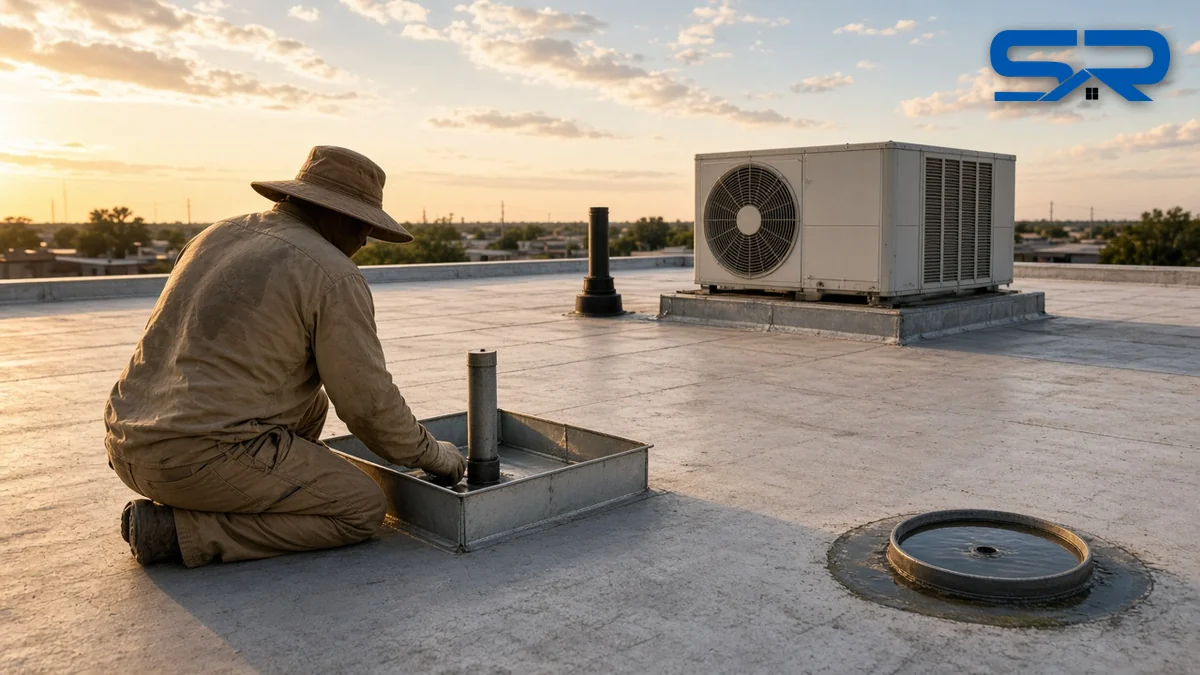
How to find a roof leak in Fort Worth starts with one fact most people don’t hear until they’ve already torn out a ceiling: water almost never enters the roof directly above the stain. It can travel along a rafter, a metal deck flute, a pipe or a wall, and drip out ten feet away. I’ve been roofing for 30 years, I’m the third generation in a family business that goes back 75 years, and tracing leaks on homes and commercial buildings across Fort Worth and North Texas is a regular part of the work.
I’m Blake Snow. When you call about a leak, we come out, get on the roof and send you a free digital photo report. Here’s how I think through the job: how the water is moving, what kind of roof and deck you have, and which penetrations are the usual entry points.
The short version
- Water enters at one spot and often shows up somewhere else.
- Wind-driven rain, capillary action, ponding and condensation each leave a different trail.
- Every roof system leaks in its own way. I don’t inspect a shingle roof the same way I inspect TPO or standing seam.
- The structural deck can carry water far from the entry point.
- Pipes, pitch pans, curbs, drains, walls and fasteners are where I look first.
- A real inspection starts inside, then the attic or the underside of the deck, then the roof, then a controlled water test from the bottom up.
How water travels on a roof
A ceiling stain is a clue, not a map. After water gets past the roof covering, gravity is only part of the story.
It runs until it finds an opening. Underlayment, decking, insulation and framing all give water a path. It can follow a rafter, a skip-sheathing gap, a flute in a metal deck or the top of a ceiling joist, then drip at a light fixture, a vent or a wall.
Wind-driven rain pushes water upslope and under laps, ridge caps, side laps and wall flashings that look fine in a calm shower. North Texas storms do this all the time.
Capillary action pulls water into tight gaps: a compressed washer, a lap that’s too tight, a hairline crack in a pipe boot, or the seam between a pitch pan and a pipe. You won’t see a stream. You’ll see a slow, stubborn wet spot.
Ponding on low-slope and flat roofs keeps water sitting at drains, scuppers and low spots. Seams and flashings that would shed a shower get hours of standing water after a storm.
Condensation is not a leak. Warm, moist air hitting a cold roof deck or a metal panel can drip in the same places a leak would. If the stain shows up on cool mornings or when the AC is running hard, and not during rain, I look at ventilation, insulation and interior moisture first. I wrote about this on metal barndominiums; the same idea applies to attics and shops. See condensation under a metal roof.
How each roof system leaks differently
I start with the system, because the weak points change.
Asphalt shingles. Missing, cracked or wind-lifted shingles, worn valleys, failed step flashing and cracked pipe boots are the usual suspects. Granule loss and older felt underlayment can let water in even when the shingles still look decent from the yard. See our shingle roofing page.
Standing seam metal. The field of the panel is rarely the leak. I look at pipe boots made for metal, wall and chimney flashing, valleys, ridge closures and eaves. A seam that wasn’t fully closed, or that got bent, can open a path. More in my post on flashing details and our standing seam page.
R-panel and other exposed-fastener metal. Backed-out screws, worn washers, overdriven heads and short side laps are where I start. Wind-driven rain under a lap is common. Our exposed-fastener and metal roof repair pages, and my Azle metal leak repair post, cover this in more detail.
Tile. The tile is a shield. The underlayment and the flashings do the waterproofing. I often find a leak with no broken tile nearby. See lift-and-relay work in Westlake and our tile roofing page.
Slate and synthetic slate or shake. Same idea as tile: slipped or broken pieces matter, but flashings and underlayment are usually the path. See synthetic roofing.
TPO and PVC. Seams, punctures, shrinkage at walls and curbs, and poorly detailed pipes and drains. Heat and foot traffic around HVAC units are common.
EPDM. Seams, punctures and shrinkage at walls and penetrations. See our EPDM page.
Modified bitumen. Laps, blisters, open flashings and worn details at drains and walls. See modified bitumen.
Built-up roofs. Splits, blisters, failed flashings and worn spots at drains and penetrations.
Coatings. A coating is only as good as what’s under it and how the details were treated. Pinholes, thin spots over seams, and flashings that weren’t prepared will show up in ponding water. Coating over wet insulation traps the water, which is why we confirm moisture first.
How the structural deck changes the trail
The covering is only half the path. What’s under it decides how far the water can run before you see it.
Plywood or OSB. Water can travel along the underside and drip at a joint, a nail, a light or a wall, well away from the hole above.
Plank or skip sheathing. Common on older homes. Water runs along a board and drips at a gap or a change in direction. The stain can be several bays over.
Metal deck with insulation. On many commercial roofs, water runs down the flutes of the metal deck for a long way. A stain in the middle of a bay can start at a curb or a drain much farther upslope. See our Fort Worth commercial roofing page.
Concrete. Water can soak in and move slowly. Stains may appear late, and the wet area can be larger than it first looks.
Tectum or gypsum decks. These can hold water and get soft. I treat them carefully and look for sagging or crumbling at the underside, not just a stain.
Wood plank on a commercial building. Same idea as residential plank: water follows the boards. I map the deck direction before I guess at the entry point.
If I only chase the stain, I miss the entry. I want to know which way the deck runs before I start a water test.
Pipes, pitch pans and other penetrations
In my experience, most leaks start at a detail, not in the middle of a clean roof field.
Plumbing vent pipes and boots. Rubber and plastic boots crack in North Texas heat and UV. A boot that sits on a seam, or that wasn’t made for the roof type, is a regular find. On metal, the boot has to be made for metal and set flat on the panel, clear of a seam.
Pitch pans and pitch pockets. These are boxes or pockets around pipes, supports or irregular penetrations, filled with pourable sealer. They work until the fill shrinks, cracks or pulls away from the pipe. Then they become a bowl that holds water against the very thing they’re supposed to protect. I check the fill, the sides and the membrane tie-in, not just whether the pan is still there.
Curbs for HVAC units and skylights. The curb flashing, the corners, the pitch of the curb and the way the unit is set all matter. Foot traffic and condensate lines around rooftop units cause a lot of “mystery” leaks on commercial roofs.
Drains and scuppers. Clogged drains and poorly flashed drain bowls or scupper sleeves keep water against seams. I look at the clamping ring, the flashing and whether water is actually leaving the roof.
Walls, chimneys and counterflashing. Wall flashing has to turn up the wall; counterflashing has to lap over it. Sealant alone along the top of a wall flashing fails in the heat. Chimneys need a cricket or diverter on the uphill side so water and leaves don’t pile up against them.
Fasteners. On exposed-fastener metal, a worn washer is a leak path. On membrane roofs, fastener plates under the sheet can telegraph and, if the membrane is cut or over-driven, let water in.
How I actually find the leak
This is the order I use. I don’t start with a hose on the high end of the roof.
- Interior stains. Where they are, whether they show up only in rain, in wind-driven rain, or on cool days with no rain. That last pattern often points to condensation.
- Attic or the underside of the deck. Staining, damp insulation, rusted fasteners, daylight, and which way the deck and framing run. This is why we need someone to let us in when there’s an active leak.
- The roof surface. I walk the area upslope of the stain and every penetration in that drainage path: pipes, pans, curbs, drains, walls, valleys and fasteners.
- Water testing, a section at a time, from the bottom up. I wet the lowest detail first, wait, and only then move upslope. If you start at the ridge, water runs over everything below and you can’t tell which detail failed.
- A moisture meter to check the deck, insulation or drywall around a suspect area, without opening more of the roof than we need to.
- Infrared and drone when they help. A drone gets photos of slopes and details that are hard to reach safely. Our drone pilot is FAA-certified. On flat and low-slope commercial roofs, a thermal scan can show wet insulation after sunset, and we confirm those areas with a meter or a core cut. Infrared is not a shortcut on every roof; it works best on certain systems and conditions. See our drone roof inspection and infrared roof leak detection pages.
Every visit comes with a free digital photo report, so you see the cracked boot, the shrunk pitch pan, the open wall flashing or the wet insulation yourself. If the leak started after a storm, that report is also useful when you’re talking with your insurance. Texas generally gives you 1 year from the date of loss to file a claim; check your policy. See our storm damage page. We don’t invent damage, and we don’t push a replacement when a repair will do. Our roof repair page covers how we handle the fix.
Areas we serve
We trace leaks on homes and commercial roofs across Fort Worth and nearby, including Keller, Denton, Decatur, Bridgeport and Rhome, where one of our offices sits just north of Fort Worth.
Let’s look at the leak
We’re certified with GAF, CertainTeed, Owens Corning, Atlas, Johns Manville, Carlisle, Tropical Roofing Products, Mule-Hide and Enviroshake, and many other roof manufacturers. Snow Roofing & Exteriors is fully insured, has offices in Bridgeport, Decatur and Rhome, is BBB A+ rated, and has 5.0 stars on Google at all three offices: Bridgeport, Decatur and Rhome. References are available on request. Our workmanship warranty runs from 10 years up to lifetime, depending on the job. We offer same-day response in almost every case, and we answer leak and storm calls 24/7.
Call (817) 733-9228 or request an estimate. I’ll walk the roof with you, send you a free digital photo report, and tell you straight what I found.