Metal roofs for churches, shops and small commercial buildings in Mineral Wells are what I’d put on most of the pitched roofs in town if the owner plans to keep the building for the long haul. I’m Blake Snow, the third generation in a family roofing business that goes back 75 years, and I’ve spent 30 years on roofs, including church roofs and commercial casino roofing. In 2006, right after Hurricane Katrina, I roofed the Imperial Palace Casino in Biloxi, Mississippi. Big buildings teach you to plan the job, protect the people inside and get the details right the first time.
Mineral Wells is about 30 miles from our Bridgeport office, and it gets hit hard. Here’s how I’d think through a metal roof for a church, a shop or a small commercial building there.
The short version
- Standing seam for churches, storefronts, offices and anything the public looks at. No exposed screws in the field, and it works on lower slopes.
- R-panel or PBR for shops, warehouses, ag and metal buildings where value and speed matter.
- Flat sections (fellowship halls, back-of-house, additions) usually get TPO, modified bitumen or a coating, tied into the metal.
- Every metal roof we install is Class 4 impact rated under UL 2218. That matters in Palo Pinto County.
- Old metal building? A retrofit over the existing panels can keep you open during the work.
- Plan around your schedule. Services, weddings, funerals and business hours all go on the job calendar.
Why metal makes sense in Mineral Wells
This year alone shows why. The Storm Prediction Center’s report for March 4, 2026 lists measured 1.75- to 2-inch hailstones 1 mile south-southwest of Mineral Wells. On April 28, 2026 the same page lists an EF-3 tornado just east of town, then hail of 1.25 inches 4 miles west, 2.5 inches 5 miles southwest and 1.5 inches 6 miles south of Mineral Wells, with 2.75-inch hail reported near Millsap minutes later.
A church or a business can’t shut down every time that happens. Here’s what metal brings to that fight:
- Life span. Standing seam usually lasts a minimum of 40 to 50 years. For a congregation or a business owner, that’s one roof decision for a generation, not two or three.
- Impact rating. Every metal roof we install is Class 4 impact rated under UL 2218, the highest class in that test.
- Wind. Long panels with concealed clips (standing seam) or a tight screw pattern (R-panel) have far fewer edges for wind to catch than shingles.
- Low upkeep. No granules to lose, no shingles to replace after every storm. Standing seam has no exposed screws in the field to back out.
One honest note: hail can still dent metal. A Class 4 rating is about the panel not cracking or leaking from impact; cosmetic dents can happen with big stones. Ask your agent how your policy treats cosmetic damage on a metal roof before you need to know.
Churches: what to plan for
Church buildings are usually a mix: a steep sanctuary, a steeple or bell tower, and a lower, flatter fellowship hall or education wing. Each piece needs its own plan.
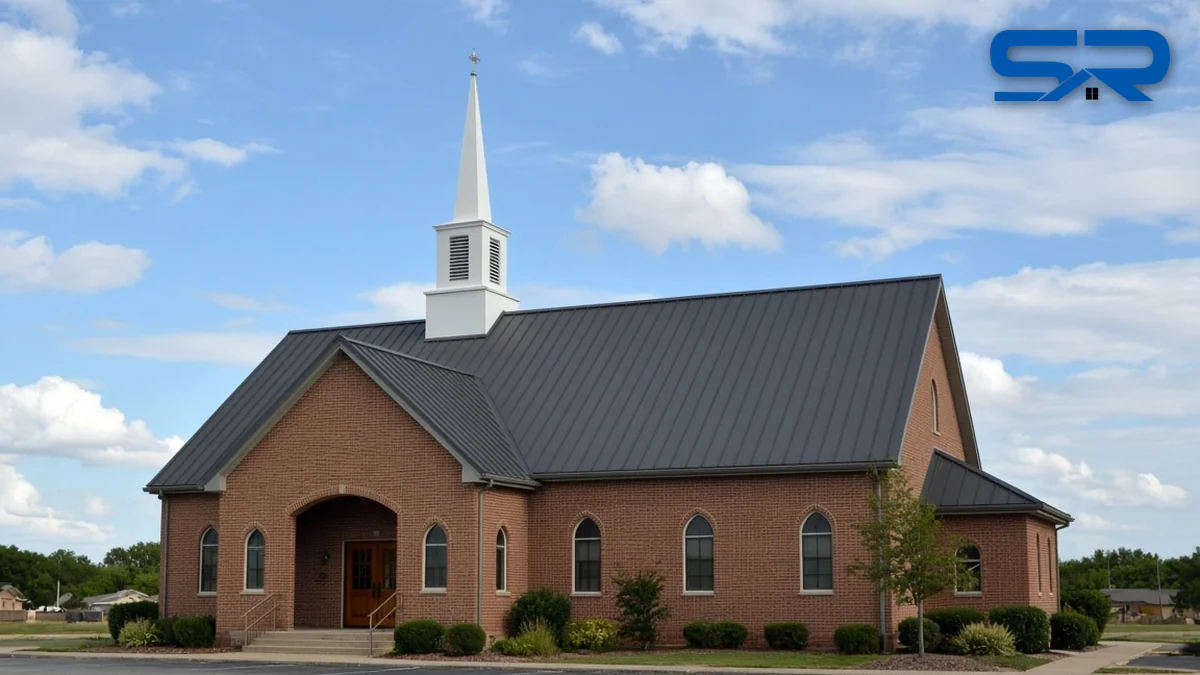
The sanctuary. A steep sanctuary roof is where standing seam shines. The long, clean lines suit a church, panels can run ridge to eave in one piece, and color choices range from charcoal and dark bronze to lighter colors that send back more of the Texas sun.
Steeples, towers and crosses. These get custom flashing and trim. We bend trim to fit and seal every base and penetration so water can’t get behind it.
Fellowship halls and education wings. Lower-slope sections can still take standing seam if the slope is right (see the code note below). Truly flat sections usually get a membrane or coating from our commercial roofing side, and the transition between systems is one of the most important details on the whole building.
Committee and budget. Most churches decide by committee. We put the scope, options and photos in writing so the building committee and the congregation can see exactly what they’re voting on. We can price standing seam and R-panel side by side, or phase the work by building, so you can plan it around your budget year.
Schedule. We plan tear-off and dry-in in sections, keep entrances and parking clear when the building is in use, and clean the site every day. Give us the calendar for services, weddings and funerals at the start.
See our church roofing page, or the Weatherford church roofing page for nearby Parker County.
Shops and metal buildings
For a shop, a warehouse, a metal building or an ag building, R-panel or PBR is usually the best value. It goes on fast, it’s strong, and the exposed screws are a fair trade on a building where looks come second.
What separates a good R-panel roof from a leaky one:
- Screws in the right place, driven right. Overdriven or underdriven screws are the number one source of leaks on exposed-fastener roofs.
- Closures and sealant at the ridge and eave to keep out water, wasps and birds.
- Condensation control. A shop that’s heated, cooled or full of equipment needs the right underlayment or insulation so it doesn’t “rain” inside.
- One-piece panels. We form panels on our own roll formers in 24 or 26 gauge, so a long run can go ridge to eave with no end laps.
If your building is part shop, part office or showroom, a common mix is standing seam over the office and storefront and R-panel over the bays. See barndominium, shop and ag buildings.
Small commercial: storefronts, offices and strip buildings
Downtown storefronts, small offices, restaurants and strip buildings around Mineral Wells often have a pitched front (or a mansard) and a flat roof behind it. Metal fits the part people see; the flat part needs a low-slope system. We handle both, so one crew owns the whole building, including the transition. Our commercial metal roofing page covers panel types, and snap-lock vs. mechanically seamed standing seam explains which seam suits which building.
Code notes: slope, re-roofing and the city
The City of Mineral Wells’ Adopted Codes page lists the 2012 International Building Code and 2012 International Existing Building Code, and the city’s permit guide says permits must be in hand before work starts. The city has amended its building regulations since (its Municipal Code page lists Ordinance No. 2026-21), so we confirm the current rules with the city on every job.
Two code points matter most for metal on commercial buildings. Under 2012 IBC Section 1507.4.2, as summarized by MBCI:
| Metal roof type | Minimum slope |
|---|---|
| Standing seam systems | 1/4 in 12 |
| Lapped, non-soldered seams with applied lap sealant (most R-panel) | 1/2 in 12 |
| Lapped, non-soldered seams without lap sealant | 3 in 12 |
That’s why a low fellowship hall or a shallow shop roof often needs standing seam or sealed laps, and why a roof that’s nearly flat needs a membrane instead. The panel maker’s own minimum slope can be stricter than the code, and we follow whichever is tighter.
Retrofitting over an old metal roof
A lot of older shops and metal buildings around Mineral Wells have a tired R-panel roof: rusted screws, leaking laps, faded paint. You have three choices:
- Repair and re-screw if the panels are still sound. See re-screw vs. re-panel an old metal barn.
- Coat the existing panels with a metal roof coating system if the metal is solid and you want to buy time.
- Retrofit a new roof over the old one. New sub-framing goes over the existing panels, and a new standing seam or R-panel roof goes on top, so the business usually stays open and dry the whole time. Room for added insulation is a bonus.
Which one is right depends on the frame, the old panels and how long you plan to keep the building. We check all three before recommending one.
Standing seam vs. R-panel at a glance
| Standing seam | R-panel / PBR | |
|---|---|---|
| Best for | Churches, storefronts, offices | Shops, warehouses, ag and metal buildings |
| Fasteners | Hidden clips | Exposed screws |
| Lowest slope (code) | 1/4 in 12 | 1/2 in 12 with lap sealant |
| Upkeep | Very low | Check screws over time |
| Look | Clean, modern lines | Utility |
| Gauge we run | 24 or 26 | 24 or 26 |
Warranties and insurance, in plain words
- Workmanship warranty: from 10 years up to lifetime, depending on the job.
- Manufacturer NDL warranties: typically 10 to 40 years, depending on the manufacturer, the system and manufacturer approval. We don’t promise a specific term until the manufacturer approves the job.
- Storm claims: in Texas you generally have 1 year from the date of loss to file. Check your policy.
- We’re fully insured, BBB A+ rated, and references are available on request.
How we handle a Mineral Wells commercial job
- Inspection and photo report. Free digital photo report with drone and thermal imaging, so the owner, the board or the building committee can see every slope.
- Options in writing. Standing seam, R-panel, retrofit or a mix, with the flat sections spelled out.
- Permit and schedule. We pull the permit and build the job around your services or business hours.
- Panels formed to length. Metal lead time is typically 1 to 2 weeks, and we form panels on our own roll formers.
- Install and daily cleanup. Sections dried in each day, sites cleaned, entrances kept clear.
- Final walk-through with photos and your warranty paperwork.
We’re certified with GAF, CertainTeed, Owens Corning, Atlas, Johns Manville, Carlisle, Tropical Roofing Products, Mule-Hide and Enviroshake, and many other roof manufacturers, and every roof is installed to manufacturer specs by certified installers. We have 5.0 stars on Google at all three offices: Bridgeport, Decatur and Rhome.
We also work in Millsap, Weatherford, Graford, Santo, Palo Pinto, Gordon and across the DFW Metroplex.
Let’s look at your building
Whether it’s a sanctuary, a shop or a storefront, the first step is the same: a free inspection and photo report. Call (817) 733-9228 or request a free estimate, and I’ll walk the roof with you.