
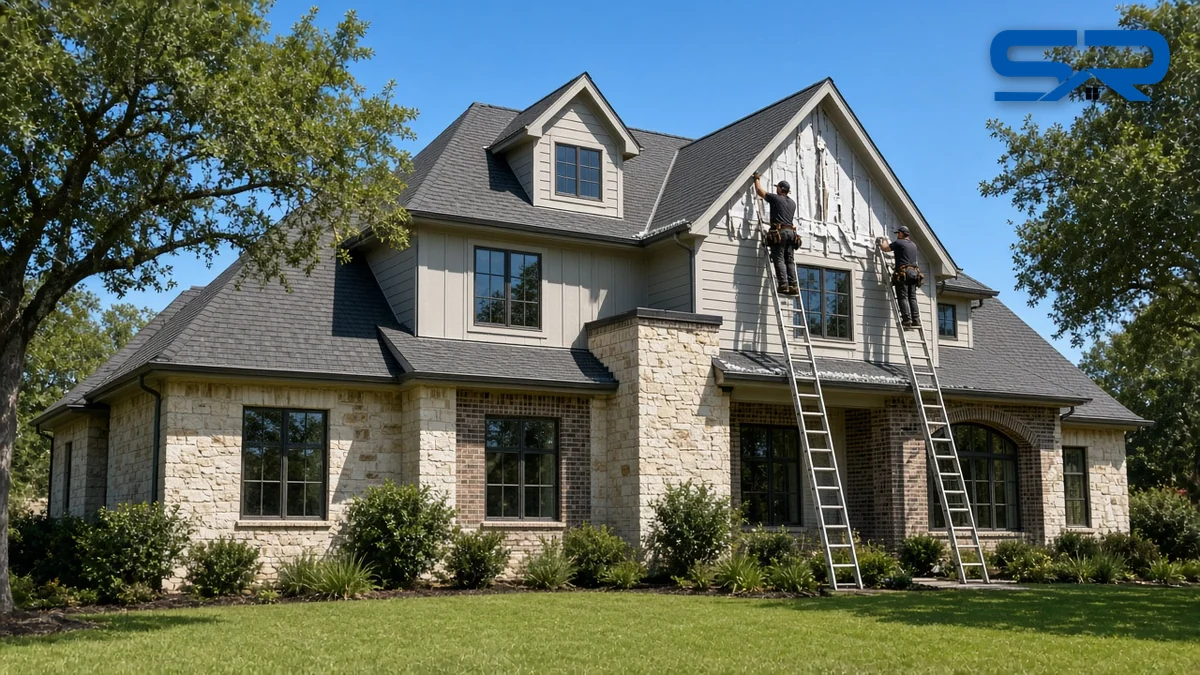
Most hail calls in Westlake and Southlake start with the roof. But on these homes the siding is usually higher, harder to reach and more exposed than the roof edges people check from the driveway: tall stone and brick first floors, then painted lap siding or board-and-batten on the upper gables, dormers and chimney chases. When hail comes in with wind behind it, those walls take a direct hit.
I’m Blake Snow. I’ve been roofing and building for 30 years, our crews have completed over $80 million in roofing projects, and our own crews replace siding, trim, soffit, gutters, windows and paint. Here’s how I handle siding after hail on Westlake and Southlake homes so it gets documented right, matches the house and keeps water out of the wall.
The short version
- Check the walls, not just the roof. Start on the side the storm came from, and look up at the gables and dormers.
- Photograph it before anything is patched, and write down the storm date.
- Repair or replace depends on matching. If the profile and texture can’t be matched, or damage covers a whole elevation, replace that elevation.
- New siding means new house wrap and flashing at every window, roof-to-wall joint and brick ledge. That’s where the leaks are.
- Southlake requires a permit for exterior siding. Westlake requires permits for remodels and every reroof. HOA approval comes first in both towns.
How much hail hits Westlake and Southlake
NOAA’s Storm Events Database lists hail of 1.75 inches (golf-ball size) or larger within about 10 miles of each town from 2016 through September 2026:
| Town | Reports of 1.75 in. or larger hail |
|---|---|
| Westlake | 54 |
| Southlake | 51 |
The biggest in that span came on June 11, 2023, with 4.25-inch hail reported near Bartonville and 4-inch hail near Grapevine Reservoir, both within about 7 miles of each town. On May 27, 2024, NOAA logged 2-inch hail near the Roanoke and Keller airports. And on April 28, 2026, 1.25-inch hail was reported in Southlake itself. Hail that size doesn’t have to break a board to cause trouble. It chips paint off cut edges, dents trim and opens up joints that let water into the wall.
What hail damage on siding looks like
| Material | What hail does | What to look for |
|---|---|---|
| Fiber cement lap or panel | Chips and cracks, especially at edges and corners; knocks paint off and exposes raw board | Chipped bottom edges, cracks running from nail lines, bare spots on paint |
| Board-and-batten | Splits battens, dents and chips panel faces | Split or loose battens, chipped panel faces on gables |
| Engineered wood | Dents and punctures the surface coating; water gets in and swells the board | Dents, soft spots, swelling at the bottom edges later |
| Wood | Dents, splits and paint damage | Splits along the grain, dents, peeling paint after the storm |
| Vinyl | Cracks and holes, worse in cold weather | Cracks, punched holes, broken lock edges |
| Metal trim coil and window wraps | Dents | Rows of dents on the storm side, dents in corner and window wraps |
| Gutters, downspouts, soffit and fascia | Dents, splits, holes in vented soffit | Dents on gutter faces, cracked soffit panels. See gutter services and soffit and fascia |
Damage that looks small from the lawn can be serious up close. A chipped fiber cement edge or a dented engineered wood face lets water in, and in a year or two you see swelling, rot and peeling paint. That’s why I look at the upper walls from a ladder, not just from the yard.
Repair a few boards or replace the wall?
| Your situation | What I recommend | Why |
|---|---|---|
| A few damaged boards, same profile and texture still available | Replace those boards, prime cut ends, repaint the full wall | A spot repair blends in once the whole wall is painted |
| Profile, exposure or texture can’t be matched | Replace the full elevation, or the gables on that side | A patch in a different profile shows from the street |
| Damage spread across one or more elevations | Replace those elevations | Patching dozens of boards costs more and leaves old wrap behind |
| Bottom edges swelling or rotting, old wrap torn | Replace and add new house wrap and flashing | The damage is behind the siding, not just on it |
| Roof is also hail-damaged | Roof first, then siding, then trim and paint | Roof work disturbs step and kick-out flashing that tie into the siding |
| Windows are also damaged or due | Windows before siding | Each window gets flashed into new wrap before the wall is closed up |
We install any kind of siding: fiber cement, engineered wood, vinyl, wood, metal and more. If you’re replacing a full elevation anyway, it’s a good time to ask whether a different material or profile makes sense for the house and the HOA. See siding services.
Matching the profile, exposure and paint
On a Westlake or Southlake estate, the siding has to look like it was always there. We match:
- Profile: lap, smooth or textured, board-and-batten, shingle-style or panel.
- Exposure: the visible height of each lap board. A half-inch difference shows.
- Trim widths and corner style so new and old sections line up.
- Paint color and sheen across the whole wall, not just the new boards.
We use Sherwin-Williams but will use any paint you want, and we paint siding, trim, brick, stone, metal and wood. Painting the full wall or elevation after a repair is how you avoid a patchwork look. See exterior painting.
What goes behind the new siding
The siding is the part you see. What keeps water out is behind it:
- New house wrap lapped so water always runs over the layer below it.
- Window and door flashing tied into the new wrap: sill pans, side flashing, then head flashing.
- Step flashing and kick-out flashing where a lower roof meets a siding wall. Without a kick-out, water runs straight into the wall at the gutter end.
- Flashing at the brick or stone ledge so siding over masonry drains out, not in.
- Clearance between the bottom edge of the siding and the roof, masonry and ground, with cut ends sealed and painted.
- Trim, soffit and fascia checked for hail and rot while the wall is open.
If a window in that wall is cracked, leaking or near the end of its life, now is the cheap time to swap it. We install all brands of windows, including our own private label, Snow Vinyl Windows. See window replacement and my post on window replacement on luxury Colleyville homes.
Insurance: document it right
- Write down the storm date and take wide and close photos of every damaged wall, gable, trim piece and gutter before anything is patched.
- Make sure the estimate covers the whole wall assembly: siding, house wrap, trim, flashing, soffit and fascia, gutters, and paint, not just “siding.”
- Ask your adjuster how your policy handles matching when the original profile isn’t available. Policies differ.
- Put the roof, siding, windows and gutters on the same claim when the same storm damaged them.
Texas generally gives you 1 year from the date of loss to file a claim; check your policy. See storm damage.
Permits and HOA
- Southlake: the city’s When is a permit required? list includes remodels with window replacement and exterior siding, along with replacing roofing materials. Contractors have to be registered with the city.
- Westlake: the town’s residential permits page lists remodels and additions among work requiring a permit, and the permitting process page says every reroof needs a permit with an official HOA approval letter.
We confirm what the town needs for your scope and pull the permits. HOA review in these neighborhoods usually covers siding material and profile, paint colors, trim and window color, so get approval in writing before anything is ordered. We’ll provide product sheets and color samples for the submittal.
If the roof is due too
Hail that damages siding often damages the roof. If you’re replacing the roof, it’s worth looking at a roof that stands up to the next storm: standing seam metal in Westlake and Southlake, or Enviroshake in Westlake and Southlake. We run our own roll formers for 24- and 26-gauge standing seam, and metal lead time is typically 1 to 2 weeks. See my posts on Enviroshake vs. cedar shake after hail and pool house roofing and siding that matches the main house.
Before you sign: 12 questions for any siding bid after hail
- Who does the work, your own crew or a sub?
- Did you inspect every wall from a ladder, including the gables and dormers?
- Which boards or elevations are you replacing, and why?
- Can you match the profile, exposure and texture? If not, what’s the plan?
- Is new house wrap included behind the new siding?
- How is each window flashed into the new wrap?
- Where are you adding step and kick-out flashing?
- Is trim, soffit, fascia and gutter damage included?
- Is paint included, which product, and is it the whole wall or just new boards?
- Who handles the permit and the HOA submittal?
- Is the roof being done first, and who coordinates the order?
- What are the manufacturer and workmanship warranties, in writing?
Nearby towns
We handle hail-damaged siding, roofs and exteriors across northeast Tarrant and south Denton County, including Colleyville, Trophy Club, Keller, Roanoke and Grapevine.
Let’s look at your siding
We’re certified with GAF, CertainTeed, Owens Corning, Atlas, Johns Manville, Carlisle, Tropical Roofing Products, Mule-Hide and Enviroshake, and many other roof manufacturers. Snow Roofing & Exteriors is fully insured, has offices in Bridgeport, Decatur and Rhome, is A+ rated on the BBB, and has 5.0 stars on Google at all three offices: Bridgeport, Decatur and Rhome. References are available on request. Our workmanship warranty runs from 10 years up to lifetime, depending on the job.
Call (817) 733-9228 or request an estimate, and I’ll walk every wall with you, document the hail damage and lay out the order that gets it fixed once.