
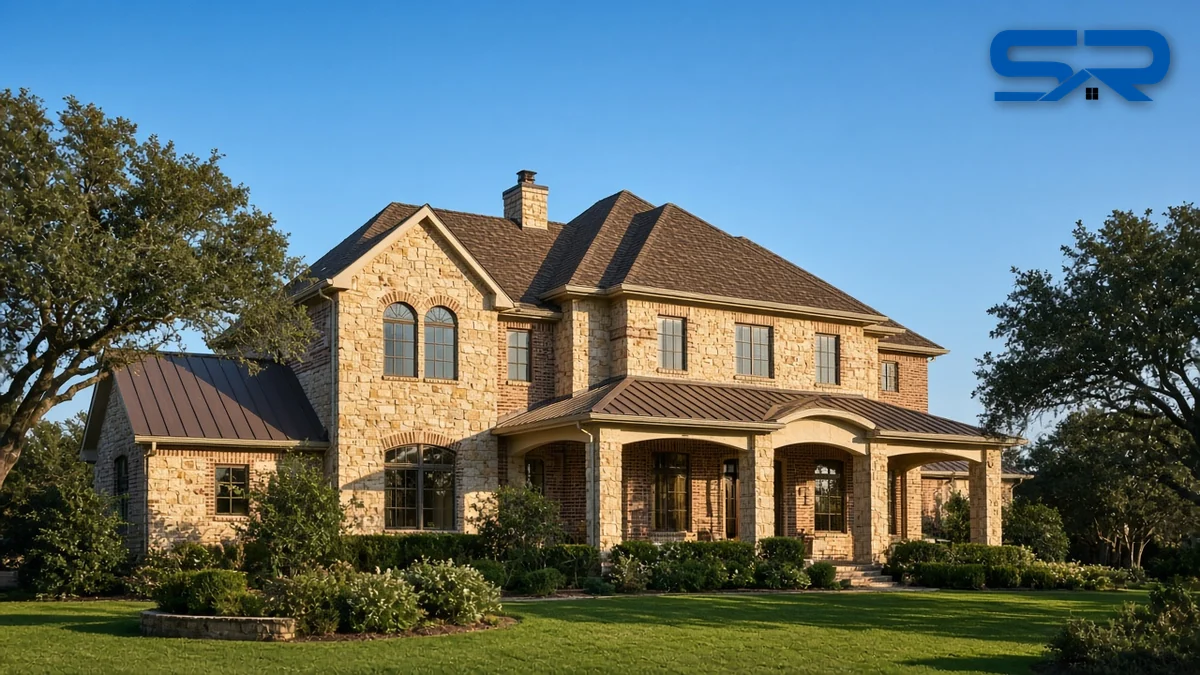
A lot of the Southlake homeowners I meet have already decided on metal. The question they’re stuck on is which kind: the clean vertical lines of standing seam, or stone-coated steel that looks like shake or tile from the street. Both are steel, both are Class 4 impact rated on our jobs, and both will outlast the shingles most of these homes were built with. They look different, though, and they have different strengths, and on a big house with a lot of roof planes that matters.
I’m Blake Snow. I’ve been roofing for 30 years, I’m the third generation of a family roofing business that goes back 75 years, and our crews have completed over $80 million in roofing projects. We form standing seam on our own roll formers right on the jobsite, and we install stone-coated steel too. Here’s how I help an estate owner pick between them.
The short answer
- Choose standing seam if you want the roof to look like metal, the house is modern farmhouse, contemporary or Hill Country style, the roof has low-pitch sections, or solar is in your plans.
- Choose stone-coated steel if the house is a traditional French, Tudor, Mediterranean or stone-and-brick estate, your HOA discourages visible metal panels, or you want a shake or tile look without the weight.
- Use both when the main roof is steep and traditional but there are porches, bays, a pool house or a low-slope wing. That’s often the best-looking answer on a large Southlake home.
How they’re built
Standing seam is long steel panels that run from ridge to eave, with the seams raised above the flat of the panel. Hidden clips hold the panels to the deck, so there are no exposed screws in the field of the roof. We install it in 24 or 26 gauge steel, form each panel to the measured length of the run on our own roll formers, and finish it in the paint color you pick. Because we make the panels on site, a long run can be one piece from top to bottom with no end lap in the middle. More on that on our standing seam page.
Stone-coated steel starts as steel too, but it gets a coating and a layer of stone granules bonded to the surface, then it’s pressed into a shake, tile or shingle profile. Most systems go down on battens, which leaves an air space under the panels. The panels are light: DECRA lists installed weights around 150 to 160 pounds per square, a fraction of what clay or concrete tile weighs. See stone-coated steel, plus our DECRA and Tilcor pages for the profiles.
The look from the street
This is where most Southlake decisions get made, and it should be.
Standing seam reads as metal, on purpose. On a white brick farmhouse with black windows, or a stone Hill Country home with deep porches, a dark bronze or matte black standing seam roof is about as sharp as a roof gets. On a big traditional French or Tudor house, a full standing seam roof can look out of place, and that’s where I steer people toward stone-coated steel on the main roof and standing seam on the porches. We wrote a separate post on standing seam accents over porches, bays and entries.
Stone-coated steel reads as a traditional roof. Shake profiles fit stone and timber homes. Tile profiles fit Mediterranean and Spanish-style homes. Heavy shingle profiles fit almost anything. If you love the look of tile but your framing was never built to carry it, this is the usual answer. Our colors and finishes page shows how paint and granule colors work.
HOA and architectural review
Read your HOA’s written rules first. Some Southlake and Westlake committees welcome standing seam on custom homes. Others discourage visible metal panels, and stone-coated steel is often an easier conversation there because it looks like shake or tile. Either way, committees mostly care about color, finish, profile and how the roof fits the street.
We’ll get you the product sheets and color samples the committee asks for, and we bring samples out so you can see them against your own brick or stone in daylight. Our post on getting standing seam approved in Southlake covers the review process in more detail.
Roof pitch: the part most comparisons skip
Big homes rarely have one pitch. They have steep main roofs, low porch roofs, shed dormers, and sometimes a nearly flat section over a back porch or a connector.
- Stone-coated steel needs a moderate pitch. DECRA generally calls for 3:12 or more, and 4:12 for some profiles. Below that, it isn’t the right product.
- Standing seam goes lower. Snap-lock panels are generally made for 3:12 and steeper. Mechanically seamed panels are made for low slopes, and the panel’s published minimum is the number that counts.
So before I recommend anything, we measure every roof plane. On a lot of Southlake estates, the honest answer is stone-coated steel on the steep planes and standing seam on the low ones, tied together with matching trim.
Hail
Northeast Tarrant County gets real hail. Our Southlake page notes that Tarrant County had more than 500 NOAA hail reports from 2016 through mid-2026, including 5-inch hail in June 2023, and NOAA’s Storm Events Database lists 4-inch hail near Grapevine Reservoir on June 11, 2023.
Every metal roof we install is Class 4 impact rated under UL 2218, the highest impact rating. That’s a lab test, not a promise, and no roof is hail-proof. Here’s how the two behave differently:
- Standing seam is smooth, so large hail can leave dents you can see. A dent usually doesn’t make it leak, but it does show. Heavier 24 gauge resists dents better than 26.
- Stone-coated steel has a textured surface that hides small marks better. Severe hail can knock granules loose, and you want that looked at.
Two things to check before you buy either one. First, read the hail section of the product warranty; some stone-coated steel warranties only cover hail up to a stated size. Second, ask your agent whether your policy has a cosmetic damage exclusion on metal, because that decides whether dents alone are covered. Some insurers give a credit for a Class 4 roof, so ask about that too. Our Class 4 metal roof and insurance page lists the questions. If you do file a claim, Texas generally gives you 1 year from the date of loss, but check your policy.
Wind, heat and noise
Wind: Both systems are tested for wind, and the rating belongs to the exact product and how it’s fastened. We confirm the rating of the product on your quote instead of quoting a generic number.
Heat: Steel moves with Texas heat. Standing seam clips let the panels move while the seams stay locked. Stone-coated steel is made of small panels, so each piece moves less. A light or reflective paint color on standing seam can help keep the attic cooler.
Noise: People ask if metal is loud in the rain. Over a solid deck with underlayment and normal attic insulation, either one is about as quiet as most roofs. Stone-coated steel’s granules and the batten space under it dampen the sound a bit more.
Solar
If solar is in the plan, standing seam is the better partner. Solar racking can clamp onto the raised seams, so the panels don’t need holes drilled through the roof to hold the racks. Solar can go on stone-coated steel too, but it takes more flashing work around each mount, and the solar crew has to know where they can step.
Living with it
- Walking on it: Standing seam is easy to service if the crew steps over the seams. Stone-coated steel should be walked on only where the manufacturer allows. Tell any satellite, solar or gutter crew what’s on your roof.
- Repairs: Keep a few spare panels or matching trim from your roof. Repairs look best with pieces from the same product line and color.
- Upkeep: Neither needs much. Keep valleys and gutters clear, and have it checked after a big hailstorm.
Cost
I won’t post a price per square foot here, because on an estate home the price is driven by your roof: how many hips, valleys and dormers it has, the pitch, the height, the gauge, and how much copper or custom trim is involved. In general, both cost more than shingles, and they usually land closer to each other than people expect. On a very cut-up roof, stone-coated steel’s small panels can install efficiently. On long, simple runs, standing seam formed on site is hard to beat. We’ll price both side by side for your house so you can see the real difference. See our standing seam cost guide for what drives the number.
What to compare on the two bids
- Profile and look: the exact standing seam profile and seam height, or the exact stone-coated steel product and profile.
- Gauge: 24 or 26 gauge for standing seam, and the steel thickness of the stone-coated product.
- Pitch check: that every roof plane meets the product’s published minimum slope.
- Underlayment and, for stone-coated steel, the batten system.
- Trim and flashing: valleys, chimneys, sidewalls, and where the two systems meet if you’re using both.
- Impact and wind ratings for the exact product, in writing.
- Warranties: the manufacturer’s product and finish warranty, including the hail terms, and our workmanship warranty, which runs from 10 years up to lifetime, depending on the job.
- Schedule: our metal lead time is typically 1 to 2 weeks.
Nearby towns
We put standing seam and stone-coated steel on homes all around Southlake, including Westlake, Colleyville, Trophy Club and Keller. See metal roofing in Southlake and standing seam in Southlake for local details.
About the photo
The image at the top is an AI-generated illustration with our SR mark added. It isn’t a Snow Roofing job and it isn’t a real Southlake home. I use it to show how a shake-look main roof and standing seam on a wing and porch can work together on one house.
Let’s look at your roof
We’re certified with GAF, CertainTeed, Owens Corning, Atlas, Johns Manville, Carlisle, Tropical Roofing Products, Mule-Hide and Enviroshake, and many other roof manufacturers. Snow Roofing & Exteriors has offices in Bridgeport, Decatur and Rhome, is A+ rated on the BBB, and has 5.0 stars on Google at all three offices: Bridgeport, Decatur and Rhome. Every inspection comes with a free digital photo report, and no job is too small.
Call (817) 733-9228 or request an estimate, and I’ll bring samples of both so you can see them against your house.