
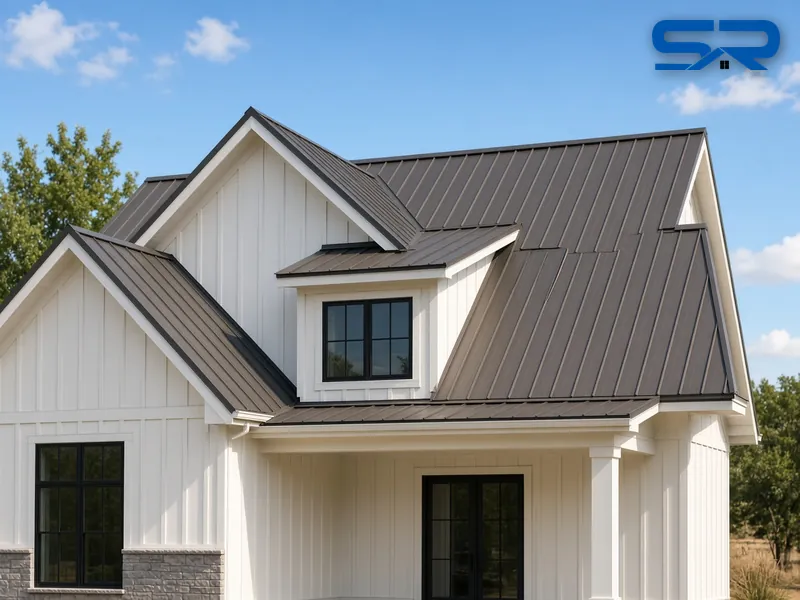
Where standing seam fits in Grand Prairie
Grand Prairie began as Dechman, a stop on the Dallas-to-Fort Worth stage road. The Handbook of Texas says Alexander Dechman traded a broken wagon, an ox team and $200 in Confederate money for a 239-acre tract here; the Texas and Pacific Railway reached the site in 1876, and in 1877 the post office took the railroad's name for it, Grand Prairie. The town incorporated in 1902. Aviation changed it: Hensley Field opened just east in 1928, and the North American Aviation defense plant next door employed as many as 38,500 workers during World War II, when Grand Prairie grew from 1,595 people to 18,000. The city reached 30,000 by 1960, 99,616 by 1990 and 175,396 by 2010, and Census estimates now put it at about 209,400, spread across Dallas, Tarrant and Ellis counties with Mountain Creek Lake on the east and part of Joe Pool Lake on the south. That growth left a city of every roof age at once: postwar houses near the old downtown, decades of subdivisions, and newer neighborhoods to the south, along with the plants, warehouses and industrial buildings that have been part of Grand Prairie since the war.
- Postwar and 1960s-80s houses whose owners are done replacing shingles after hail. Dark standing seam over brick is the conversion we're asked about most, and the long, simple roof lines of older houses show it off well.
- Newer two-stories in HOA neighborhoods, often as accents over porches, bays and entries with a designer or Class 4 shingle main roof where the association limits full metal.
- Lake-area homes near Joe Pool Lake where the owner wants the house, the boat cover and the RV cover to match.
- Churches, offices, schools and commercial buildings with pitched or mansard roofs, where the owner wants a long-lived finish and a commercial NDL warranty (we offer 10- and 20-year NDL warranties at different prices).
Comparing standing seam with stone-coated steel, R-panel or metal shingles? See metal roofing in Grand Prairie.
Snap-lock or mechanically seamed?
| Snap-lock | Mechanically seamed | |
|---|---|---|
| How the seam closes | Panels snap together by hand | A seaming tool folds the seam closed along its length |
| Best on | Most steep-slope house roofs | Low-slope porches and wings, and very long runs |
| Look from the street | Clean, slim seam | Slightly heavier seam; same concealed fasteners |
More detail: snap-lock vs. mechanical lock. We use 24 or 26 gauge steel and never 29 gauge on a home (why). We don't publish prices because size, pitch, tear-off and detail work move them too much; our standing seam cost page explains what moves the number, and you get a written price for your roof.
Grand Prairie's wind record
NOAA's event narratives show wind taking roofs and trees in Grand Prairie:
- January 15, 2017: a brief EF-0 tornado in southern Grand Prairie left about 20 homes with minor roof damage, blew down or destroyed most of the fences in the neighborhood and took down about 40 trees. Grand Prairie Municipal Airport recorded a 63 mph gust that day.
- March 13, 2019: emergency management measured an 80 mph gust in the city, part of a broad swath of wind damage along the I-20 corridor.
- October 2019: a 65 mph gust measured by a weather station on Palmer Trail.
- March 29, 2017: many trees snapped and uprooted along Mountain Creek Parkway and Camp Wisdom Road, and roof damage at a church in Arlington about four miles away.
- August 4, 2025: 61 mph gusts measured twice at Arlington Municipal Airport, about four to five miles away.
Standing seam handles that kind of wind well when it's installed to the manufacturer's tested system. What we do on every Grand Prairie roof:
- Clip spacing tightened at the perimeter. Uplift is highest at the eaves, rakes, hips and ridge, so that's where the clips go closer together, per the manufacturer's pattern.
- Hemmed panel ends and cleated trim, so there's no raw edge or loose flange for wind to get under.
- Mechanically seamed panels on low-slope sections and where the exposure calls for the extra seam strength.
- Deck nailing checked after tear-off, because the clips can only hold as well as the wood or deck they're screwed into. On an older house, that can mean replacing some original decking, which we photograph and price per sheet in writing first.
Low slope on churches, offices and additions
Commercial buildings and older home additions often have lower pitches than the main house. Standing seam has no laps in the field, so it handles lower slopes well when the panel and seam are the right ones. On low planes we use mechanically seamed panels, so the seam is folded closed along its full length, and we check the manufacturer's minimum slope for the exact panel and seam before we quote. Where the pitch changes (a porch tying into the main roof, a parapet wall, a rooftop unit curb) we bend transition flashings and curb details on our brake. If a section is too flat for any steep-slope roof, we'll tell you and quote the right low-slope system for it.
Color, finish and the street view
Charcoal, black and dark bronze are the most requested on brick and stone, and muted grays and bronze suit churches and commercial frontage. Lighter colors run cooler in a Texas summer. We bring real panel samples, put the exact color and finish system in writing, and include the profile drawing and product sheet in your HOA packet if you have one. Those same product sheets go to the City with the permit application. See metal roof colors and finishes. Approval is up to your association.
What a good standing seam job looks like up close
- One panel from eave to ridge, formed to the length of each roof plane.
- Clips that let the panels move with the heat, so they don't oil-can or pull fasteners.
- Bent flashings, not caulk, at walls, chimneys, valleys, skylights and pipes.
- High-temperature underlayment made for metal, over a deck we've checked and repaired.
- Vent piping and flues reconnected and flashed, the manufacturer’s specifications on file with the City permit, and no work past an inspection point until the City signs off.
City of Grand Prairie re-roof permit
Grand Prairie is strict and simple: per the City's Residential Re-Roof Permit page, a permit is required for any roof replacement, recovering or repair, and every residential re-roof needs an approved permit from the Building Inspections Division. From the City's own pages:
- Online, through the Customer Self-Service portal, with a description of the work, the square footage, the contacts and the manufacturer's specifications for the roof covering attached, plus a signed acknowledgement. The City says permits are processed in about 5 to 10 business days.
- Registered contractors only. The contractor must be registered with the City as a General Contractor to work in Grand Prairie (a $75 registration).
- Inspected to the 2021 International Residential Code, with no work past each inspection point until it is approved.
- The fee is the City's, not ours. The City's Unified Development Code fee schedule (Article 22, adopted September 2, 2025) lists a Residential Roof Repair Permit at $50 and a Commercial Re-Roof Permit at 1% of the work, with a $150 minimum.
The City also warns that it does not accept wire transfers for building permits and only takes payment through its portal, in person or by mail, so treat any emailed "permit invoice" asking for a wire as a scam. Questions go to Building Inspections at 972-237-8230. We register, apply, attach the product specifications and schedule each inspection.
Hail and standing seam in Grand Prairie
NOAA's Storm Events Database lists 45 reports of hail 1.75 inches (golf-ball size) or larger within about 10 miles of the center of Grand Prairie from 2016 through the September 2026 update. Only 2 of those fell within about three miles of the center, but Grand Prairie is a big city, roughly 81 square miles, so storms that look "nearby" on a map are often over part of town. The biggest:
- April 25, 2026: hail up to 3 inches around Dallas Baptist University, about four and a half miles east, where NOAA notes car windows were blown out, and 1-inch hail at the Grand Prairie airport the same day.
- June 12, 2023: 4-inch hail near Cedar Hill, about six miles south, with 2.75-inch (baseball) hail near Cedar Hill State Park and 5-inch hail in Mansfield, about nine miles southwest.
- May 27, 2024: 3.25-inch hail near Dalworthington Gardens, about five miles west, and 1.75-inch hail about a mile and a half from the center of Grand Prairie.
- June 1, 2025: 2-inch hail about a mile and a half from the center, with 2- to 2.5-inch hail across west Arlington the same afternoon.
- May 22, 2024: 1.5-inch hail at the Grand Prairie airport, about a mile from the center.
No roof is hail-proof, and very large hail can dent steel. Standing seam doesn't crack, curl or lose granules, so it usually keeps shedding water after storms that ruin shingles. If you'd rather keep a shingle look on the main roof, we'll compare Class 4 designer shingles with full metal. See Class 4 metal roofs and insurance. Texas insurers must offer a premium credit for UL 2218 impact-rated roofs, but each company sets its own amount, and Class 4 earns the largest. We can't promise a discount; ask your insurer for their figure in writing. After a qualifying install we fill out TDI Form PC068 for you. If you file an insurance claim, we document the damage and meet your adjuster on the roof. Texas law requires you to pay your deductible, and a contractor may not waive, absorb or rebate it. We never will. In Texas you generally have 1 year from the date of loss to file; check your policy.
Why it matters that we form our own panels
- One piece from eave to ridge. We cut standing seam and R-panel to the length of each roof plane, so long runs don't need mid-slope laps.
- 24 or 26 gauge on every standing seam and R-panel roof. See 26 vs. 29 gauge.
- No waiting in a panel shop's queue after a hailstorm, when everyone needs a roof at once. Metal lead time is typically 1 to 2 weeks.
- Flashings bent for the panel, not caulked: walls, chimneys, valleys, skylights and pipes.
- Every inspection comes with a free digital photo report, so you see what we see.
How a metal roof job runs with us
- Inspection and free digital photo report: deck, ventilation, penetrations, valleys and measurements.
- Written spec for each option: system, gauge, profile, color, underlayment, trim and every flashing detail.
- Approvals: the HOA or historic-review packet if you need one, then the permit.
- Tear-off and deck repair where needed, then high-temperature synthetic underlayment made for metal.
- Install by our own crew, with hips, ridges, eaves and penetrations detailed for the system.
- Final walk-through, a magnet sweep of the yard and driveway, and your warranty in writing.
Who installs standing seam roofs in Grand Prairie?
Snow Roofing & Exteriors does. Here are the facts you can check before you call anyone:
- 75 years as a family roofing business, and 30 years in the business for owner Blake Snow, who is still on the roofs.
- Over $80 million in completed roofing projects, from small repairs to multi-million-dollar jobs.
- 5.0 stars on Google at all three offices: Bridgeport, Decatur and Rhome.
- Our own roll formers for standing seam and R-panel, in 24 or 26 gauge, with metal lead times that are typically 1 to 2 weeks.
- Our own crew, about 47 road miles (roughly an hour) from Grand Prairie with our Rhome-area team.
- Snow Roofing & Exteriors is BBB A+ rated.
Our metal work, up close
The photos on this page show our roof work up close. We never show a street or address.
We're certified with GAF, CertainTeed, Owens Corning, Atlas, Johns Manville, Carlisle, Tropical Roofing Products, Mule-Hide and Enviroshake, and many other roof manufacturers. We give a workmanship warranty from 10 years up to lifetime, depending on the job, and the manufacturer warranty on the panel and finish, in writing.
More: metal roofing in Grand Prairie, our Grand Prairie roofing page, storm damage in Grand Prairie, and standing seam in nearby Arlington, Mansfield and Fort Worth.
Product names, ratings and features are as published by the manufacturer and can change. We confirm the current rating and warranty of the exact product before we order it.
Residential warranty: a workmanship warranty from 10 years up to lifetime, depending on the job, with manufacturer warranties up to lifetime. Manufacturer coverage depends on the product and brand, and on the project qualifying for that manufacturer's program. We put the exact warranty for your roof in writing.
Certified, with 30 years installing every major roofing brand, a family roofing business going back 75 years, and over $80 million in completed roofing projects. 5.0 stars on Google at all three of our offices.
Request a free inspection or call (817) 733-9228. Small repairs are welcome too.


