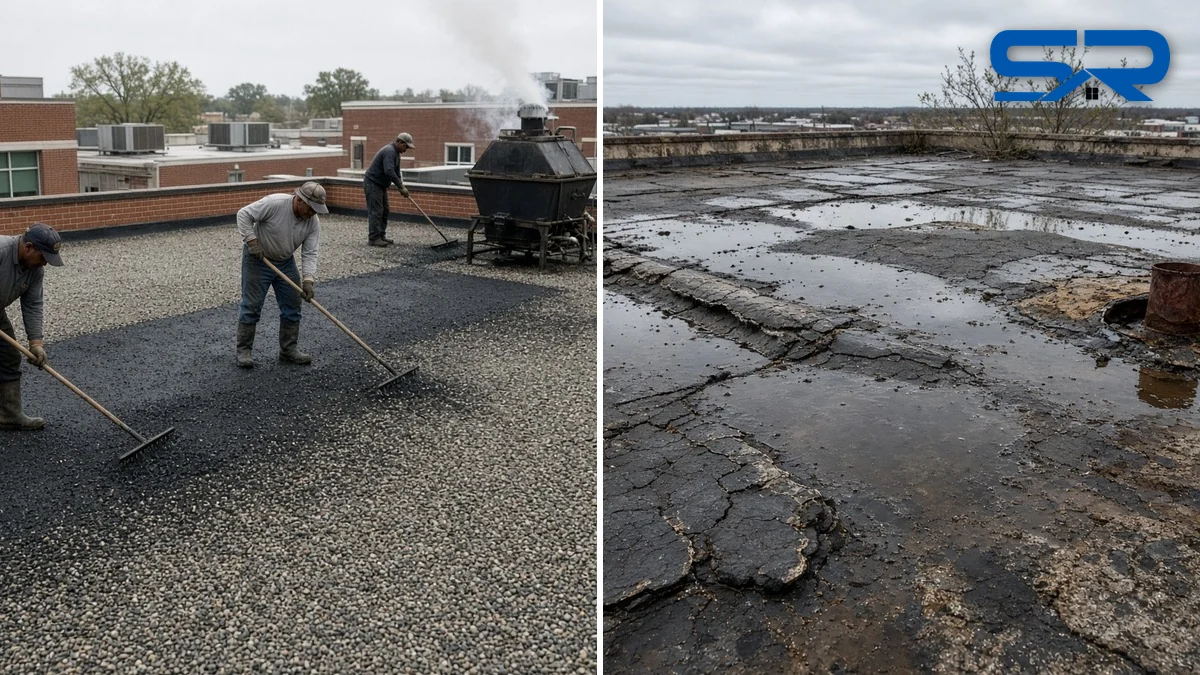
Drive through the older industrial parks, strip centers and church campuses around Fort Worth and you’ll still see plenty of built-up roofs (BUR): layers of felt and asphalt, often finished with gravel, sometimes smooth or aluminum-coated. When one of those roofs starts leaking, the first question an owner asks is usually, “Can we just coat it?”
I’m Blake Snow. I’ve been roofing for 30 years, and we repair, coat and replace commercial roofs across Fort Worth and the rest of Tarrant County. I’ve worked with APOC, Henry and Karnak coatings. All three can work on an old built-up roof, and all three fail fast when the prep is skipped. Here’s how they compare, straight from their own data sheets.
The short version
- Gravel has to come off. None of the three is written to go over loose gravel.
- Asphalt bleeds. Every brand has a primer, base coat or test step to stop brown bleed-through on white coatings.
- Wet insulation has to go. A coating seals moisture in. It doesn’t dry it out.
- Water that sits points you toward silicone, and toward fixing the drainage.
- Product warranties are narrow. Read what’s covered before you compare prices.
The three silicones at a glance
Most old built-up roofs I’m asked to coat in Fort Worth are flat, with low spots, so silicone is usually the starting point. Here’s how each brand’s main silicone stacks up on paper.
| APOC 585 Armor Flex | Henry 887 Tropi-Cool | Karnak 670HS Karna-Sil Ultra | |
|---|---|---|---|
| Maker | Gardner-Gibson, Inc., Tampa, FL | Henry Company (part of Carlisle since Sept. 2021) | KARNAK, Clark, NJ |
| Solids by volume | 98% ± 2% | 91% ± 3% | 91% nominal |
| Elongation | 425% | 280% minimum | 212% at 73°F |
| Coverage | 1.5 to 4 gal per 100 sq ft | At least 1.5 gal per 100 sq ft, 22 dry mils minimum | 1.5 gal per 100 sq ft (24 wet mils) in one coat; up to 3 gal on approved surfaces |
| Over asphalt / BUR | Approved bleed-blocking primer should be used; field adhesion test | Aged BUR listed; test area for bleed-through and adhesion first | Smooth BUR needs 180 epoxy primer, 405 or 406 base coat |
| Ponding water | Marketed with Pond-Proof technology | “Permanent ponding water resistant” | Data sheet: all surfaces must have positive drainage |
| New BUR age before coating | Not stated on the sheet | Roof at least 90 days old | 90 to 180 days |
| Application temperature | 40°F to 120°F | 35°F to 120°F | 50°F to 120°F |
| Reflectance / SRI | 0.90 initial, SRI 115 initial | 0.88 initial, 0.73 aged; SRI 111 initial, 90 aged | 0.87 initial, 0.70 at 3 years |
Sources: APOC 585 data sheet, Henry 887 data sheet and application guide, Karnak 670HS data sheet. Numbers on paper don’t decide the job. The roof underneath does.
Problem 1: the gravel
A tar-and-gravel roof is the most common kind of old BUR I see in Fort Worth, and it’s the one that surprises owners the most.
- Henry’s 887 application guide says it is not intended for gravel-covered roofs (or coal tar, shingles, or cold storage buildings).
- APOC’s ICC-ES evaluation report for its coating systems over existing built-up roofs (ESR-3796) says the roof must be repaired, made sound and watertight, cleaned to remove loose gravel, power washed and dried before coating.
- Karnak’s Karna-Sil brochure says all BUR surfaces must be cleaned, then primed with its 180 epoxy primer before 670HS goes on.
Getting the gravel off a big roof is real labor: scraping or power-brooming, vacuuming and hauling, then repairing the asphalt underneath. It goes on our bid as its own line, so you can compare it against a tear-off or a new membrane honestly.
Coal tar is a separate question. Some older roofs are coal tar pitch, not asphalt. Henry’s guide excludes coal tar outright. We identify what the roof is made of before we recommend any product.
Problem 2: asphalt bleed-through
Put a white coating straight on old asphalt and it can stain brown or tan. Each brand handles it differently.
- APOC: For silicone, the 585 sheet says an APOC-approved bleed-blocking primer should be used over asphalt. Its 583 Armor-Base epoxy primer calls for at least 8 dry mils of continuous film over asphalt for bleed-through resistance. For acrylics, APOC’s gray 230 Bleed-Block base coat goes down first.
- Karnak: The 180 Karna-Sil epoxy primer goes on smooth BUR at 100 to 150 sq ft per gallon, and Karnak warns that too much primer reduces adhesion. For acrylic or silicone systems, its 405 Bond-N-Shield base coat contains stain blockers and goes on at 1.5 gal per 100 sq ft on smooth surfaces, up to 2 gal on granule surfaces.
- Henry: The 887 data sheet tells applicators to coat a test area over the existing membrane first to check for bleed-through and adhesion.
Whatever the brand, we run adhesion tests on the actual roof before we commit to a system. APOC’s own sheets recommend a pull test, and it’s the cheapest insurance on the whole job.
Problem 3: wet insulation
This is the one that turns a coating into a waste of money. Old BUR often has insulation that has been soaking up leaks for years. Karnak’s data sheets say it plainly: all wet insulation should be removed and replaced with like materials before coating.
Before we price a coating, we look for trapped moisture with drone and thermal imaging and confirm with moisture readings or core samples where needed. Wet areas get cut out and replaced. If a big share of the roof is wet, a coating isn’t the right fix, and we’ll tell you that.
Problem 4: water that sits
Flat Fort Worth roofs collect water at drains, around rooftop units and in sagged bays.
- Silicone is the usual choice for ponding areas. Henry lists 887 as permanently ponding-water resistant, and APOC markets 585 with Pond-Proof technology.
- Karnak is stricter on paper: its 670HS and 180 primer sheets both say all surfaces must have positive drainage.
- Acrylic base coats like APOC 230 are not recommended where ponding water sits.
My approach: fix what drainage you can (clear drains, add crickets, build up low spots), then choose the coating for whatever water is left.
Foot traffic and rooftop units
Silicone is slick. Henry’s guide warns that silicone-coated surfaces are extremely slippery and are designed for moderate maintenance traffic only. APOC says to embed 40 to 60 lb of #11 ceramic granules per 100 sq ft into the top coat where people will walk, and Karnak also recommends back-rolling ceramic granules into the final coat. On a roof with HVAC techs up there every month, we add granules or walkway paths around units and access points.
Recoating later
Plan for the next coat now. Karnak lists previously silicone-coated roofs as a surface that needs no primer for its silicone. In practice, once a roof is silicone, future maintenance coats are silicone too.
Warranty: read the fine print
- Henry 887 comes with a limited product warranty: Henry warrants that the product is free of defects, proof of purchase is required, and the remedy is limited.
- APOC offers extended warranties under its published qualifications on apoc.com, and its 585 sheet says coverage depends on warranty and term.
- Karnak’s product data sheets don’t spell out a system warranty, so ask for any warranty in writing as its own document.
A material-only warranty isn’t a roof warranty. When we quote a coating, we spell out the product warranty, any system warranty the job qualifies for and its film-thickness requirements, and our own workmanship warranty, from 10 years up to lifetime, depending on the job. For full replacements, commercial jobs offer 10- and 20-year NDL warranties.
Coat it, re-cover it or tear it off?
A coating usually makes sense when:
- The BUR is aged but still mostly sound, with only local blisters, splits and flashing problems
- The insulation is mostly dry
- You want to extend roof life with less disruption to tenants
A re-cover or replacement usually makes sense when:
- Large areas of insulation are wet
- The roof is coal tar and the product you want excludes it
- Blisters, splits and ridging are everywhere
- You need a different roof system, such as TPO or modified bitumen
See our built-up roofing and commercial roof coatings pages, our brand pages for APOC, Henry and Karnak, and our guide to TPO vs. modified bitumen vs. coating.
After a storm in Fort Worth
Hail can bruise old BUR and crack aged coatings, and damage is hard to see under gravel. Get the roof inspected and photographed before anyone coats over it. You can look up past storms near your building in NOAA’s Storm Events Database. In Texas you generally have 1 year from the date of loss to file a claim, but check your policy. Our commercial hail claims guide covers the process.
What goes on our coating quotes
- Roof survey: drone and thermal imaging, moisture checks and a digital photo report
- What the roof is (asphalt BUR, coal tar, smooth or gravel) and how we know
- Gravel removal and disposal, if needed
- Wet insulation to replace, by area
- Repairs: blisters, splits, seams, flashings, drains and edge metal
- Primer or base coat, and the adhesion test results
- Coating product, gallons per 100 sq ft and target dry mils
- Granules or walkways for foot traffic
- Product, system and workmanship warranties in writing
Talk to us about your Fort Worth built-up roof
We coat, repair and replace commercial roofs in Fort Worth, Haltom City, North Richland Hills, Watauga and Keller. We have hands-on experience with APOC, Henry and Karnak coatings, and every roof is installed to manufacturer specs by certified installers. We’re certified with GAF, CertainTeed, Owens Corning, Atlas, Johns Manville, Carlisle, Tropical Roofing Products, Mule-Hide and Enviroshake, and many other roof manufacturers. We’re BBB A+ rated, with 5.0 stars on Google at all three offices: Bridgeport, Decatur and Rhome. Request a free inspection or call (817) 733-9228.
Sources
- APOC 585 Armor Flex Liquid Silicone Roof Membrane: Technical Data Sheet (C25)
- APOC 583 Armor-Base Waterborne Bleed-Blocking Primer: Technical Data Sheet (C25)
- APOC 230 Energy-Armor Bleed-Block Elastomeric Base Coat: Technical Data Sheet (C25)
- ICC-ES Evaluation Report ESR-3796 (APOC coating systems over existing roofs)
- Henry 887 Tropi-Cool 100% Silicone White Roof Coating: Technical Data Sheet
- Henry Maintenance System: Application Guide for 100% Silicone
- Carlisle Companies: Carlisle completes purchase of Henry Company (2021)
- KARNAK 670HS Karna-Sil Ultra: Product Data
- KARNAK 180 Karna-Sil Epoxy Primer: Product Data
- KARNAK 405 Bond-N-Shield (Asphalt Surface Base Coat)
- KARNAK Karna-Sil brochure
- NOAA NCEI: Storm Events Database