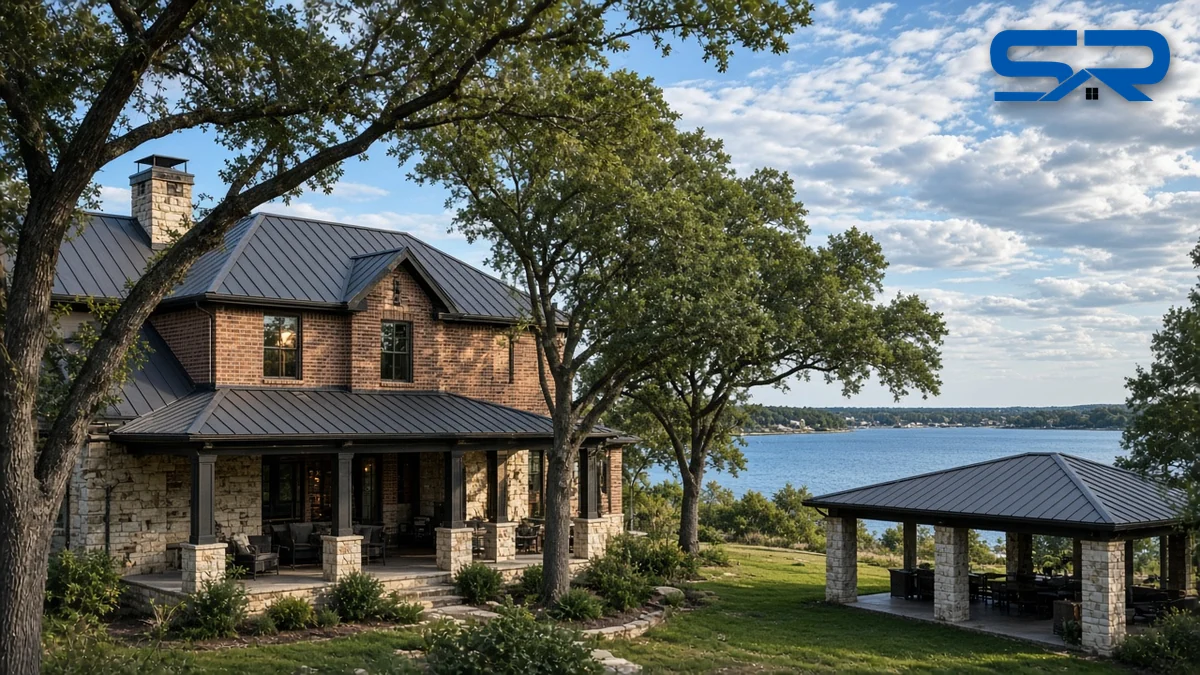
Lake Dallas and Hickory Creek sit side by side on I-35E at the west end of Lewisville Lake, and they look nothing like each other street to street. Lake Dallas is the old lake town, with homes near Main Street, lake houses that have been added onto for decades, and newer subdivisions on the edges. Hickory Creek is one of the fastest-growing towns on the lake: Census estimates show it going from 4,722 residents in 2020 to about 6,875 in 2025. Both get the same wind off the water and the same hail. That’s why I like standing seam here.
I’m Blake Snow. I’ve been roofing for 30 years, I’m the third generation in a family business that goes back 75 years, and our crews have completed over $80 million in roofing projects. We form standing seam and R-panel on our own roll formers in 24 or 26 gauge, and our own crews install them. Here’s how I’d put a metal roof on a Lewisville Lake home.
The short answer
For most lake-area homes in Lake Dallas and Hickory Creek, I recommend standing seam with edges set for wind off the water, coated or stainless fasteners, and proper flashing at every wall and tie-in. Where an HOA expects a shingle or shake look, stone-coated steel or metal shingles get you metal without the standing seam look. Carports, boat covers and shops get R-panel or PBR in a color that matches the house.
What the lake does to a roof
Homes near the water get more wind across open water and more humid air than homes a few miles inland. On a metal roof, that shows up in three places:
- The edges. Wind gets under trim at the eaves and rakes first. We set clip and fastener spacing at the edges for the exposure and use trim and closures made for the panel, so wind-driven rain and wasps stay out of the ribs.
- The fasteners. Damp air is hard on cheap screws. We use stainless or coated fasteners and clips rated for the exposure.
- The attic. Humid lake air meeting a cool deck can mean condensation. We check ventilation and underlayment before the new roof goes on. Our post on condensation control under metal explains the basics.
Why standing seam fits lake homes
- No exposed screws. Clips hide under the seams and let the steel move with Texas heat and cold, so there are no washers to crack and leak. See hidden fasteners vs. exposed screws.
- One piece from ridge to eave. Our roll formers cut each panel to the length of the run, so most roofs have no end laps for water to find. See long panel runs.
- Lower slopes. Mechanically seamed standing seam can go on slopes shingles shouldn’t be on, which matters on the next point.
Additions, closed-in porches and tie-ins
A lot of Lake Dallas houses have been added onto: a porch closed in, a room on the back, a carport roof tied into the house. Those are where leaks start, because the pitch drops and two roofs meet. Metal fixes a lot of it when it’s detailed right:
- Measure every plane. We check the pitch on the main roof, the porch and the addition before we recommend anything.
- Pick the seam for the slope. Snap-lock on normal pitches, mechanically seamed on lower ones. See snap-lock vs. mechanical lock.
- One system across the house. One continuous panel where two old roofs used to overlap, in one color, so the addition stops looking like an addition.
- Flashing, not caulk. Bent for the panel at every wall, chimney and pipe. See metal roof flashing details.
- Be honest about flat spots. If a section is too flat for any metal panel, we’ll say so and quote a membrane for that part.
Matching the house to the lake life
| Part of the property | What I usually recommend |
|---|---|
| Older home near the center of Lake Dallas | Standing seam or metal shingles sized to the house, with trim that suits its age |
| Lake house or home near the water | Standing seam, coated or stainless fasteners, edges set for lake wind |
| Hickory Creek subdivision home with an HOA | Stone-coated steel or metal shingles; standing seam porch and bay accents |
| Home that’s been added onto | One metal system across the old roof and the addition |
| Carport, boat or RV cover, shop | R-panel, PBR or corrugated, or standing seam to match the house |
If you’re also planning a pool house or outdoor kitchen, our post on pool houses and outdoor kitchens in the Lewisville Lake towns covers that side. Our own crews build them, and we can roof them to match.
Hail around Lake Dallas and Hickory Creek
NOAA’s Storm Events Database lists 59 reports of hail 1.75 inches (golf-ball size) or larger within about 10 miles of Lake Dallas, and 57 within about 10 miles of Hickory Creek, from 2016 through its September 2026 update. The worst day close to home was March 26, 2017: NOAA lists 2.75-inch hail in Lake Dallas, less than a mile from the center of town, and 4.25-inch hail at Corinth. On June 11, 2023, 4.25-inch hail fell near Bartonville and 3-inch hail about three miles south of Hickory Creek, and on March 14, 2024, 3.5-inch hail fell near Bartonville and 2-inch hail within two miles of both towns.
I’ll be straight with you: hail that size can dent any metal roof. What metal doesn’t do is crack, split or shed granules like an asphalt shingle, and 24- or 26-gauge panels dent less than the thin 29-gauge panels common on budget buildings. See metal roofs and hail and 26 vs. 29 gauge. If a storm already came through, start with our Lake Dallas storm damage page or Hickory Creek storm damage page. In Texas you generally have 1 year from the date of loss to file a claim, but check your policy.
Permits: two towns, two sets of rules
Lake Dallas, Hickory Creek, Shady Shores and Corinth are called the Lake Cities, and an address can be in one town while the house across the street is in another. We check which one you’re in before we file anything.
Lake Dallas. The city’s Development Services FAQ says a permit is required to replace roof shingles, and a metal re-roof is the same kind of work. Per the city’s permits page, contractors register before starting ($100, state-licensed trades exempt), the city doubles permit fees on work that starts before the permit is issued, and inspections are done by Bureau Veritas.
Hickory Creek. The town’s permitting department works under the 2021 International Building Codes. Its master fee schedule lists a roofing permit at a flat $150, and contractor registration is $75. If your lot backs up to the Corps-managed shoreline, the town’s permit form asks for approvals from easement holders, including the U.S. Army Corps of Engineers, with the application. HOA approval is a separate step the town doesn’t handle, so we gather that too.
Why Lake Cities owners call us
- Our own roll formers and our own crews for standing seam and R-panel, 24 or 26 gauge.
- Metal lead time is typically one to two weeks.
- Certified with GAF, CertainTeed, Owens Corning, Atlas, Johns Manville, Carlisle, Tropical Roofing Products, Mule-Hide and Enviroshake, and many other roof manufacturers.
- 5.0 stars on Google at all three offices: Bridgeport, Decatur and Rhome.
- BBB A+ rated.
- Workmanship warranty from 10 years up to lifetime, depending on the job.
See our Lake Dallas standing seam page, Hickory Creek standing seam page, metal roofing in Lake Dallas and metal roofing in Hickory Creek. We also work in nearby Shady Shores, Corinth, Highland Village and Denton, and our post on metal roofing in Lewisville covers the south side of the lake.
Get a metal roof estimate in Lake Dallas or Hickory Creek
Whether it’s standing seam on a lake house, a leaking addition, or a new roof on the boat cover, I’m glad to come out and look. Every estimate starts with a free digital photo report. Request an estimate or call (817) 733-9228.