
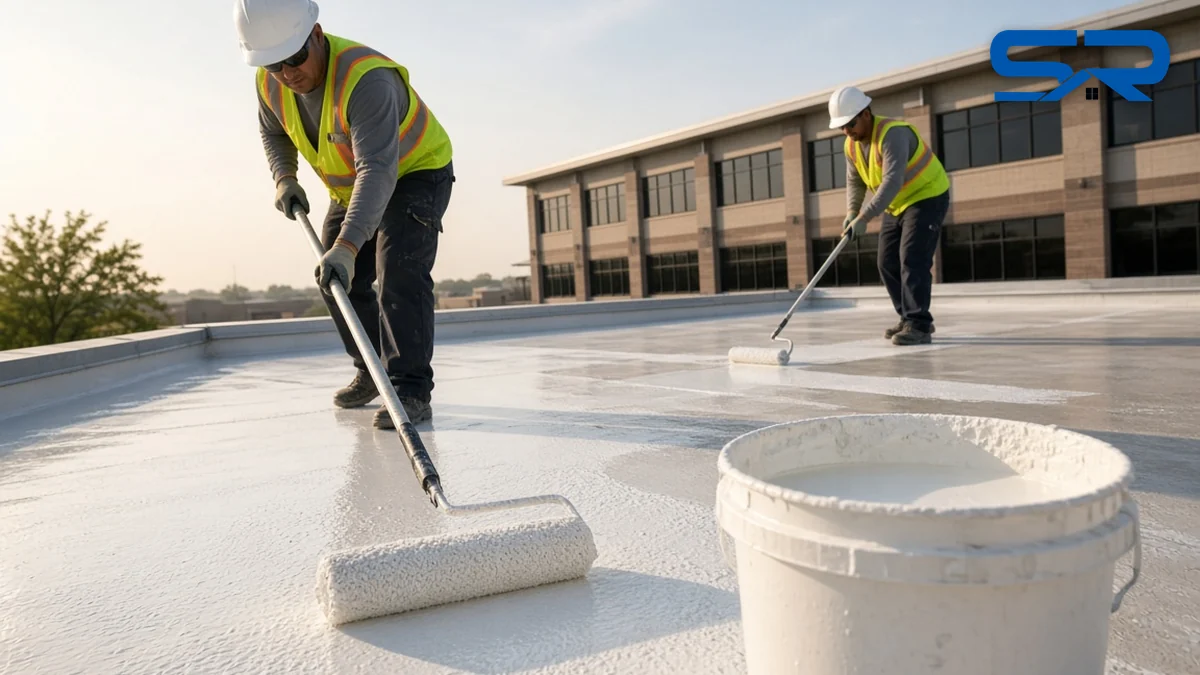

Around Bridgeport and the rest of Wise County, a lot of commercial roofs are the kind coatings were made for: metal shops and ag buildings, churches with a low-slope section behind the sanctuary, small offices and retail buildings with a tired mod-bit or built-up roof, and older TPO roofs that are dry but chalky. When an owner asks about a roof coating, the first fork in the road is almost always the same: silicone or acrylic?
I’m Blake Snow. I’ve been in roofing for 30 years, and we’re certified with Mule-Hide. This post compares Mule-Hide’s two main coating families using Mule-Hide’s own data sheets and system specifications, then tells you which one I’d put on which kind of Bridgeport building, and why. If you’re looking at Mule-Hide membranes for a porch or addition instead, see my Mule-Hide low-slope porches post.
The short answer
- Roof holds water after a rain, or you want one heavy coat and a fast recoat window? Mule-Hide 100% Silicone Roof Coating is usually the better fit.
- Roof drains well, it’s metal or foam, and you want a bright white finish with a base-and-finish system? Mule-Hide’s acrylic system (A-300 Base topped with A-300 or A-310 Finish) is a solid, well-proven choice.
- Either way, the coating is only as good as the roof under it. Wet insulation, failed seams and rust have to be dealt with first. That part of the job decides whether a coating lasts.
Side by side: Mule-Hide’s published numbers
| 100% Silicone Roof Coating | A-300 Finish (acrylic) | A-310 Finish (acrylic) | |
|---|---|---|---|
| Chemistry | 100% silicone, single part, moisture cure | Water-based acrylic elastomeric | 100% acrylic, high solids, heavy bodied |
| Solids by volume | 90% (±2) | 53% (±2) | 54% |
| Solids by weight | 92% (±3) | 68% (±2) | 69% |
| Tensile strength | 325 psi | 275 psi (±50) | 250 psi (±25) |
| Elongation | 300% | 250% (±25) | 185% (±50) |
| Recoat time (product page) | 2-4 hours | 12 hours | Per data sheet |
| Ponding water | Listed as resistant to periodic ponded water | Use on roofs that drain (A-320 Finish is listed for ponding areas) | Use on roofs that drain |
| White reflectance | Initial solar reflectance 0.89, SRI 113 (white) | CRRC listed | Listed as staying bright white after weathering |
| Colors | White, gray, tan, Santa Fe tan, black | White, beige, tan, Arizona tan, light gray, dark gray, custom | White, gray, tan and more |
| VOC | Under 50 g/L | Under 50 g/L | Under 50 g/L |
| Warranty (product page) | Up to 20 years on multiple substrates | Up to 20 years | Up to 20 years |
Sources: Mule-Hide’s 100% Silicone Roof Coating product page and product data sheet, and the A-300 Finish, A-310 Finish and A-320 Finish product pages and data sheets. Mule-Hide notes these are typical values, not guarantees for every sample.
Why the solids number matters: solids are what’s left on your roof after the coating cures. A 90%-solids silicone loses very little as it cures. A water-based acrylic around 53% solids loses close to half its wet thickness as the water leaves. That’s why acrylic systems are built in more coats, and why “how many gallons per square” on your bid matters more than the brand name on the bucket.
Ponding water: the question that usually decides it
Walk your roof the day after a good rain. If there are spots still holding water 48 hours later, that’s ponding, and it’s the single biggest reason I steer an owner toward silicone. Mule-Hide lists its 100% Silicone Roof Coating as resistant to periodic ponded water.
Mule-Hide does list A-320 Finish as a top coat in ponding areas, so acrylic isn’t automatically off the table. But on a Bridgeport roof where water sits for days, I’d rather fix the slope with crickets or tapered insulation, or use silicone, than ask a water-based coating to sit underwater all spring.
Weather and recoat windows
North Texas weather matters on a coating job:
- Silicone cures by pulling moisture from the air. Mule-Hide recommends applying at 40°F and rising, and says cure time is much quicker in humid weather. Its product page lists a recoat window of 2-4 hours.
- Acrylic cures as the water evaporates. Mule-Hide’s A-300 data sheet says not to apply if rain is likely within 24 hours, warns that cool, humid weather slows the cure, and recommends multiple thin coats above 90°F to avoid trapping moisture. The product page lists a 12-hour recoat.
In practice, that means a silicone job can often be finished in fewer days, and an acrylic job needs a cleaner weather window. In a Wise County spring with storms rolling through every few days, that difference is real.
What each system looks like on your roof
Mule-Hide silicone system (from Mule-Hide’s specifications):
- Clean with Mule-Hide 115 Cleaner and power wash. Rinse well.
- Prime where needed (Mule-Hide lists Multibase SB primer in its silicone specs, and primer choice depends on the surface).
- Seal seams, fasteners and penetrations with Mule-Hide Silicone Sealant.
- Apply the silicone in one coat at the rate your warranty term requires.
Mule-Hide acrylic system (from Mule-Hide’s specifications):
- Clean with 115 Cleaner.
- On metal, prime with A-125 Metal Roof Primer, a high-solids primer Mule-Hide says encapsulates existing rust.
- Seal seams, fasteners and penetrations with A-200 Flashing Grade, and reinforce moving end laps and corners with polyester fabric.
- Apply A-300 Base (tinted gray, so you can see coverage), then the white A-300 Finish or A-310 Finish. Over an asphalt roof with aluminum coating that can’t be removed, Mule-Hide lists A-300 Base-RA as the alternate base.
Coverage rates and warranty terms
These are the minimum rates in Mule-Hide’s published specifications. Your bid should show the rate, not just the term.
| Warranty term | Silicone topcoat (Mule-Hide minimum) | Acrylic over metal (Mule-Hide step-by-step) |
|---|---|---|
| 10-year | 1.5 gal per 100 sq ft (24 wet / 22 dry mils) | Per spec |
| 15-year | 2.0 gal per 100 sq ft (32 wet / 29 dry mils) | A-300 Base at 1 gal per square, plus A-300 Finish at 1.5 gal per square |
| 20-year | 2.5 gal per 100 sq ft (40 wet / 36 dry mils) | A-300 Base at 1 gal per square, plus 2 coats of A-300 Finish at 1 gal per square each |
Sources: Mule-Hide silicone system specification and acrylic over metal step-by-step. Silicone rates exclude primer and extra coating at details.
What kind of warranty? Mule-Hide offers a material-only limited warranty and, on commercial buildings, a 10-, 15- or 20-year NDL (No Dollar Limit) system warranty that covers leaks from manufacturing defects, premature weathering and the contractor’s workmanship. For a silicone NDL warranty, Mule-Hide requires a moisture survey, adhesion testing and a pre-project roof evaluation before the job starts. On our jobs, pull and adhesion tests are usually done with the manufacturer’s rep, who meets our crew on site.
On our commercial bids we offer 10-year and 20-year NDL options at different prices, and our own workmanship warranty runs from 10 years up to lifetime, depending on the job.
What it won’t cover: Mule-Hide’s sample NDL system warranty excludes the existing roof underneath, metal flashings not approved by Mule-Hide, appearance and staining, and natural causes including hail, wind, lightning and tornadoes. It also requires written notice to Mule-Hide within 10 days of finding a leak. Telling your contractor is not notice to Mule-Hide.
The recoat question nobody asks
Think about year 15 before you pick year one. Very little sticks to cured silicone except more silicone, so a silicone roof gets recoated with silicone. Acrylic is easier to recoat with acrylic. Mule-Hide’s silicone data sheet does list aged acrylic coatings as an approved surface, so an old, well-bonded acrylic roof can usually be cleaned, tested and topped with silicone later. Going from silicone back to acrylic is the move you generally can’t make.
Which coating I’d use, building by building
| Your Bridgeport-area building | What I’d usually spec | Why |
|---|---|---|
| Low-slope office or retail roof that ponds after storms | 100% Silicone, 2.0-2.5 gal per 100 sq ft | Listed ponding resistance, one heavy coat |
| Metal shop or ag building, some surface rust, good slope | Acrylic: A-125 primer, A-200 at fasteners, A-300 Base + Finish | Rust primer, fastener detailing, water sheds off a sloped roof |
| Aged TPO that’s dry and passes adhesion testing | 100% Silicone with the specified primer | Mule-Hide lists TPO as a silicone substrate |
| Church fellowship hall with an old granulated mod-bit roof | Silicone with asphalt primer, or acrylic with A-300 Base-RA if old aluminum coating can’t come off | Depends on drainage and what’s on the surface now |
| Spray foam roof | Either; Mule-Hide lists foam for both | Drainage and budget decide |
| Wet insulation or a failing deck | No coating. Repair or re-roof | Coating over wet roofs voids warranties and traps water |
These are starting points. Your drainage, the existing roof and your budget decide the final spec.
What to ask before you sign a Mule-Hide coating bid
- Is it silicone or acrylic, and which exact Mule-Hide product?
- How many gallons per 100 sq ft (or wet mils), and does that match the warranty term?
- Is a primer included? Which one, and was an adhesion test done?
- Was a moisture survey done? Where are the wet areas, and how will they be replaced?
- How are seams, fasteners, curbs and drains detailed (sealant, fabric, three-coursing)?
- Is it a material-only warranty or an NDL system warranty? How many years?
- Who submits the warranty application before work starts?
- What’s the plan if rain moves in mid-job?
- What maintenance does the warranty require?
- Who handles the metal edge and flashings, and are they covered?
We also offer EpoxyFlex, our own private-label roof coating, and we’re an American WeatherStar Approved Contractor, so if another system fits your roof better, we’ll show you that option side by side. See my American WeatherStar restoration post for one comparison.
After a storm
Get the roof inspected and documented before anyone coats over it. A coating is not a hail repair, and coating over unrecorded damage can complicate a claim. Our FAA-certified drone pilot can fly the roof for a full overview, see our drone roof inspection page. In Texas you generally have 1 year from the date of loss to file a claim, but check your policy.
Talk to us about a coating in Bridgeport
We coat and restore commercial roofs across Bridgeport, Lake Bridgeport, Runaway Bay, Chico, Paradise, Boyd and Decatur. We’re certified with GAF, CertainTeed, Owens Corning, Atlas, Johns Manville, Carlisle, Tropical Roofing Products, Mule-Hide and Enviroshake, and many other roof manufacturers. We’re fully insured, BBB A+ rated, and references are available on request. We have 5.0 stars on Google at all three offices: Bridgeport, Decatur and Rhome.
See our silicone roof coating, acrylic roof coating and Bridgeport commercial roofing pages, use the estimate form below, or call (817) 733-9228.