A natural slate roof on a Preston Hollow home can last longer than the house’s next three owners, or it can be ruined in one afternoon by the wrong crew. The National Park Service says it plainly in its guide to historic slate roofs: laying slate right “requires training, much practice, and the right tools.” Most of the slate problems I’m called to look at don’t start with the stone. They start with a bad repair, the wrong nails, short headlap, cheap flashing or somebody walking across the roof in work boots.
I’m Blake Snow. I’ve been roofing for 30 years, and we install, repair and re-lay natural slate in Preston Hollow, Highland Park, University Park and across Dallas. Here are the questions I’d ask any slate roofer, including us, before you sign. Each one is tied to published guidance from the National Slate Association (NSA), the Slate Roofing Contractors Association (SRCA), the National Park Service and the Copper Development Association, so you can check the answers yourself.
The short version
| # | Ask this | A good answer sounds like |
|---|---|---|
| 1 | Repair, re-lay or replace? | “Your stone is sound (or it isn’t), and here’s how I know.” |
| 2 | What slate will match mine? | Quarry, color, size, thickness, weathering (fading vs. unfading) |
| 3 | What grade is the new slate? | ASTM C406 S1, with the quarry’s test results |
| 4 | What nails? | Solid copper, smooth shank, sized to the slate thickness |
| 5 | How do you replace a single broken slate? | Slate hook or nail-and-bib, never a face nail with tar |
| 6 | What headlap at my pitch? | 3” from 8:12 to 20:12, 4” from 4:12 to 8:12 |
| 7 | What’s in the valleys and at the chimney? | Copper, with the weight written down (16 or 20 oz) |
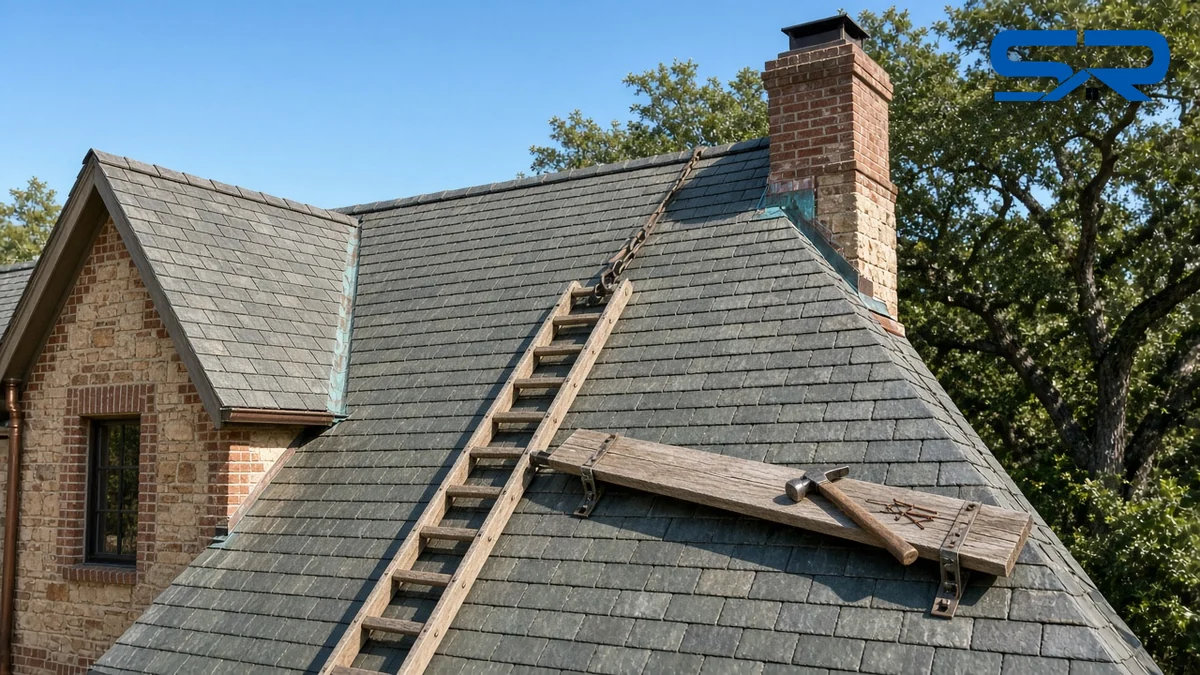
| 8 | How will you stage the roof? | Roof brackets, scaffold planks and hook ladders. Nobody walks on the slate |
| 9 | What’s in the written scope? | Every material spelled out, plus unit prices for extra slates and decking |
| 10 | What about early cracked slates? | “We come back and replace them” |
| 11 | Who checks the framing on a new slate roof? | Load checked before slate goes on a house that never had it |
| 12 | Insurance? | Certificates of insurance before work starts |
| 13 | Permits and district rules? | Checked on every job |
| 14 | How will you document it? | Before, during and after photos, including drone views |
| 15 | What’s the workmanship warranty? | In writing, with what it covers |
The details behind each one are below.
1. “Should this roof be repaired, re-laid or replaced?”
This is the most important question, and the one where a slate roof gets lost. The NSA says slates are meant to hang on their nails, and on old roofs it’s usually the nails, flashing or bad past repairs that fail while the stone still has decades left. Sound slate can often be stripped and re-laid on new copper nails with new flashing.
A good slate roofer can tell you why your stone is sound or worn out: whether slates are delaminating, flaking or soft, or whether they’re sliding out because the nails rusted. If the first answer you hear is “tear it off,” get a second look. Our full guide: natural slate repair vs. replacement.
2. “What slate will you use to match mine?”
“Like-kind” slate means the replacement matches your roof in color, size, thickness and texture, and weathers the same way. Some slate colors are “unfading” and some are “fading” (they change color over the first years). A mismatch on a front slope of a Preston Hollow home is something you’ll look at every day.
Ask for:
- The quarry or source and color name
- Size and thickness, measured against your existing slate
- Whether the color is fading or unfading
- Samples held up next to your roof, not just a brochure photo
For source options, see our slate quarries and brands guide and natural slate sources compared. On a large repair, salvaged slate from a hidden slope can sometimes be moved to the front, with new slate going where it’s least seen.
3. “What grade is the new slate?”
ASTM C406 grades roofing slate S1, S2 or S3. They all have the same minimum breaking load. What separates them is how much water the stone absorbs and how much it softens in an acid test, and that predicts service life: over 75 years for S1, 40 to 75 for S2, and 20 to 40 for S3. The SRCA’s architectural standard calls for S1, and that’s what I recommend on a Preston Hollow roof. “Premium slate” isn’t a grade. Ask for the grade in writing and the quarry’s test results. More: slate grade and thickness in a quote.
4. “What nails will you use?”
The NSA guide specification starts from an 11-gauge, smooth-shank, solid copper slating nail, two per slate, typically twice the slate thickness plus 1 inch long, and does not recommend galvanized except for short-term repairs. The National Park Service’s Preservation Brief 29 says plain steel and galvanized nails “will usually rust out long before the slate itself begins to deteriorate,” and that rusting nails are a common cause of slate loss on historic roofs.
How they’re set matters too. The Park Service and NSA both say slate nails should not be driven tight. The slate should hang on the nail. Overdriven nails crack the slate. Proud nail heads wear through the slate above. Details: slate hooks vs. copper nails.
5. “How do you replace one broken slate?”
You can’t nail a replacement slate in the middle of a roof, because the slate above covers the nail spot. The right methods are a slate hook (copper or stainless, sized to the slate thickness and headlap) or nail-and-bib, where a copper bib slides up under the course above to cover the nail.
The wrong answer: a slate face-nailed through the front with a dab of tar or caulk over the nail head. The Park Service notes exposed nail heads give water a way in and speed up the roof’s decline. If your roof already has tar patches and face nails, that’s a sign of past repairs that need to be redone right.
6. “What headlap will you lay at my roof’s pitch?”
Headlap is how far each slate overlaps the slate two courses below. It’s what keeps wind-driven rain out. The SRCA’s installation training says:
| Roof slope | Minimum headlap |
|---|---|
| 20:12 and steeper | 2” allowed |
| 8:12 up to 20:12 | 3” |
| 4:12 up to 8:12 | 4” |
| Below 4:12 | Slate not recommended in the U.S. |
Many Preston Hollow homes mix very steep main roofs with lower porch and dormer roofs. Each slope should get the right headlap, and the low porch roofs below 4:12 shouldn’t be slated at all. That’s where we often use standing seam metal or copper instead.
7. “What metal is in the valleys and at the chimney, and how heavy?”
A slate roof outlasts cheap flashing. The Copper Development Association’s design handbook calls for at least 16 oz copper for chimney apron, cap and base flashing, and recommends 20 oz base flashing on slate or tile roofs. Valleys, step flashing and counterflashing should be in the quote by metal and weight, not just “new flashing.”
Ask how the chimney counterflashing goes into the masonry. A reglet cut into the mortar joints is permanent. Counterflashing caulked to the face of the brick is a maintenance item. Wide chimneys (over 30 inches) also need a cricket under the IRC. See copper chimney caps, crickets and dormers in Preston Hollow and copper flashing, valleys and gutters on slate and tile.
8. “How will you stage the roof so nobody walks on the slate?”
This one surprises people, and it may matter more than anything else on the list. The SRCA’s repair, restoration and maintenance guidelines say “workers shall not damage slates by walking on them.” The roof should be staged with roof brackets and scaffold planks, and hook ladders or similar devices used for areas that aren’t staged. A hook ladder hangs over the ridge and spreads the worker’s weight along its length instead of onto single slates.
A crew that shows up to a slate roof with only shingle tools and boots can break more slate in a day than a hailstorm. Ask what staging they bring.
9. “What’s in the written scope?”
The SRCA’s repair guidelines say contractors should provide contract documents with a detailed scope of work and specifications for all materials, and that contingency fees or unit prices can be included for unforeseen work like deck replacement or extra slates not found in the first assessment. Ask for a unit price per slate and per sheet of decking up front, so a surprise doesn’t become a blank check.
10. “What happens if a few slates crack after the job?”
The NSA’s slate myths bulletin says a few broken slates in the first year or two aren’t automatically a sign of poor workmanship. Fine cracks can happen as slates are trimmed, punched and installed, typically on the order of one-tenth of one percent on a well-installed roof. Many designers specify that the installer returns after a year or two to replace them. Ask whether that’s in your contract.
11. “Will the framing carry it?”
If your home never had slate, or you’re going from a lighter roof to natural slate, the framing has to be checked for the load before anyone quotes it. The NSA puts nominal 1/4” slate at about 935 lb per square with a standard 3” headlap, and heavier for thicker slate. If the load doesn’t work, ask about synthetic slate or Enviroslate.
12. “Can I see your certificates of insurance?”
The SRCA guidelines say contractors should carry liability and workers’ compensation insurance per state requirements and provide certificates of insurance to the owner on request before work starts. Ask for them. We’re fully insured, and references are available on request.
13. “Who handles permits and district rules?”
The City of Dallas building inspection FAQ says re-roofing a single-family or duplex home needs no permit only when the work is $500 or less, and historic, conservation and planned development districts can have additional requirements. The SRCA guidelines also say contractors should follow local historical regulations where they apply. We check the permit and any district rules on every job, and we do historic-district work.
14. “How will you document the roof?”
You should get photos of your roof before, during and after the work, including the hidden layers (deck, underlayment, flashings) that you’ll never see again. We include a free digital photo report, with drone views from our FAA-certified drone pilot, so you aren’t walking anyone across your slate just to look.
15. “What’s your workmanship warranty?”
Get it in writing, with what it covers. Ours runs from 10 years up to lifetime, depending on the job.
Red flags
- “It’s just slate, we’ll walk it.”
- Galvanized or steel nails, or no nail spec at all
- Face-nailed replacement slates with tar or caulk
- New slate that’s a different size, thickness or color, with no samples shown
- “New flashing” with no metal or weight listed
- Tear-off recommended without explaining why the stone is worn out
- Slate proposed on porch roofs below 4:12
After hail
Hail can crack slate and dent copper. Get it inspected and photographed after a storm, ideally by drone first. You can look up past storms in NOAA’s Storm Events Database. In Texas you generally have 1 year from the date of loss to file a claim, but check your policy. Ask the adjuster and contractor how replacement slates will be matched and fastened.
What goes on our slate quotes
- Repair, re-lay or replace, and why
- Slate source, color, size, thickness, ASTM C406 grade (we recommend S1), and samples
- Nail material, gauge and length; hook or nail-and-bib method for repairs
- Headlap by slope
- Flashing metal and weight at valleys, walls, chimneys and dormers
- Staging plan (brackets, planks, hook ladders)
- Underlayment, deck repairs and unit prices for extra slates and decking
- Permit and district check
- Free digital photo report, and our workmanship warranty from 10 years up to lifetime, depending on the job
Related pages
Talk to us about your slate roof in Preston Hollow
We repair, re-lay and install natural slate in Preston Hollow, Highland Park, University Park and across Dallas, along with the copper and standing seam details that go with it. Every roof is installed to manufacturer specs by certified installers. We’re certified with GAF, CertainTeed, Owens Corning, Atlas, Johns Manville, Carlisle, Tropical Roofing Products, Mule-Hide and Enviroshake, and many other roof manufacturers. We’re BBB A+ rated, with 5.0 stars on Google at all three offices: Bridgeport, Decatur and Rhome. Request a free inspection or call (817) 733-9228.
Sources
- National Park Service: Preservation Brief 29, The Repair, Replacement, and Maintenance of Historic Slate Roofs
- Slate Roofing Contractors Association: Slate Roof Repair, Restoration, and Maintenance Guidelines
- Slate Roofing Contractors Association: Basic Slate Roof Installation Training (2020), headlap
- Slate Roofing Contractors Association: General architectural standards
- National Slate Association: Guide Specification Section 07 31 26, Uniform Slate Roofs
- National Slate Association: Technical Bulletin 9, Slate Myths
- National Slate Association: Common myths about slate roofing (weight)
- ASTM C406/C406M Standard Specification for Roofing Slate
- Copper Development Association: Copper in Architecture Design Handbook
- City of Dallas: Building Inspection FAQs
- NOAA NCEI: Storm Events Database