Krum sits on Farm Road 1173 about seven miles northwest of Denton. It was platted by the Santa Fe railroad in the 1880s, and by 1900 it was shipping half a million bushels of wheat a year. Today it’s growing fast, with new subdivisions going in right beside farm and ranch land. That mix is why so many calls I get from Krum are about more than one building: the house, the shop out back, and sometimes a hay barn or horse barn too.
I’m Blake Snow. I’ve been roofing for 30 years, I’m the third generation in a family business that goes back 75 years, and our crews have completed over $80 million in roofing projects. We run our own roll formers for standing seam and R-panel and our own crews. Here’s how I’d roof a Krum property, building by building.
The short answer
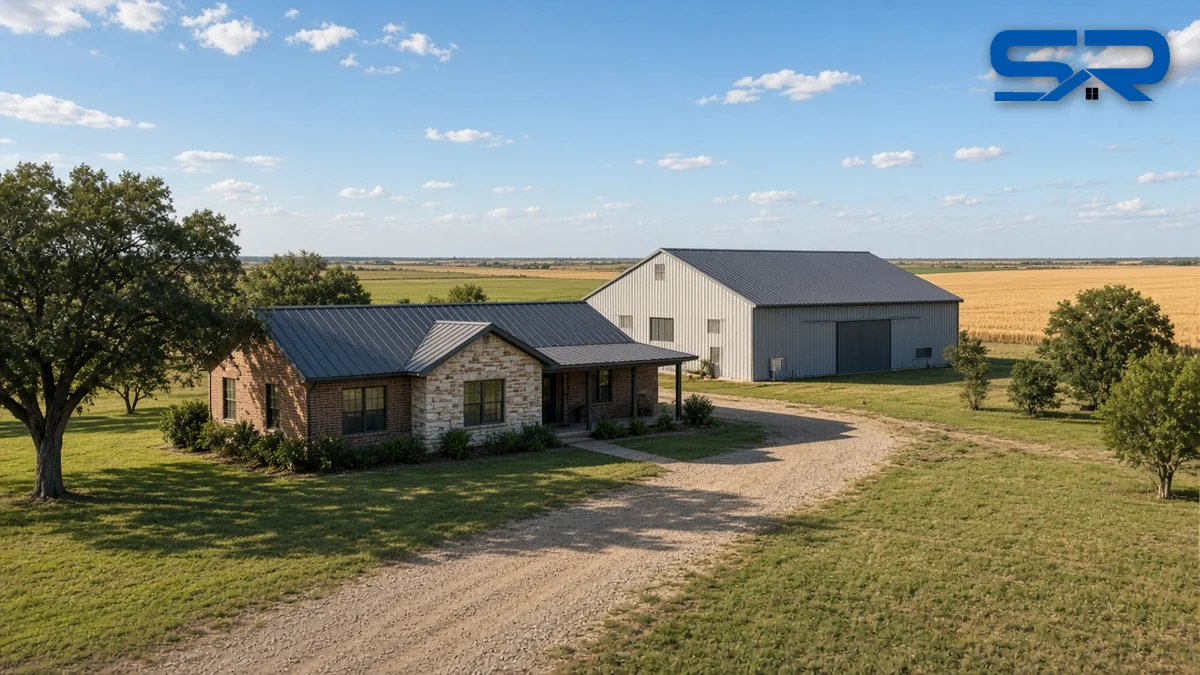
Put standing seam on the house. Put R-panel or PBR on the shop, barn and carport. Run them in the same color so the whole place matches. That’s the setup I recommend most around Krum, and it’s what the photo at the top of this post shows.
There are good reasons to break that rule, and I’ll cover them below.
Which panel goes on which building
| Building | What I usually recommend | Why |
|---|---|---|
| House in a subdivision | Standing seam, or stone-coated steel if the HOA wants a shingle or shake look | Hidden clips, clean lines, no exposed screws |
| Ranch house on acreage | Standing seam, or R-panel if you like the ranch look and accept screw upkeep | Long runs, one piece from ridge to eave |
| Shop or detached garage | R-panel or PBR, 24 or 26 gauge | Spans open purlins, goes on fast, easy to fix one sheet at a time |
| Barndominium | Standing seam or R-panel over a planned insulation and vapor layer | Living space under metal needs condensation control |
| Hay barn or equipment barn | R-panel or PBR | Tough, practical, made for open framing |
| Horse barn or arena | R-panel, PBR or standing seam | Ventilation and condensation planned for the animals |
| Carport, boat or RV cover | R-panel, PBR or corrugated | Simple, strong, affordable |
Standing seam on the house
A standing seam panel locks to the next one at a raised seam, and the clips that hold it down sit under that seam. No screws go through the face of the roof, so there’s nothing to back out over years of Texas heat and cold. The clips also let the steel slide as it grows and shrinks, instead of working against its fasteners.
Standing seam normally goes over solid decking with a good underlayment, which is what a house already has. The work that makes or breaks it is at the valleys, chimneys, walls and penetrations. Our post on metal roof flashing details shows what a good job looks like, and switching from shingles to standing seam walks through the process day by day.
R-panel and PBR on the shop and barn
R-panel has tall trapezoid ribs and fastens with exposed screws. It’s built to span open purlins, the way most shops, barns and metal buildings are framed. PBR is the same idea with a purlin-bearing leg at the side lap, which gives a stronger lap on long runs.
The screws are part of the deal. They need to be the right screw, set at the right torque so the washer seals without crushing, and checked over the years. Our post on hidden fasteners vs. exposed screws explains the long-term difference.
If you want a cleaner look on a shop that sits close to the house, standing seam can go on a shop too, once the framing is set up for it. We’ll tell you what it takes.
Old shop and barn roofs: re-screw, re-panel or re-roof?
Plenty of metal roofs around Krum are older than the people who own them now. Most don’t need to come off.
- Re-screw when the panels are sound but washers have cracked or screws have backed out. Where holes are worn, we go one size up.
- Re-panel when a few sheets are rusted through or punctured by hail. We replace those and fix the trim around them.
- Re-roof when rust is widespread, or the building is being enclosed or turned into living space.
We check the purlins and framing first either way. See metal roof repair and restoration and our post on fixing leaks at screws, seams and flashing.
Barndominiums: plan the underside
When a metal building has people living in it, the underside matters as much as the panel. Warm, humid air inside meets a cool steel roof and turns to water. We plan the insulation and vapor layer with the roof, not after it. Our post on condensation control under metal goes deeper, and barndominium roofs: R-panel, PBR or standing seam compares the panels.
We don’t only roof these buildings, we build them. For a new barndominium, shop or barn, we can bring in an architect to spec it or build to your plans, and our own crews do the work.
Gauge, roll formers and lead time
We run 24 or 26 gauge. Thicker steel holds fasteners better and resists denting better than the thin 29-gauge panels common on budget buildings. Our post on 26 vs. 29 gauge metal explains the number.
Because we form our own standing seam and R-panel, each panel is cut to the length of its run. On most houses and shops that means one piece from ridge to eave, with no end laps for water to find. See why we form metal panels on site and long panel runs. Metal lead time is typically one to two weeks once you’ve picked a color and profile.
Krum permits, and the land outside city limits
The City of Krum’s permits page says most construction work requires a permit and asks owners to check with Development Services at (940) 398-7302 before work starts. The city’s online permit portal has a separate Roofing Application, and contractors set up an account with the city before they file. Krum has adopted the 2024 International Residential and Building Codes with regional and local amendments, so a new roof inside the city is built and inspected to the 2024 code.
A lot of land with a Krum mailing address is outside the city limits. Before we file anything, we check which jurisdiction your property falls in, so a shop or barn on acreage gets the right paperwork, or none if none is required. If your subdivision has an HOA, we’ll put together the color, profile and sample they ask for. Our post on standing seam and HOA review has tips.
Hail and wind around Krum
NOAA’s Storm Events Database lists 25 reports of hail 1.75 inches (golf-ball size) or larger within about 10 miles of Krum from 2016 through its September 2026 update. The largest was 5.9-inch hail near Sanger on June 15, 2023. In town, NOAA lists 2.5-inch hail in Krum on September 21, 2023.
I’ll be straight with you: big hail can dent any metal roof. What metal doesn’t do is crack, split or shed granules like an asphalt shingle, and thicker panels dent less than thin ones. Our post on metal roofs and hail goes deeper.
Out on open land, wind works a roof harder than hail most years. It goes after the eaves, rakes and ridge first, so that’s where fastener spacing, trim and closures get the most attention on every roof we put on, house or barn.
If a storm already came through, start with our storm damage page. We do a free digital photo report so you can see your roof yourself. In Texas you generally have 1 year from the date of loss to file a claim, but check your policy.
Why Krum owners call us
- Our own roll formers and our own crews for standing seam and R-panel.
- Our Rhome office is about 21 road miles from Krum.
- Certified with GAF, CertainTeed, Owens Corning, Atlas, Johns Manville, Carlisle, Tropical Roofing Products, Mule-Hide and Enviroshake, and many other roof manufacturers.
- 5.0 stars on Google at all three offices: Bridgeport, Decatur and Rhome.
- BBB A+ rated.
- Workmanship warranty from 10 years up to lifetime, depending on the job.
We also work in nearby Denton, Sanger, Ponder and Corinth. See our Krum metal roofing page, our Krum standing seam page, the barn roofing guide, and our standing seam brick ranch project in the Sanger and Valley View area.
Get a metal roof estimate in Krum
Whether it’s standing seam on the house, R-panel on a new shop, or a few leaking screws on an old barn, I’m glad to take a look. Request an estimate or call (817) 733-9228.