
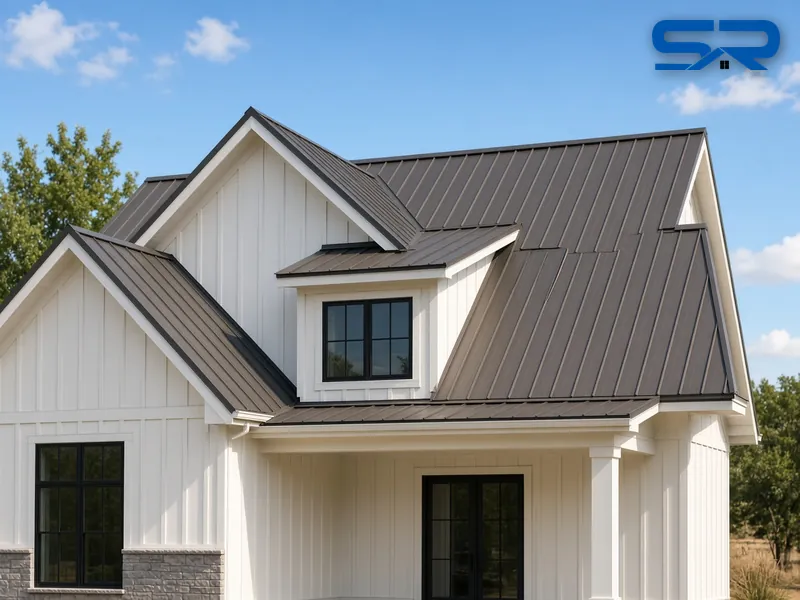
Where standing seam fits in Duncanville
Duncanville is a railroad town that became a suburb. The Handbook of Texas says settlement began when Crawford Trees arrived from Illinois in 1845; in 1880 the Chicago, Texas and Mexican Central Railway reached the area and built Duncan Switch, named for a line foreman, and the first postmaster renamed it Duncanville in 1882. A fire in 1884 destroyed most of the town's commercial buildings. It stayed small, with just over 300 people in 1933, until residents incorporated a 225-acre city on August 2, 1947, partly to avoid annexation by Dallas. Then the suburbs arrived: about 5,000 people in 1962, about 13,000 in 1970, more than 31,000 by 1988 and 35,748 in 1990. Census counts put it at 40,705 in 2020, with about 38,900 estimated for 2025. So Duncanville is mostly built out, and most of its houses, brick ranches and two-stories from the 1960s through the 1980s, are on their second or third roof, often over original decking that is 40 to 60 years old.
- 1960s and 1970s brick ranches with long, low roof lines. Dark standing seam over brick is the conversion we're asked about most, and a simple ranch roof shows it off well.
- 1980s two-stories and split-levels, often as accents over porches, bays and entries with a designer or Class 4 shingle main roof.
- Low-pitch patio covers and additions that have leaked under shingles for years. Mechanically seamed standing seam is made for lower slopes.
- Churches, offices, schools and commercial buildings with pitched or mansard roofs, where the owner wants a long-lived finish and a commercial NDL warranty (we offer 10- and 20-year NDL warranties at different prices).
Comparing standing seam with stone-coated steel, R-panel or metal shingles? See metal roofing in Duncanville.
Snap-lock or mechanically seamed?
| Snap-lock | Mechanically seamed | |
|---|---|---|
| How the seam closes | Panels snap together by hand | A seaming tool folds the seam closed along its length |
| Best on | Most steep-slope house roofs | Low-slope porches and wings, and very long runs |
| Look from the street | Clean, slim seam | Slightly heavier seam; same concealed fasteners |
More detail: snap-lock vs. mechanical lock. We use 24 or 26 gauge steel and never 29 gauge on a home (why). We don't publish prices because size, pitch, tear-off and detail work move them too much; our standing seam cost page explains what moves the number, and you get a written price for your roof.
Duncanville's wind record
NOAA's event narratives show what wind has done in and right around Duncanville:
- March 4, 2025: multiple homes in Cedar Hill's Stone Hill neighborhood, about five miles south, had roof damage in winds estimated around 70 mph.
- June 23, 2019 and May 28, 2024: Dallas Executive Airport, three and a half to five miles east, measured 61 mph and 60 mph gusts.
- March 29, 2017: many trees snapped and uprooted along Mountain Creek Parkway and Camp Wisdom Road, about four miles northwest.
- July 8, 2025 and February 14, 2026: a tree blown onto a home in DeSoto, and tree limbs snapped along Wheatland Road from Duncanville into south Dallas.
Standing seam handles that kind of wind well when it's installed to the manufacturer's tested system. What we do on every Duncanville roof:
- Clip spacing tightened at the perimeter. Uplift is highest at the eaves, rakes, hips and ridge, so that's where the clips go closer together, per the manufacturer's pattern.
- Hemmed panel ends and cleated trim, so there's no raw edge or loose flange for wind to get under.
- Mechanically seamed panels on low-slope sections and where the exposure calls for the extra seam strength.
- Deck nailing checked after tear-off, because the clips can only hold as well as the wood they're screwed into. On a 40- to 60-year-old house that often means replacing some original decking, which we photograph and price per sheet in writing first.
Re-decking first, then standing seam
Duncanville lists re-decking as its own permitted item, and the City's residential re-roof fee includes decking. That fits how we build standing seam on an older house: tear off every layer, inspect every sheet, replace what won't hold a clip, close up any spaced board decking with new sheathing where needed, and lay high-temperature underlayment made for metal. Then the City inspects, and only then do panels go on. Doing the deck right is the difference between a standing seam roof that lasts for decades and one that rattles loose at the eaves.
Low slope on churches, offices and additions
Commercial buildings and older home additions often have lower pitches than the main house. Standing seam has no laps in the field, so it handles lower slopes well when the panel and seam are the right ones. On low planes we use mechanically seamed panels, so the seam is folded closed along its full length, and we check the manufacturer's minimum slope for the exact panel and seam before we quote. Where the pitch changes (a patio cover tying into the main roof, a parapet wall, a rooftop unit curb) we bend transition flashings and curb details on our brake. If a section is too flat for any steep-slope roof, we'll tell you and quote the right low-slope system for it.
Color, finish and the street view
Charcoal, black and dark bronze are the most requested on brick, and muted grays and bronze suit churches and commercial frontage. Lighter colors run cooler in a Texas summer. We bring real panel samples, put the exact color and finish system in writing, and include the profile drawing and product sheet in your HOA packet if you have one; the City also reminds owners to check deed restrictions. See metal roof colors and finishes.
What a good standing seam job looks like up close
- One panel from eave to ridge, formed to the length of each roof plane.
- Clips that let the panels move with the heat, so they don't oil-can or pull fasteners.
- Bent flashings, not caulk, at walls, chimneys, valleys, skylights and pipes.
- High-temperature underlayment made for metal, over a deck we've checked and repaired.
- Vent piping and flues reconnected and flashed, the City permit in our name as a registered contractor, and no work past an inspection point until the City signs off.
City of Duncanville roof permit rules
Duncanville spells it out. The City's Permit & Inspection Services page lists the projects that need a permit, and "Shingle replacement" and "Re-deck" are both on it. From the City's own pages:
- Registered on the City portal. Per the Building Inspections page, a contractor registers through the City's online portal, gets a login, and applies for the permit there. The City says it is moving to new permitting software starting December 1 and asks everyone to set up a new account, so we handle that on our end.
- Inspected before it's done. Once a permit is issued, one or more inspections are required before the work counts as complete and in compliance with the applicable codes.
- Built to the 2021 codes. Duncanville adopted the 2021 International Residential Code, Building Code and Energy Conservation Code (with the 2023 National Electrical Code), signed October 23, 2025.
- Good for six months. A permit is valid for six months from the day it is issued; an extension can be requested from the Building Official.
- The fee is the City's, not ours. The Master Fee Schedule effective October 1, 2026 lists a Residential re-roof at $150, including decking. Commercial roofs are priced on the City's commercial fee table.
The City also points out that homeowners' insurance may not pay for damage caused by work done without permits and inspections, and that work without a required permit may have to be removed. It reminds owners to check with their HOA, if they have one, for deed restrictions. Questions go to Permit & Inspection Services at 972-780-5000.
Hail and standing seam in Duncanville
NOAA's Storm Events Database lists 16 reports of hail 1.75 inches (golf-ball size) or larger within about 10 miles of the center of Duncanville from 2016 through the September 2026 update. None of those fell within about three miles of the center, but 8 reports of 1-inch hail did, including two on April 25, 2026 and one on May 24, 2026. The pattern is big hail on every side of the city and steady smaller hail across it. The biggest nearby:
- June 12, 2023: 4-inch hail near Cedar Hill, about five and a half miles south, with baseball-size hail near Cedar Hill State Park and tennis-ball-size hail west of Cedar Hill. NOAA's damage estimate for the 4-inch report alone is $1 million. Duncanville itself had 1-inch hail that day and four days earlier.
- April 25, 2026: hail up to 3 inches around Dallas Baptist University, about five miles north, where NOAA notes car windows were blown out, and 1-inch hail in north Duncanville the same day.
- April 9, 2021: 2-inch hail at Dallas Executive Airport, about four miles east, and in Cockrell Hill.
- June 1, 2025: 2-inch hail near Florence Hill, about five and a half miles northwest.
- April 26, 2017: hen-egg-size (2-inch) hail in Cedar Hill, about five miles south.
No roof is hail-proof, and very large hail can dent steel. Standing seam doesn't crack, curl or lose granules, so it usually keeps shedding water after storms that ruin shingles. If you'd rather keep a shingle look on the main roof, we'll compare Class 4 designer shingles with full metal. See Class 4 metal roofs and insurance. Texas insurers must offer a premium credit for UL 2218 impact-rated roofs, but each company sets its own amount, and Class 4 earns the largest. We can't promise a discount; ask your insurer for their figure in writing. After a qualifying install we fill out TDI Form PC068 for you. If you file an insurance claim, we document the damage and meet your adjuster on the roof. Texas law requires you to pay your deductible, and a contractor may not waive, absorb or rebate it. We never will. In Texas you generally have 1 year from the date of loss to file; check your policy.
Why it matters that we form our own panels
- One piece from eave to ridge. We cut standing seam and R-panel to the length of each roof plane, so long runs don't need mid-slope laps.
- 24 or 26 gauge on every standing seam and R-panel roof. See 26 vs. 29 gauge.
- No waiting in a panel shop's queue after a hailstorm, when everyone needs a roof at once. Metal lead time is typically 1 to 2 weeks.
- Flashings bent for the panel, not caulked: walls, chimneys, valleys, skylights and pipes.
- Every inspection comes with a free digital photo report, so you see what we see.
How a metal roof job runs with us
- Inspection and free digital photo report: deck, ventilation, penetrations, valleys and measurements.
- Written spec for each option: system, gauge, profile, color, underlayment, trim and every flashing detail.
- Approvals: the HOA or historic-review packet if you need one, then the permit.
- Tear-off and deck repair where needed, then high-temperature synthetic underlayment made for metal.
- Install by our own crew, with hips, ridges, eaves and penetrations detailed for the system.
- Final walk-through, a magnet sweep of the yard and driveway, and your warranty in writing.
Who installs standing seam roofs in Duncanville?
Snow Roofing & Exteriors does. Here are the facts you can check before you call anyone:
- 75 years as a family roofing business, and 30 years in the business for owner Blake Snow, who is still on the roofs.
- Over $80 million in completed roofing projects, from small repairs to multi-million-dollar jobs.
- 5.0 stars on Google at all three offices: Bridgeport, Decatur and Rhome.
- Our own roll formers for standing seam and R-panel, in 24 or 26 gauge, with metal lead times that are typically 1 to 2 weeks.
- Our own crew, about 54 road miles (roughly an hour and 10 minutes) from Duncanville with our Rhome-area team.
- Snow Roofing & Exteriors is BBB A+ rated.
Our metal work, up close
The photos on this page show our roof work up close. We never show a street or address.
We're certified with GAF, CertainTeed, Owens Corning, Atlas, Johns Manville, Carlisle, Tropical Roofing Products, Mule-Hide and Enviroshake, and many other roof manufacturers. We give a workmanship warranty from 10 years up to lifetime, depending on the job, and the manufacturer warranty on the panel and finish, in writing.
More: metal roofing in Duncanville, our Duncanville roofing page, storm damage in Duncanville, and standing seam in nearby Cedar Hill, Grand Prairie and Arlington.
Product names, ratings and features are as published by the manufacturer and can change. We confirm the current rating and warranty of the exact product before we order it.
Residential warranty: a workmanship warranty from 10 years up to lifetime, depending on the job, with manufacturer warranties up to lifetime. Manufacturer coverage depends on the product and brand, and on the project qualifying for that manufacturer's program. We put the exact warranty for your roof in writing.
Certified, with 30 years installing every major roofing brand, a family roofing business going back 75 years, and over $80 million in completed roofing projects. 5.0 stars on Google at all three of our offices.
Request a free inspection or call (817) 733-9228. Small repairs are welcome too.


