
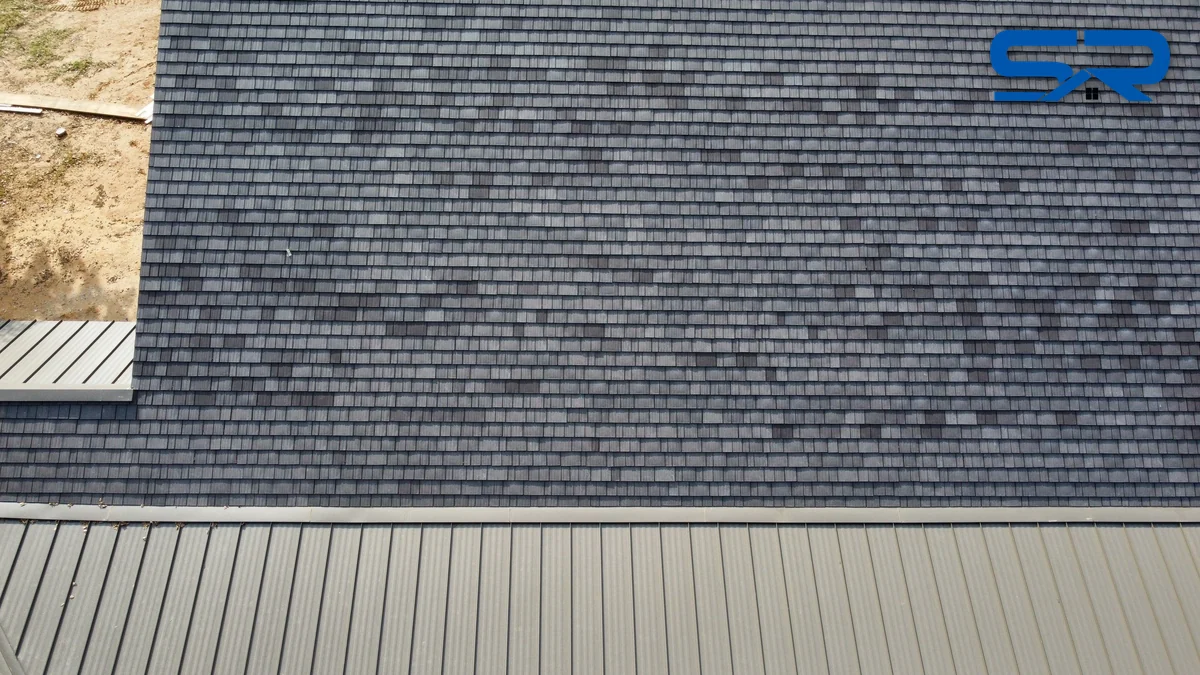
Can you mix shake and metal roofing on the same house? Yes, and done right it’s one of the best-looking roofs you can put on a ranch or estate home. Done wrong, the spot where the two materials meet is where your first leak starts. I’ll walk you through how we did it on a big new ranch estate in Clay County, near Bowie and Bellevue, with real photos from the job.
I’m Blake Snow. I’ve been roofing for 30 years, I’m the third generation in a family business that goes back 75 years, and our crews have completed over $80 million in roofing projects. I’m a certified Enviroshake installer and an Enviroshake representative, and we form our standing seam metal panels on our own roll formers. So I’ve been on both sides of this transition.
The short answer
- Yes, you can mix them. Shake on the main roof and standing seam on porches, low-slope sections or a separate wing is a proven combination.
- Let the roof slope decide where metal goes. Shake products have a minimum slope. Standing seam can go much flatter. Metal takes over where the roof flattens out.
- The transition is the whole job. Water from the upper roof has to land on top of the lower roof every time, with flashing behind it.
- Install each product to its own instructions. That’s what protects both warranties.
- Pick colors together. The metal should pick up the shake, the stone or the trim.
“Shake” can mean real cedar, a composite shake like Enviroshake, a synthetic like DaVinci, stone-coated steel shake, or a shake-look shingle. The rules below apply to all of them, but the details change with the product, so we always follow the specific manufacturer’s guide.
The job: Enviroshake and standing seam near Bowie
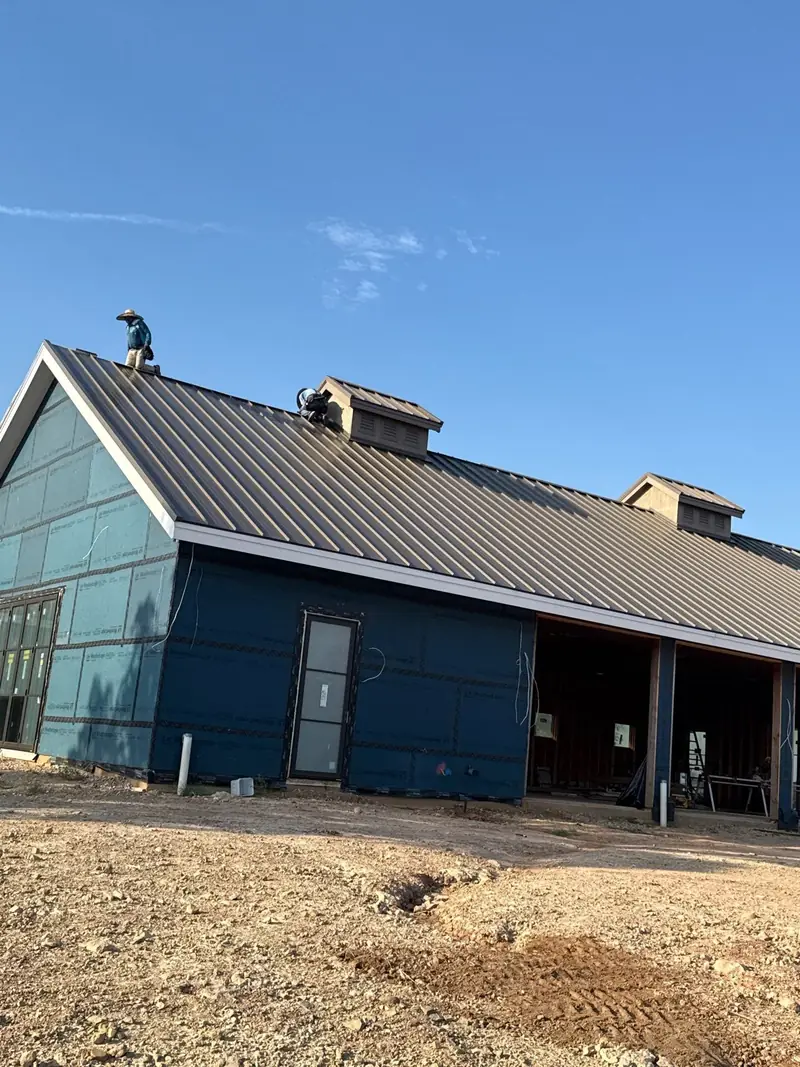
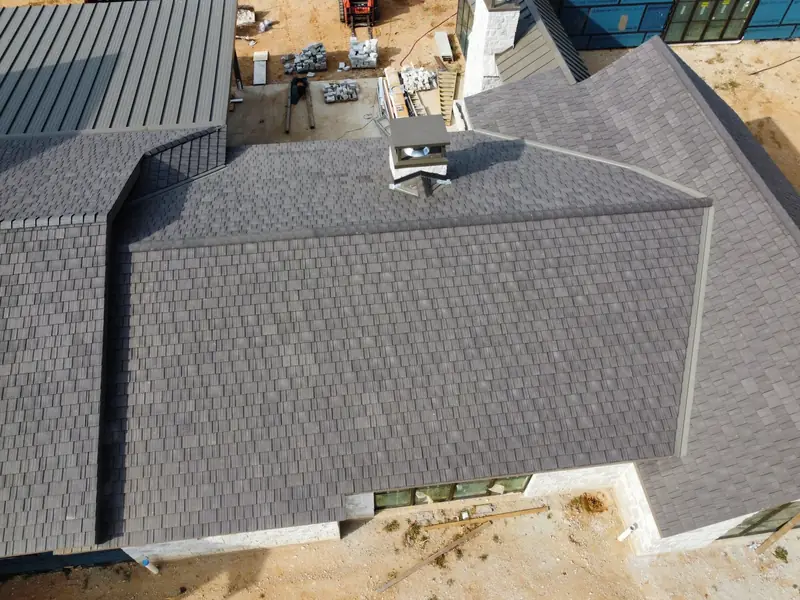
This was new construction: a large single-story ranch estate with stone and blue board-and-batten siding, a glass gable entry, covered porches, an outdoor fireplace and detached buildings. At roughly 25,000 square feet under roof, it’s a big one. The main roof is Enviroshake composite shake. The porches, the low-slope sections and a board-and-batten wing are standing seam metal. You can see the full photo set on the Clay County ranch estate project page.
Here’s the order the work went in, from our job photo records:
- Dry-in (late 2024). Synthetic underlayment over the deck, with an ice-and-water style membrane.
- Material delivery (March 2025). The Enviroshake pallets came in on a flatbed. The pallet labels are in our photos.
- Shake install (August 2025). The main roof, valleys and hips.
- Low-slope prep and standing seam (late August to early September 2025). Membrane on the low-slope areas first, then the standing seam panels and the shake-to-metal transitions.
- Final walk and drone photos (November and December 2025).
Where the metal goes, and why
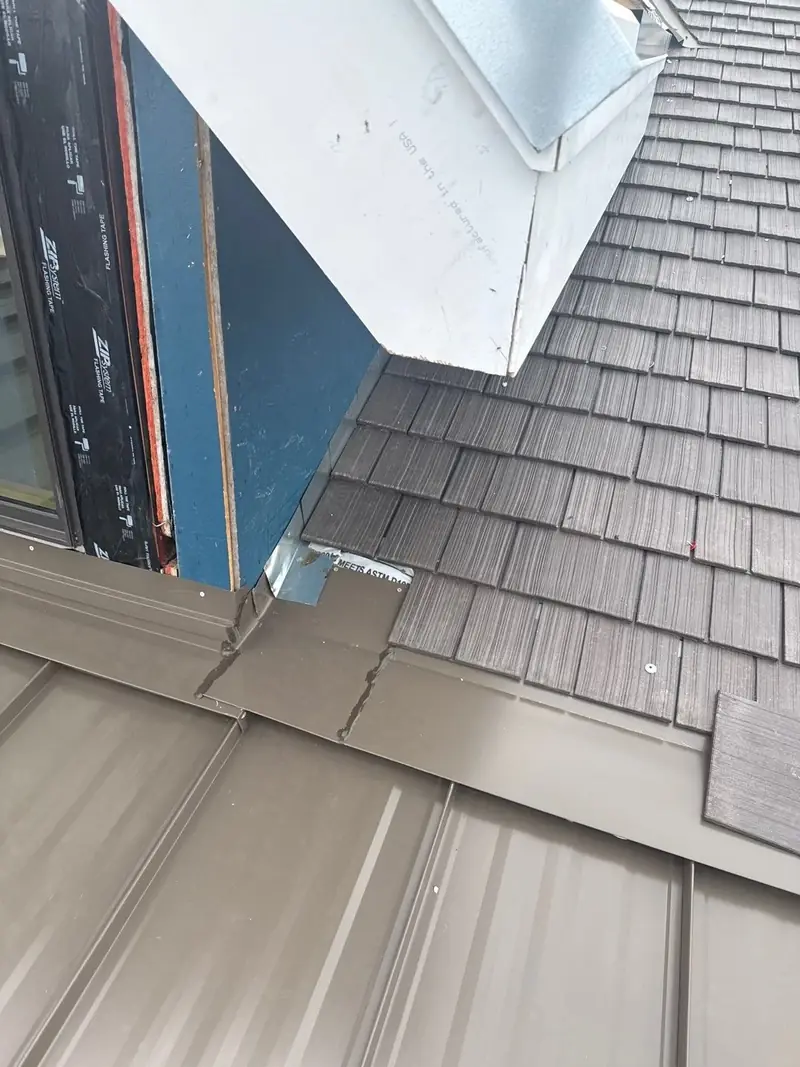
On a house like this, the metal isn’t random. It goes where the roof gets flat.
Enviroshake lists 2:12 as its recommended minimum slope and has a separate low-slope guide for roofs under 3:12. Most shake and shingle products want more slope than that. Standing seam is different. The residential code (IRC R905.10.2) allows standing seam roof systems down to a quarter inch per foot (1/4:12), although each panel profile has its own minimum, and the panel maker’s number is what counts. Covered porches, patios, shed roofs over bays and long, low wings are exactly where a shake product runs out of slope and a standing seam panel is comfortable.
On the Bowie-area estate, that’s what you see: shake on the steep main roof, standing seam where the roof drops to the porches, and standing seam on the board-and-batten wing, where the metal also fits the barn-style look of that part of the house.
The transition is where the job is won or lost
The code requires flashing wherever a roof meets a wall and wherever the roof changes slope or direction (IRC R903.2.1). When two different materials meet, I look at three kinds of joints:
1. Slope change: shake above, metal below
This is the one in the hero photo at the top of this page. The shake roof steps down to a flatter metal roof. The rule is simple: the upper roof drains onto the lower roof. A continuous metal transition flashing runs across the slope change, the membrane laps the right way under it, and the last course of shake sits over the flashing so water can’t get behind it. The standing seam panels run up under that flashing, and their tops are closed off so wind can’t drive rain up the panel.
2. Side wall: metal porch roof against a stone or sided wall
Where a porch roof runs along a wall, step flashing or a metal side-wall trim goes under the siding or into the stone, and counter flashing covers it. Our roof flashing pages explain step flashing and counter flashing in plain terms.
3. Valleys and hips where materials meet
Where a shake slope and a metal slope share a valley, the valley metal and the water path have to work for both. If a manufacturer doesn’t publish a detail for a joint, we plan it before the roof goes on, not on the roof that day.
One more thing: metal moves. Standing seam panels grow and shrink with Texas heat, and the clips under the seams let them do that. A transition should never pin a moving panel down.
Matching colors and the look
Pick the metal from the house, not from a color chart. On this estate, a warm bronze-tone standing seam sits under a dark composite shake, over stone and blue board-and-batten. The metal reads as an accent, and the shake stays the main roof. Darker metals look more modern, lighter bronze and gray tones look softer. Our metal roof colors and finishes page covers paint systems and how they hold up. If you’re torn between the two materials for the whole roof, read my standing seam vs. Enviroshake comparison, and for smaller metal accents, my post on standing seam over porches, bays and entries.
Hail and wind in Montague and Clay Counties
Out here, both materials have to stand up to weather. NOAA’s Storm Events Database lists 3-inch hail at Bowie on April 11, 2016, 2.5-inch hail about 1.4 miles south of Bellevue on May 22, 2020, and 2.5-inch hail about 6 miles west of Bowie on May 9, 2024. On May 19, 2025, it lists hail up to 4.5 inches in Montague County.
Enviroshake lists a UL 2218 Class 4 impact rating. Standing seam steel can dent in big hail even when it doesn’t leak, so ask about the panel and the cosmetic-damage language in your insurance policy. No roof is hail-proof. If a storm does hit, in Texas you generally have 1 year from the date of loss to file a claim; check your policy.
Warranties when you use two materials
Each material carries its own manufacturer warranty, and each one depends on following that maker’s instructions. Enviroshake says its products must be installed by a Factory Trained Installer, and the roof has to be registered. Its top Gold-Level warranty also requires its Enviroshield underlayment. The metal side has its own paint finish warranty. On top of that, our workmanship warranty runs from 10 years up to lifetime, depending on the job. Get all of it in writing, including how the transitions are handled.
8 questions to ask before you sign
- Which parts of my roof will be shake, and which will be metal, and why?
- What’s the slope of each section, and is each product rated for it?
- How will you flash each place the two materials meet?
- Who forms the metal panels, and how long are they?
- What gauge is the metal? (We run 24 or 26 gauge.)
- Are you a Factory Trained Installer for the shake product, and will you register the roof?
- Can I see samples of both materials together at my house?
- What do the manufacturer and workmanship warranties cover, in writing?
Serving Bowie, Bellevue and the Red River country
We serve Bowie, Bellevue, Nocona, Henrietta, Montague and the rest of Montague and Clay Counties from our offices in Bridgeport, Decatur and Rhome. Shake and metal on the house, plus barn and shop roofs in Bowie, are all part of what we do. Metal lead time is typically 1 to 2 weeks because we form the panels ourselves.
Get a roof plan for your house
Every inspection comes with a free digital photo report, with drone and thermal imaging, and a free written estimate. For a mixed roof, I’ll mark where the metal makes sense on your house and how each joint will be flashed.
We’re certified with GAF, CertainTeed, Owens Corning, Atlas, Johns Manville, Carlisle, Tropical Roofing Products, Mule-Hide and Enviroshake, and many other roof manufacturers. We’re fully insured, BBB A+ rated, with references available on request, and we have 5.0 stars on Google at all three offices: Bridgeport, Decatur and Rhome.
Request your free estimate or call (817) 733-9228. You can also use the estimate form below.
Sources
- Enviroshake: installation requirements and product documents
- International Residential Code, sections R903.2.1 (flashing) and R905.10.2 (metal roof panel slope)
- NOAA NCEI Storm Events Database, Montague and Clay Counties, Texas